
Do I Need HRT Quiz
How the Scales are Structured
Who Usually Takes This Test?
See How You Compare
Below is a preview of how scores are typically distributed across each scale.
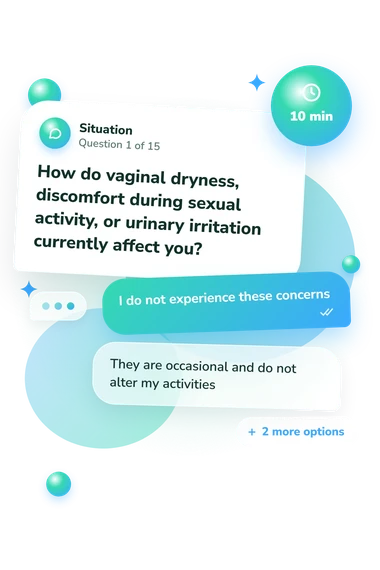
Example Questions From the Test
- I do not experience these concerns
- They are occasional and do not alter my activities
- I regularly use adjustments or over-the-counter measures to stay comfortable
- They cause substantial discomfort or lead me to avoid activities I value
- I would mainly want an introduction and time to think afterward
- I could identify what additional information I need before deciding
- I could weigh a proposed option against my priorities and concerns
- I could take part in a shared decision, including choosing to try, defer, or decline treatment
- I have not noticed a relevant change
- The changes are mild and rarely affect what I do
- I sometimes need extra time, reminders, or recovery space
- The changes frequently disrupt responsibilities or relationships
Do I Need HRT Quiz - Description and methodology of the test
For people weighing whether menopause-related symptoms merit a focused conversation about hormone therapy, the Do I Need HRT Quiz provides a structured starting point. It is intended for anyone who wants to organize experiences, preferences, and medical-history questions before meeting a clinician. For anyone weighing the choice-Should I Take HRT Quiz?-its result helps prepare questions, priorities, and relevant history for that conversation.
What This Assessment Explores
The questionnaire functions as an HRT quiz, separating symptom impact, treatment preferences, and conversation readiness. It covers hot flushes, sleep, vaginal or urinary discomfort, mood, concentration, symptom timing, bleeding, medicines, alternatives, and review preferences.
The result uses three displayed dimensions:
- Decision Conversation Readiness (0-15) shows how clearly you can describe symptoms, priorities, and relevant history: Early preparation (0-5), Building the picture (6-10), or Conversation-ready (11-15).
- HRT Preference Alignment (0-15) shows whether your current preferences lean away from, remain open to, or more strongly align with HRT: Lower alignment (0-5), Open, weighing options (6-10), or Stronger alignment (11-15).
- Symptom Impact (0-15) shows whether covered experiences have limited, meaningful, or strong effects on daily life: Limited impact (0-5), Meaningful impact (6-10), or Strong impact (11-15).
The results show which discussion points need preparation.
Methodology and Scientific Basis
Each item offers four ordered choices, moving from lower to greater impact, readiness, or alignment. The questionnaire does not specify how responses produce displayed totals, so its bands are descriptive rather than a documented clinical scoring rule.
Conceptually, the questionnaire aligns with O'Connor et al. (1998) on values, options, and shared decisions. Readiness is conceptually consistent with O'Connor's Decisional Conflict Scale (1995), while symptom domains are conceptually consistent with Heinemann et al. (2004) and Menopause Rating Scale methodology. This is not presented as an adaptation or validation of those instruments and has no stated population norms or diagnostic thresholds.
On this HRT decision quiz, a higher band marks more of the named tendency and identifies topics for clinician discussion. Scores reflect current symptoms, recall, self-awareness, and candid self-report; they can change, do not establish HRT need, safety, or suitability, and covered symptoms can have other causes, so clinical review should consider bleeding, menopause timing, medicines, and personal or family history. New or unexplained vaginal bleeding needs prompt attention; chest pain, breathing difficulty, fainting, or one-sided weakness require urgent help.
- O'Connor, A. M., Tugwell, P., Wells, G. A., Elmslie, T., Jolly, E., Hollingworth, G., McPherson, R., Bunn, H., Graham, I., & Drake, E. A decision aid for women considering hormone therapy after menopause: Decision support framework and evaluation. Patient Education and Counseling. 1998;33(3):267-279. 10.1016/S0738-3991(98)00026-3
- Heinemann, K., Ruebig, A., Potthoff, P., Schneider, H. P. G., Strelow, F., Heinemann, L. A. J., & Do, M. T. The Menopause Rating Scale (MRS) scale: A methodological review. Health and Quality of Life Outcomes. 2004;2:45. 10.1186/1477-7525-2-45
- O'Connor, A. M. Validation of a decisional conflict scale. Medical Decision Making. 1995;15(1):25-30. 10.1177/0272989X9501500105