
Do I Have Olive Skin Quiz
How the Scales are Structured
Who Usually Takes This Test?
See How You Compare
Below is a preview of how scores are typically distributed across each scale.
Example Questions From the Test
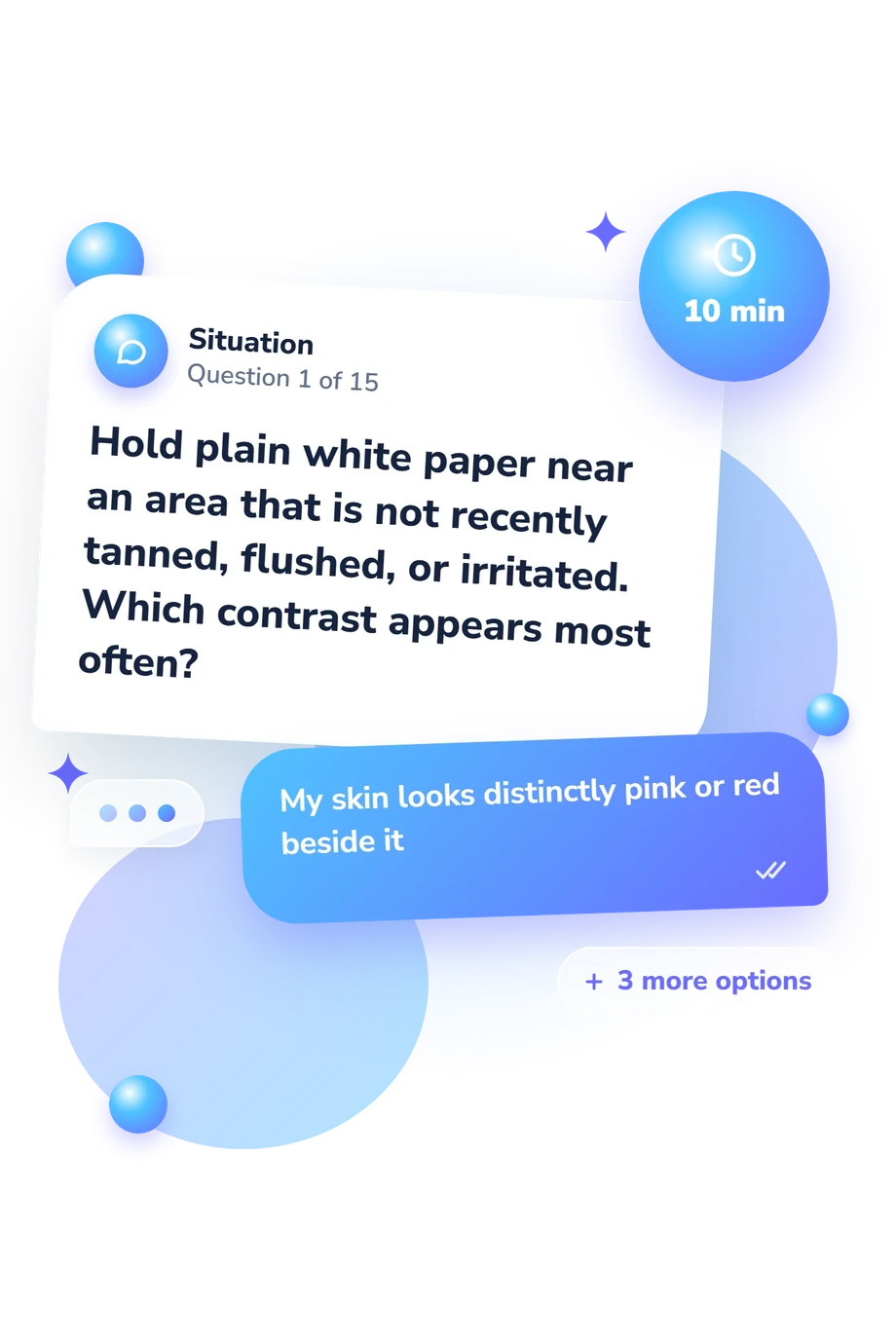
- My skin looks distinctly pink or red beside it
- My skin looks clearly yellow, peach, or golden
- My skin looks beige or neutral but somewhat subdued
- My skin develops a gray-green, khaki, or muted-gold cast
- They appear mainly blue or purple
- They are faint or have no repeatable color
- Some look blue while others look green
- They repeatedly appear green, teal, or blue-green
- It continues to look primarily rosy or cool
- It continues to look primarily warm and golden
- It stays muted or neutral, although I cannot identify a color
- A green-gray or khaki quality remains even as the depth changes
Do I Have Olive Skin Quiz - Description and methodology of the test
People who are unsure whether their complexion reads as cool, warm, neutral, or muted can use the Do I Have Olive Skin Quiz to organize repeated visual observations. The complexion quiz is intended for personal reflection around color matching, not for assigning identity from skin depth or ethnicity. It focuses on patterns that may become clearer when lighting, redness, seasons, and nearby colors are considered.
What This Assessment Explores
The questions examine whether muted green-gray, khaki, or olive-like cues recur across visual checks and everyday color decisions. They cover veins, white-fabric contrast, seasonal and lighting changes, temporary redness, metals, clothing, and complexion products. The test looks for whether muted or olive-like cues recur across contexts, while recording observations about a possible olive skin undertone rather than confirming one.
The result is organized into three dimensions:
- Color and Product Behavior (0-15) shows how clothing, metals, and complexion colors interact: Clear cool or warm fit (0-5), Flexible or mixed fit (6-10), or Olive-compatible behavior (11-15).
- Consistency Across Contexts (0-15) tracks recurring cues after lighting, redness, and seasonal depth: Another Pattern Predominates (0-5), Context-Dependent (6-10), or Consistent Olive-Like (11-15).
- Visible Undertone Clues (0-15) summarizes direct visual clues, not skin depth or ethnicity: Few olive-pattern clues (0-5), Mixed clues (6-10), or Strong olive-pattern clues (11-15).
Methodology and Scientific Basis
Each prompt offers four descriptive response options, moving from cool or warm observations through neutral or mixed descriptions to muted green-gray or khaki cues. Items address direct clues, cross-context consistency, and interactions with colors or products.
Scoring summarizes responses across the displayed dimensions, with a band for each rather than one overall verdict. The four options feed those dimensions by capturing visual clues, recurring patterns across contexts, and reactions to colors, metals, or complexion products.
Research by Branigan and colleagues on skin red and yellow undertone ratings provides the closest subject parallel, emphasizing how lighting, observer consistency, and measurement choices can affect judgments. The questionnaire is conceptually consistent with that work, not an adaptation of it. The CLBT approach offers a secondary methodological parallel because it evaluates complexion qualities systematically.
As an olive undertone test, it is most useful as a structured self-reflection aid. The visible-clue score is unvalidated, and the displayed bands organize this questionnaire's observations rather than clinical thresholds; all results remain sensitive to lighting, temporary redness, memory, and expectations.
- C. Musnier, Philippe Piquemal, Philipp Beau, and Jacques C. Pittet. "Visual evaluation in vivo of 'complexion radiance' using the C.L.B.T. sensory methodology." Skin Research and Technology. 2004;10(1):50-56. 10.1111/j.1600-0846.2004.00053.x
- Amelia R. Branigan, Johanna G. Nunez, Mariya Adnan Khan, and Rachel A. Gordon. "Variation in Skin Red and Yellow Undertone: Reliability of Ratings and Predicted Relevance for Social Experiences." Social Psychology Quarterly. 2024;87(3):249-271. 10.1177/01902725231196851
- Rachel A. Gordon, Amelia R. Branigan, Mariya Adnan Khan, and Johanna G. Nunez. "Best Practices for Measuring Skin Color in Surveys." Survey Practice. 2024;17(1):1-15. 10.29115/sp-2024-0005
Updated: