
Do I Have Lupus Quiz
How the Scales are Structured
Who Usually Takes This Test?
See How You Compare
Below is a preview of how scores are typically distributed across each scale.
Example Questions From the Test
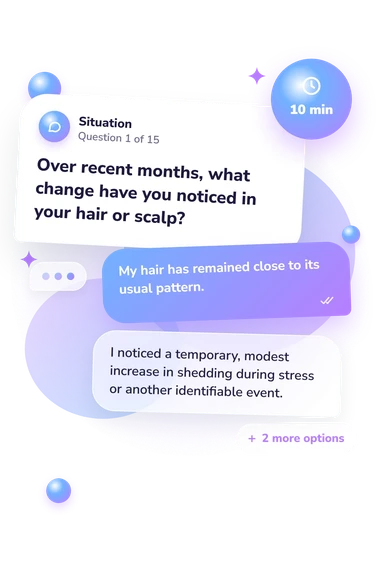
- My hair has remained close to its usual pattern.
- I noticed a temporary, modest increase in shedding during stress or another identifiable event.
- I have noticeable or recurring unexplained thinning or shedding.
- I have developed distinct bald patches, scalp inflammation, scarring, or rapid substantial hair loss.
- I have not noticed a recurring rash in that pattern.
- I sometimes get general facial redness after heat, exercise, or a skin product.
- A distinct cheek-and-nose rash has returned without a clear external trigger.
- The rash is persistent or recurrent and has been documented as medically concerning, or it appears with other systemic symptoms.
- I have not had unexplained marks of this kind.
- I occasionally bruise after a remembered bump or pressure.
- Unexplained spots or bruise-like marks have appeared more than once.
- I have had a rapidly spreading or non-fading spotted rash, especially with fever or feeling acutely unwell.
Do I Have Lupus Quiz - Description and methodology of the test
People who are noticing several unexplained symptoms can use this self-report questionnaire to organise what they have experienced and decide what deserves medical attention. The Do I Have Lupus Quiz focuses on patterns that may be relevant to lupus, including systemic, musculoskeletal, skin, mucosal, organ, and urgent warning signs. As a lupus quiz, it helps prepare clearer conversations with a clinician without presenting symptom recognition as a diagnosis.
What This Assessment Explores
This assessment helps people organise recurring or concerning experiences across several body systems. It examines symptoms rather than causes and highlights patterns that may merit routine, prompt, or urgent medical discussion. The result from this lupus symptom questionnaire is a structured reflection, not a probability estimate for lupus.
The three displayed dimensions are:
- General and Musculoskeletal Signs (0-15) covers fatigue, fever, joint, circulation, and muscle experiences. Bands are No items endorsed (0), Limited indicators (1-2), and Medical review warranted (3-15).
- Organ and Urgent Warning Signs (0-15) covers cardiopulmonary, kidney, neurological, clotting, and visual warnings. Bands are No indicators (0), Limited indicators (1-2), and Prompt assessment needed (3-15).
- Skin and Mucosal Signs (0-15) covers skin, hair, mouth, nose, and sun-related changes. Bands are No items endorsed (0), Limited indicators (1-2), and Medical review warranted (3-15).
Methodology and Scientific Basis
The questionnaire uses four self-report choices, moving from no relevant or explained experience toward recurring unexplained symptoms and severe warning patterns. Items address repetition, triggers, persistence, and functional impact.
Results are separate domain totals, not one overall lupus score. The numerical range does not show how each answer is weighted, and a higher total does not establish cause, severity, or likelihood. A single red-flag response matters independently; severe chest pain, breathing difficulty, seizure, stroke-like changes, sudden vision loss, suspected clot, or major urine reduction require urgent action.
The structure is conceptually consistent with the Systemic Lupus Activity Questionnaire (SLAQ), a published population-study instrument, but this online lupus symptom questionnaire is not that validated instrument. The 2012 SLICC and 2019 EULAR/ACR frameworks explain the broad organ-system coverage; their criteria are not scoring rules here.
Recall, interpretation, current context, and response bias can affect self-report. With no stated clinical norms or validated diagnostic cutoff, the bands organise observations and questions for professional evaluation; a lupus symptom screening result cannot identify an illness without history, examination, and appropriate testing.
- Karlson EW, Daltroy LH, Rivest C, Ramsey-Goldman R, Wright EA, Partridge AJ, Liang MH, Fortin PR. Validation of a systemic lupus activity questionnaire (SLAQ) for population studies. Lupus. 2003;12(4):280-286. doi 10.1191/0961203303lu332oa
- Aringer M, Costenbader K, Daikh D, Brinks R, Mosca M, Ramsey-Goldman R, et al. 2019 European League Against Rheumatism/American College of Rheumatology Classification Criteria for Systemic Lupus Erythematosus. Arthritis & Rheumatology. 2019;71(9):1400-1412. doi 10.1002/art.40930
- Petri M, Orbai A-M, Alarcon GS, Gordon C, Merrill JT, Fortin PR, et al. Derivation and Validation of the Systemic Lupus International Collaborating Clinics Classification Criteria for Systemic Lupus Erythematosus. Arthritis & Rheumatism. 2012;64(8):2677-2686. doi 10.1002/art.34473