
Fretboard Quiz
How the Scales are Structured
Who Usually Takes This Test?
See How You Compare
Below is a preview of how scores are typically distributed across each scale.
Example Questions From the Test
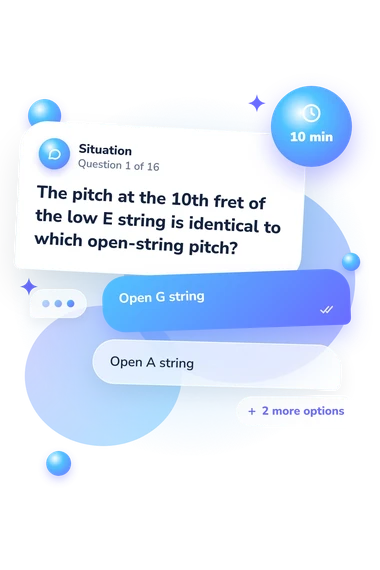
- Open G string
- Open A string
- Open D string
- Open B string
- 2nd fret, F♯
- 4th fret, G♯
- 5th fret, A
- 3rd fret, G
- E–A–D–F–B–E
- E–A–D–G–B–E
- D–A–D–G–B–E
- E–B–D–G–A–E
Fretboard Quiz - Description and methodology of the test
For guitarists who want to turn theory into quicker decisions, this fretboard quiz offers a focused check of note recognition on the neck. Presented as a quiz on the guitar fretboard, it suits players who want to see which relationships feel automatic and which still require counting, recall, or deliberate mapping. The result gives a practical snapshot for planning practice.
What This Assessment Explores
The questionnaire asks you to connect a fret with a note name. Items cover standard tuning, chromatic movement, open-string equivalence, individual-string positions, and notes repeated at the twelfth fret or in other octaves. This guitar note quiz can show whether your note-location knowledge is dependable or whether counting is still doing most of the work.
Results use one scale, Fretboard Knowledge (0-16), which counts correct answers. The displayed bands are Starting Foundations (0-6), Developing Navigation (7-12), and Strong Fretboard Knowledge (13-16). They describe navigation in tested positions, not musicianship as a whole.
The question groups represent these abilities:
- Identifying string-and-fret notes shows how securely you connect locations with pitch names.
- Using tuning, semitone movement, and open strings shows how well you calculate from reliable references.
- Matching unisons and octaves shows whether you recognize equivalent notes across strings and registers.
Methodology and Evidence Base
Each item presents a fretboard situation with four answer choices: identify a note, move by semitones, match a pitch on another string, or recognize an octave or unison. The score counts correct responses, while the displayed bands describe performance rather than population norms.
The questionnaire is conceptually consistent with Letailleur, Bisesi and Legrain's (2020) discussion of mental representations in musicians' pitch identification, but it tests visual fretboard knowledge and is not an adaptation of that study. Leavitt (2014) and Feist (2009) supply relevant instructional context for tuning, fretboard locations, and notation.
The questions create a guitar fretboard notes quiz covering landmarks, interval counting and cross-string mapping; the single score does not separate those areas into subscores.
The score is a snapshot of the tested knowledge, shaped by practice history and attention. It does not assess rhythm, technique, ear training, or positions outside these tasks. It is most useful when read alongside actual playing experience.
- Letailleur, Alain, Erica Bisesi, and Pascal Legrain. (2020). Strategies Used by Musicians to Identify Notes’ Pitch: Cognitive Bricks and Mental Representations. Frontiers in Psychology, 11, 1480. 10.3389/fpsyg.2020.01480
- Leavitt, William. (2014). A Modern Method for Guitar, Volume 1. Berklee Press.
- Feist, Jonathan. (2009, April 22). Guitar Notation Basics. Berklee Online.