
Home Quiz
How the Scales are Structured
Who Usually Takes This Test?
See How You Compare
Below is a preview of how scores are typically distributed across each scale.
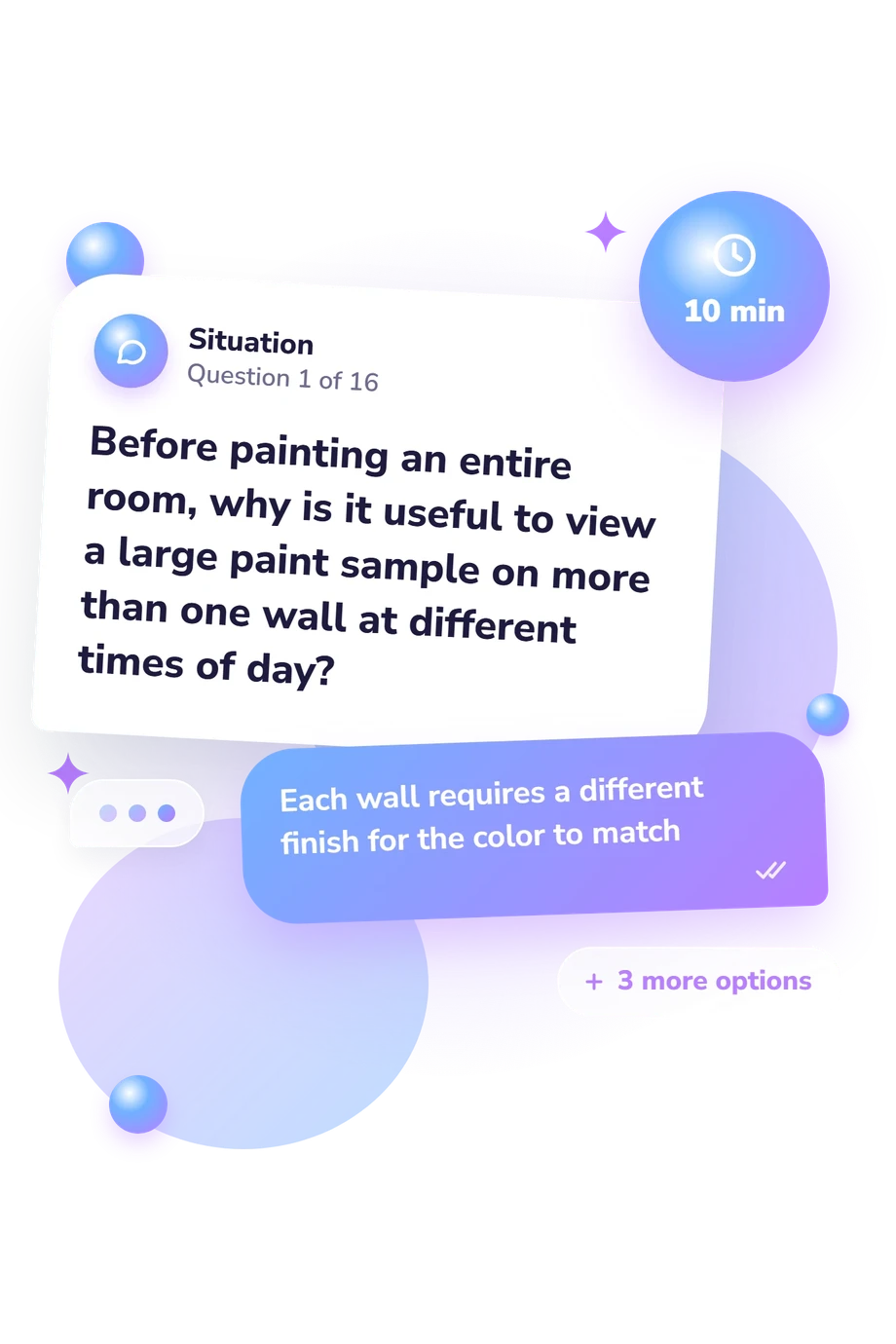
Example Questions From the Test
- The largest piece of furniture in a room
- The geometric center of the floor plan
- The brightest artificial light in a room
- The feature intended to attract attention first
- The fixture's maximum wattage
- The bulb's Color Rendering Index, or CRI
- The bulb's beam angle
- The bulb's physical diameter
- Sink, main cooking area, and refrigerator
- Sink, dishwasher, and trash bin
- Refrigerator, pantry, and kitchen island
- Oven, dining table, and pantry
Home Quiz - Description and methodology of the test
People who want to make more confident room decisions can use the home quiz to check practical design knowledge rather than personal taste. It works as an interior design knowledge test for learners, homeowners, renters, and anyone curious about why certain arrangements feel balanced, functional, or comfortable. The result places overall performance in a knowledge band, while the questions can show which foundations deserve more attention during review.
What This Assessment Explores
The questions examine how design principles work in ordinary rooms: clear routes, focal points, light, color, furnishings, and comfort. Scenarios also address rugs, window treatments, lighting layers, sound absorption, balance, scale, rhythm, proportion, and accessible hardware.
As an interior design fundamentals quiz, this assessment links design vocabulary to decisions at home, making it more useful for practical learning. Its themes include:
- Layout and function show how furniture placement and work zones affect use.
- Light and color reflect task lighting, color relationships, and changing visual conditions.
- Visual organization measures focal points, rhythm, balance, scale, and proportion.
- Materials and access capture attention to sound, surfaces, and easier-to-operate hardware.
The Home Design Knowledge scale runs from 0-16: Foundation Builder (0-6), Developing Designer (7-12), and Strong Knowledge (13-16). The result summarizes current understanding across the quiz rather than personal taste.
Methodology and Evidence Base
Each item presents a short practical scenario or design-knowledge question with four answer choices. The response format asks the participant to identify the most appropriate principle or solution, so the result reflects recognition and application rather than a preference ranking. As a room design assessment, it is suited to self-directed learning and reflection.
Adams (2013) supplies a relevant framework for core design principles, while Ching and Binggeli and Dodsworth and Anderson explain how layout, lighting, color, materials, proportion, and function operate in interior spaces. The questions cover principles discussed in these works, including space, light, materials, function, and accessible design.
The score condenses responses into the displayed knowledge result, where a higher band indicates stronger recognition of the tested concepts. Interpretation is clearest when you review which topics felt certain or difficult and use the outcome to choose what to study next. The displayed bands describe performance on this quiz, not universal benchmarks. Guessing, prior exposure to design terms, and current attention can also influence performance, so the score is best understood as a snapshot of present knowledge.
- Erin Adams, "The Elements and Principles of Design: A Baseline Study," International Journal of Art & Design Education, 32(2), 2013, pp. 157-175. 10.1111/j.1476-8070.2013.01761.x.
- Francis D. K. Ching and Corky Binggeli, Interior Design Illustrated, 4th ed., Wiley, 2018. ISBN 978-1-119-46853-0.
- Simon Dodsworth and Stephen Anderson, The Fundamentals of Interior Design, 2nd ed., Fairchild Books, 2019. ISBN 978-1-350-10656-7.
- U.S. Department of Justice, 2010 ADA Standards for Accessible Design, 2010.
Updated: