
Vietnam War Quiz
How the Scales are Structured
Who Usually Takes This Test?
See How You Compare
Below is a preview of how scores are typically distributed across each scale.
Example Questions From the Test
- The collapse of South Vietnam and the effective end of the war
- The beginning of direct American ground combat in Vietnam
- The overthrow of North Vietnam’s communist government
- The return of Vietnam to French colonial rule
- Mutually assured destruction
- The Marshall Plan
- The domino theory
- The policy of détente
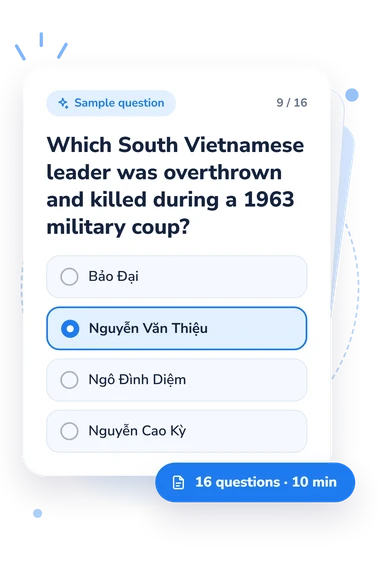
- Bảo Đại
- Nguyễn Văn Thiệu
- Ngô Đình Diệm
- Nguyễn Cao Kỳ
Vietnam War Quiz - Description and methodology of the test
Readers who want to revisit a complex twentieth-century conflict can use the Vietnam War Quiz to check historical knowledge rather than personality or opinion. The assessment is suited to students, general readers, and anyone refreshing an understanding of the war’s chronology, decisions, and consequences. As a Vietnam War history quiz, it offers a focused way to identify which parts of the subject deserve closer study.
What This Assessment Explores
The items test historical connections rather than isolated recall. They ask readers to order developments, identify leaders, interpret policies, compare outcomes, and connect military events with diplomatic, political, and social consequences. Themes include Dien Bien Phu, Geneva, escalation, Vietnamization, Tet, protest, civilian harm, the Paris Peace Accords, and Saigon's fall.
Readers using questions and answers from this quiz about the Vietnam War can treat each item as a prompt to place events in context. The result shows recognition of chronology, actors, decisions, and consequences.
The single scale is Vietnam War Knowledge (0-16), with these result bands:
- Foundation to build (0-6) indicates some recognition and points to review of chronology, leaders, and policies.
- Developing knowledge (7-12) indicates many central connections, with detail and context still to strengthen.
- Strong knowledge (13-16) indicates a well-developed grasp of events, figures, strategies, and consequences.
Methodology and Scientific Basis
Each question presents four answer choices and asks for the most accurate event, sequence, comparison, policy, or consequence. The format tests recognition and historical reasoning within a defined content set; it does not create separate scores for combat, diplomacy, or protest. One overall result summarizes the selected responses.
Vietnam's American War (Asselin, 2024) provides the closest historical frame for chronology and major decisions. The two 2024 Cambridge volumes edited by Lien-Hang T. Nguyen, Andrew Preston, and Pierre Asselin extend context across escalation, stalemate, endings, and aftermaths. The 1971 Pentagon Papers support the focus on decision-making, official claims, and the credibility gap. The questionnaire is conceptually consistent with these works, not an adaptation of any one of them.
After a result appears, reviewing answers to the history quiz on the Vietnam War is most useful when you examine why an option fits its period and evidence. These sources support content coverage, but they do not establish reliability, population norms, or standardized interpretation for this online questionnaire. Performance may vary with prior study, guessing, wording, attention, and current knowledge.
- Asselin, Pierre. Vietnam's American War: A New History. 2nd ed. Cambridge University Press, 2024. 10.1017/9781009229302
- Nguyen, Lien-Hang T., and Andrew Preston, eds. The Cambridge History of the Vietnam War, Volume II: Escalation and Stalemate. Cambridge University Press, 2024. 10.1017/9781316225264
- Nguyen, Lien-Hang T., and Pierre Asselin, eds. The Cambridge History of the Vietnam War, Volume III: Endings and Aftermaths. Cambridge University Press, 2024. 10.1017/9781316225288
- United States Department of Defense. The Pentagon Papers: The Defense Department History of United States Decisionmaking on Vietnam. The Senator Gravel Edition. Boston: Beacon Press, 1971.