
Verbals Quiz
How the Scales are Structured
Who Usually Takes This Test?
See How You Compare
Below is a preview of how scores are typically distributed across each scale.
Example Questions From the Test
- When Ava called Nora, she was boarding the train.
- Daniel told Marcus that his report needed revision.
- After Lena handed Maya the folder, Maya filed the folder.
- Priya met Zoe after she finished work.
- The list of required items are on the desk.
- The list of required items is on the desk.
- The boxes beside the door needs labels.
- The results from the survey shows a pattern.
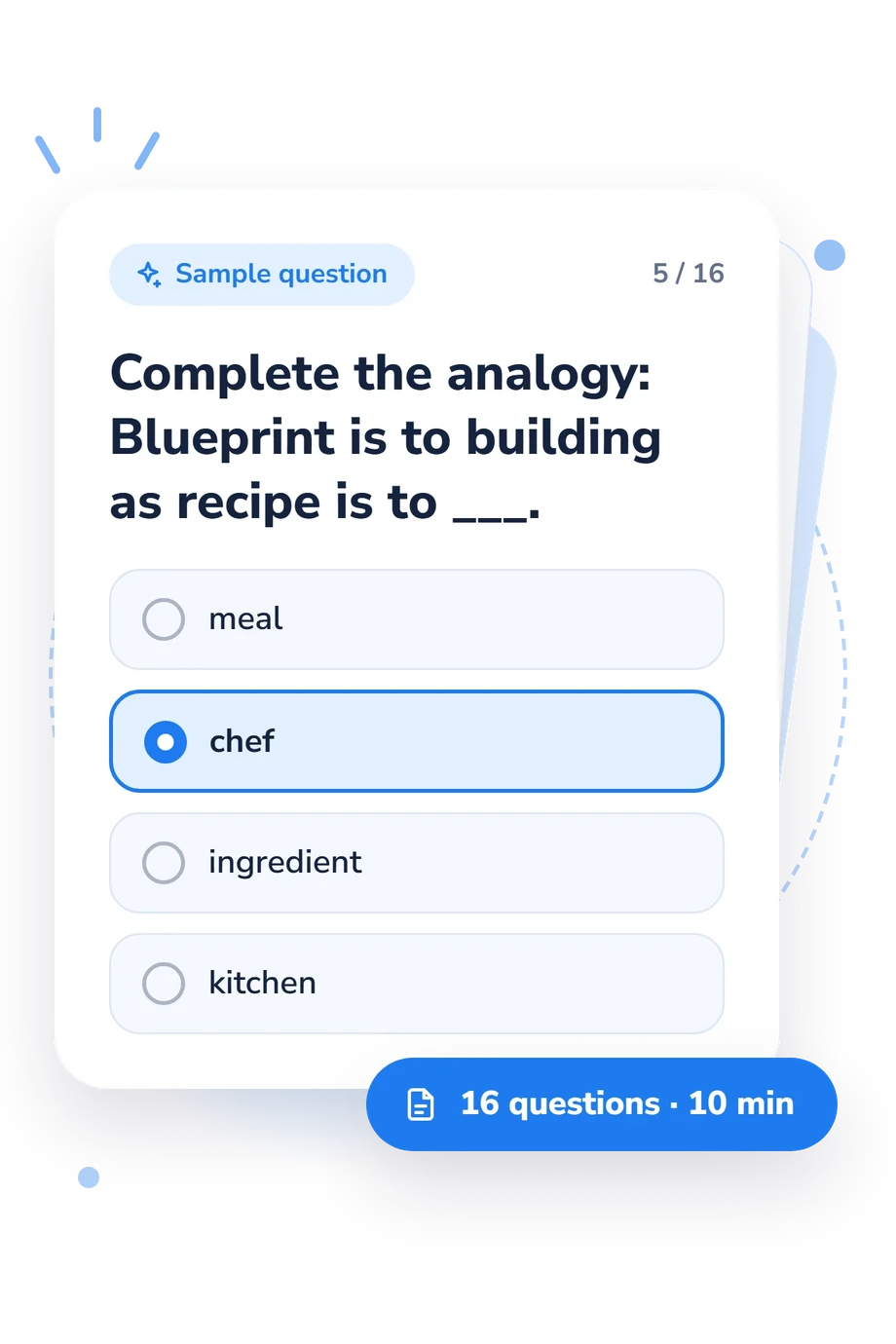
- meal
- chef
- ingredient
- kitchen
Verbals Quiz - Description and methodology of the test
Learners, test-takers, and curious adults who want to decide which language skills to practise can use this assessment to examine meaning, grammar, sentence relationships, and verbal inference. The verbals quiz can show where performance is steadier and where targeted review may be useful. Taken as a verbals practice quiz, this assessment can help identify which skills deserve review.
What This Assessment Measures
Questions sample vocabulary, sentence analysis, grammar, analogies, concise expression, and inference. The assessment serves as a quiz for identifying verbal skills, and it suits learners and adults seeking a focused profile of verbal performance.
The main areas represented are:
- Vocabulary and context show how accurately you infer word meaning.
- Sentence and grammar analysis show how well you track references, agreement, conditionals, structure, and punctuation.
- Analogical reasoning shows how you transfer relationships between terms.
- Verbal inference shows whether you distinguish what must follow from what merely could be true.
Together, these tasks map the patterns represented in the result. The displayed scale is Verbals Knowledge, 0-16: Foundational (0-6) reflects inconsistent recognition of verbal patterns; Developing (7-12) reflects generally successful performance with subtler distinctions to strengthen; Strong (13-16) reflects consistently accurate command of the sampled skills, including sentence analysis and inference.
Methodology and Evidence Base
Each item uses four answer choices, and the respondent selects the best response for tasks such as interpreting context, correcting grammar, completing an analogy, choosing a transition, or drawing a necessary conclusion. The format samples recognition and reasoning rather than open-ended explanation.
The result from this verbals assessment is reported through the displayed bands, and no per-answer weighting or extra cutoff rule is stated. It summarizes performance on the language operations represented by these items, including vocabulary, grammar, sentence structure, analogies, concise expression, and inference.
Methodologically, the quiz is conceptually consistent with CASL-2 (Carrow-Woolfolk, 2017) in its attention to vocabulary, grammar, and sentence-level language, but it is not a CASL-2 administration. Its analogy tasks also align with Duran, Enright, and Peirce (1987) and Wallen and Campbell (1967), whose studies connect verbal-analogy performance with reasoning and vocabulary. These sources clarify relevant constructs, not standardization for this questionnaire.
The questionnaire has no stated norm sample, reliability estimate, or standardized administration. Education, reading experience, concentration, and familiarity with test conventions can affect performance, so the score reflects this quiz rather than overall intelligence or standardized-test ability.
- Carrow-Woolfolk, Elizabeth. (2017). Comprehensive Assessment of Spoken Language, Second Edition (CASL-2) [Manual]. Torrance, CA: Western Psychological Services.
- Duran, Richard P., Mary K. Enright, and Leslie P. Peirce. (1987). GRE Verbal Analogy Items: Examinee Reasoning on Items. ETS Research Report Series, 1987, i-47. 10.1002/j.2330-8516.1987.tb00209.x
- Wallen, Norman E., and Mary Lou A. Campbell. (1967). Vocabulary and Non-verbal Reasoning Components of Verbal Analogies Tests (Miller Analogies Test and Concept Mastery Test). The Journal of Educational Research, 61(2), 87-89. 10.1080/00220671.1967.10883594
Updated: