
Should I Take the SAT or ACT Quiz
How the Scales are Structured
Who Usually Takes This Test?
See How You Compare
Below is a preview of how scores are typically distributed across each scale.
Example Questions From the Test
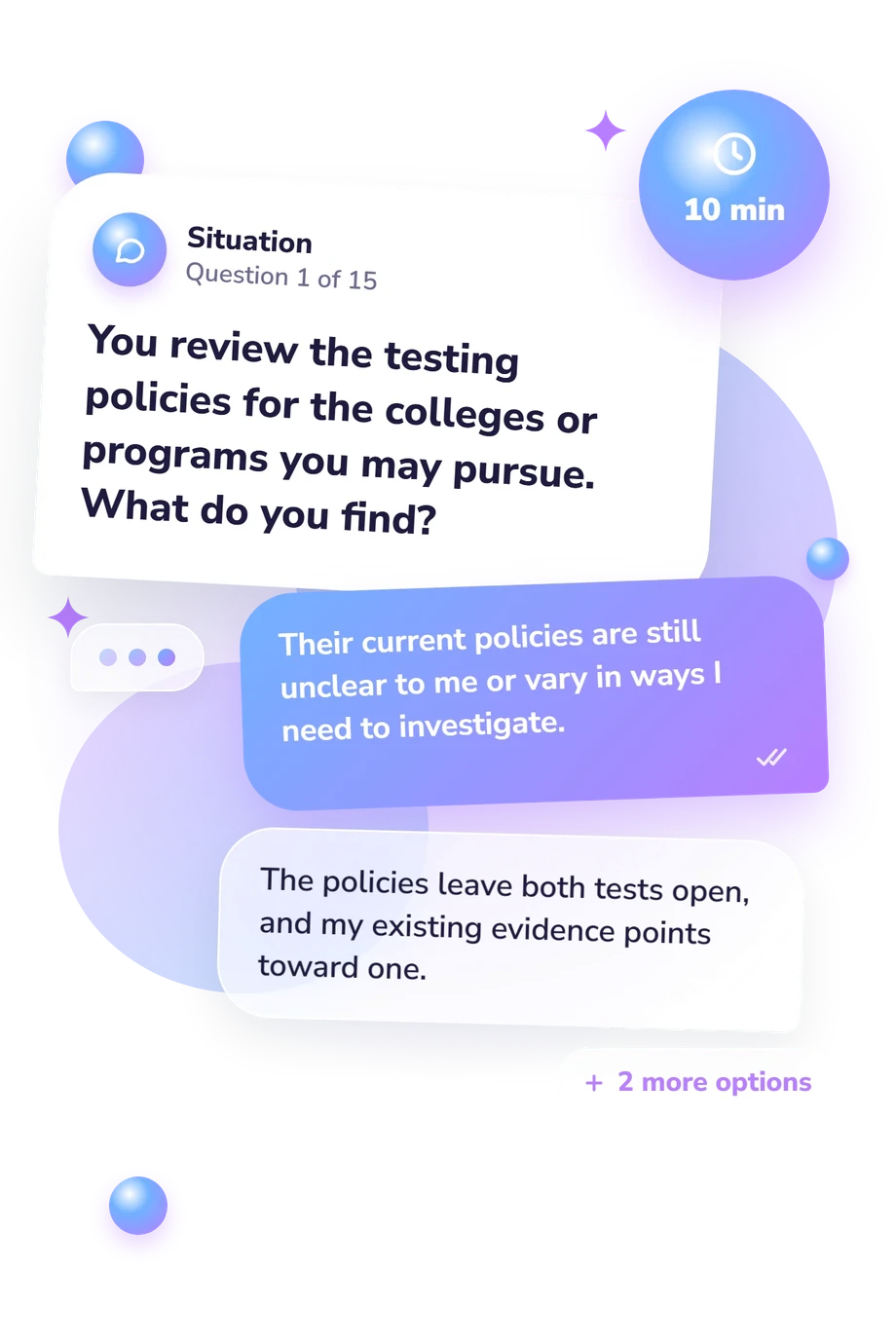
- Their current policies are still unclear to me or vary in ways I need to investigate.
- The policies leave both tests open, and my existing evidence points toward one.
- A specific requirement or established preference makes one route clearly more relevant.
- Both remain viable, but special program or scholarship details could affect the choice.
- One test has a clear and repeatable advantage for me.
- One test has a modest but fairly consistent edge.
- The two results are nearly equivalent once testing conditions are considered.
- The apparent advantage changes between attempts or conflicts with how each test feels.
- Mostly longer passages followed by a connected set of questions.
- A fairly even mixture of long passage sets and short standalone material.
- Short excerpts are comfortable, although I sometimes want more surrounding context.
- Brief excerpts with one focused question at a time.
Should I Take the SAT or ACT Quiz - Description and methodology of the test
Students weighing two college-admissions tests can use the Should I Take the SAT or ACT Quiz when neither route is yet an obvious choice. It helps organize a choice shaped by competing requirements or uncertainty about which testing experience will be the better match. The result from this SAT or ACT quiz offers a current decision aid: favor one route or compare both before registering.
What This Assessment Explores
Rather than measuring intelligence or predicting admission results, the questionnaire examines reported preferences and experiences under different testing demands. Its scenarios cover digital comfort, adaptive or linear progression, reading structure, timed math, data interpretation, practice evidence, and practical conditions. The result describes format affinity and whether further comparison would help someone choosing between the SAT and ACT.
The three displayed scales summarize the decision:
- ACT Fit (0-15) indicates ACT-format alignment: Limited alignment (0-5), Plausible fit (6-10), or Strong affinity (11-15).
- Compare Both First (0-15) indicates whether comparison adds value: Decision evidence available (0-5), Comparison would help (6-10), or Compare before registering (11-15).
- SAT Fit (0-15) indicates SAT-format alignment: Limited alignment (0-5), Plausible fit (6-10), or Strong SAT affinity (11-15).
In this SAT vs ACT quiz, the bands describe current fit and decision conditions, not ability or a predicted score.
Methodology and Scientific Basis
Each prompt presents a testing situation with four choices. They address policy, practice results, digital tools, adaptive or linear pacing, passage structure, timed math, data interpretation, and preparation habits. The answers capture reported preferences, experiences, and practical conditions rather than right-or-wrong knowledge.
Methodologically, structured self-report answers produce three displayed descriptive scales. Their bands indicate whether responses favor one format or whether comparison would add evidence; item-level weighting is unspecified, so point contributions should not be inferred.
The 2018 ACT/SAT Concordance provides score-comparability context for the two tests, but this questionnaire is neither a concordance table nor an adaptation of that work. College Board's 2024 digital SAT manual and ACT's 2025 technical manual provide format context; Marco, Abdel-fattah, and Baron's 1992 study documents score-comparability methods. The displayed bands provide descriptive format-fit guidance, not a predicted score or population comparison.
For an SAT or ACT decision, interpret the result as a current self-report snapshot of format fit and comparison value. Preparation, familiarity, anxiety, accommodations, and changing conditions can alter the experience, so matched official practice tests are the strongest next check.
- The College Board and ACT, Inc. (2018). Guide to the 2018 ACT/SAT Concordance. College Board and ACT, Inc.
- College Board. (2024). Digital SAT Suite of Assessments Technical Manual. College Board.
- ACT. (2025). ACT Technical Manual. ACT Education Corp.
- Marco, Gary L., Abdel-fattah, A. A., and Baron, Patricia A. (1992). Methods Used to Establish Score Comparability on the Enhanced ACT Assessment and the SAT. ETS Research Report Series, 1992(1), i-19. 10.1002/j.2333-8504.1992.tb01456.x
Updated: