
Am I a Bully Quiz
How the Scales are Structured
Who Usually Takes This Test?
See How You Compare
Below is a preview of how scores are typically distributed across each scale.
Example Questions From the Test
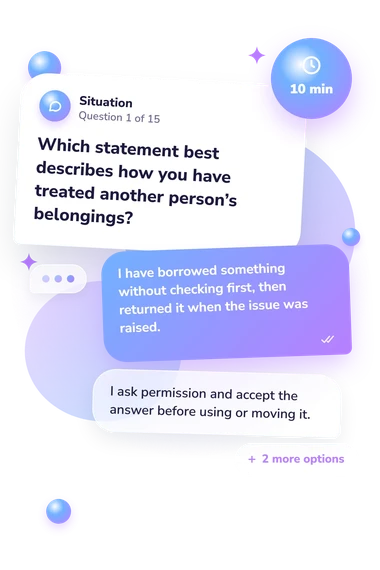
- I have borrowed something without checking first, then returned it when the issue was raised.
- I ask permission and accept the answer before using or moving it.
- I have hidden or withheld an item to get a reaction or embarrass its owner.
- I have taken, damaged, or threatened property to punish someone or force compliance.
- I share it only when the person has clearly agreed to that use.
- I forward it assuming it is harmless, then remove it and acknowledge the impact when challenged.
- I deliberately share it with selected people to embarrass the person.
- I distribute intimate, threatening, or seriously exploitative material without consent.
- I create a fake account, expose private information, or impersonate them to cause harm.
- I post a teasing caption and tag them without first checking whether they are comfortable.
- I avoid making a person the target unless they have clearly agreed to participate.
- I fabricate a quote or edit content to make them look foolish or dishonest.
Am I a Bully Quiz - Description and methodology of the test
People who want to examine how their conduct affects others can use this assessment as a structured prompt for accountability rather than a fixed label. The Am I a Bully Quiz focuses on interactions with friends, classmates, teammates, coworkers, and online contacts. This bully quiz helps readers notice pressure, humiliation, intimidation, exclusion, and ignored boundaries before patterns become harder to change.
What This Assessment Explores
The scenarios examine bullying behavior through consent, personal space, property, privacy, and whether another person can disengage. Results identify areas for reflection, repair, or interruption rather than defining character.
The three profile dimensions are:
- Digital Harassment and Group Pile-Ons (0-15) measures harmful sharing, pile-ons, exposure, impersonation, block evasion, and audience targeting; bands: No endorsement recorded (0), Signal to review (1-2), Action indicated (3-15).
- Physical and Property Coercion (0-15) measures intimidation, unwanted contact, restraint, damage, taking, or pressure involving belongings; bands: No endorsement recorded (0), Signal to review (1-2), Action indicated (3-15).
- Verbal and Relational Targeting (0-15) measures insults, humiliation, exclusion, rumors, degrading labels, and repeated attacks; bands: No endorsement recorded (0), Signal to review (1-2), Action indicated (3-15).
The displayed profile helps respondents notice where safer conduct, repair, or interruption may be needed.
Methodology and Scientific Basis
Each item describes a situation with four choices. Options show contrasting patterns: consent-aware conduct, repairable lapses, and deliberate, repeated, coercive, or escalating harm; order is not fixed. Respondents select the closest description, producing a three-domain profile rather than one identity label.
The self-report approach is conceptually consistent with Murray and colleagues’ Zurich Brief Bullying Scales, Thomas and colleagues’ perpetration research, and Hall’s BullyHARM. Hall’s measure focuses on receiving bullying, harassment, and aggression, whereas this questionnaire asks about the respondent’s conduct. The questionnaire is not adapted from them.
The displayed bands are unvalidated reflective summaries, not severity, legal, or clinical cutoffs. A zero means no endorsement was recorded but cannot establish that no harm occurred.
Students can use it as a bullying self-assessment when reviewing classroom, team, friendship, or online conduct, while adults can apply it to work and personal relationships. Any concerning endorsement matters independently of the total, and a single red-flag response should be acted on regardless of the summed score. Self-awareness, context, and impression management can shape self-report, so the result cannot capture every circumstance or impact.
- Murray, Aja Louise, Manuel Eisner, Denis Ribeaud, Daniela Kaiser, Karen McKenzie, and George Murray. "Validation of a Brief Self-Report Measure of Adolescent Bullying Perpetration and Victimization." Assessment, 2021, 28(1), 128-140. 10.1177/1073191119858406
- Thomas, Hannah J., James G. Scott, Jason M. Coates, and Jason P. Connor. "Development and Validation of the Bullying and Cyberbullying Scale for Adolescents: A Multi-Dimensional Measurement Model." British Journal of Educational Psychology, 2019, 89(1), 75-94. 10.1111/bjep.12223
- Hall, William J. "Initial Development and Validation of the BullyHARM: The Bullying, Harassment, and Aggression Receipt Measure." Psychology in the Schools, 2016, 53(9), 984-1000. 10.1002/pits.21957