
Ribs Quiz
How the Scales are Structured
Who Usually Takes This Test?
See How You Compare
Below is a preview of how scores are typically distributed across each scale.
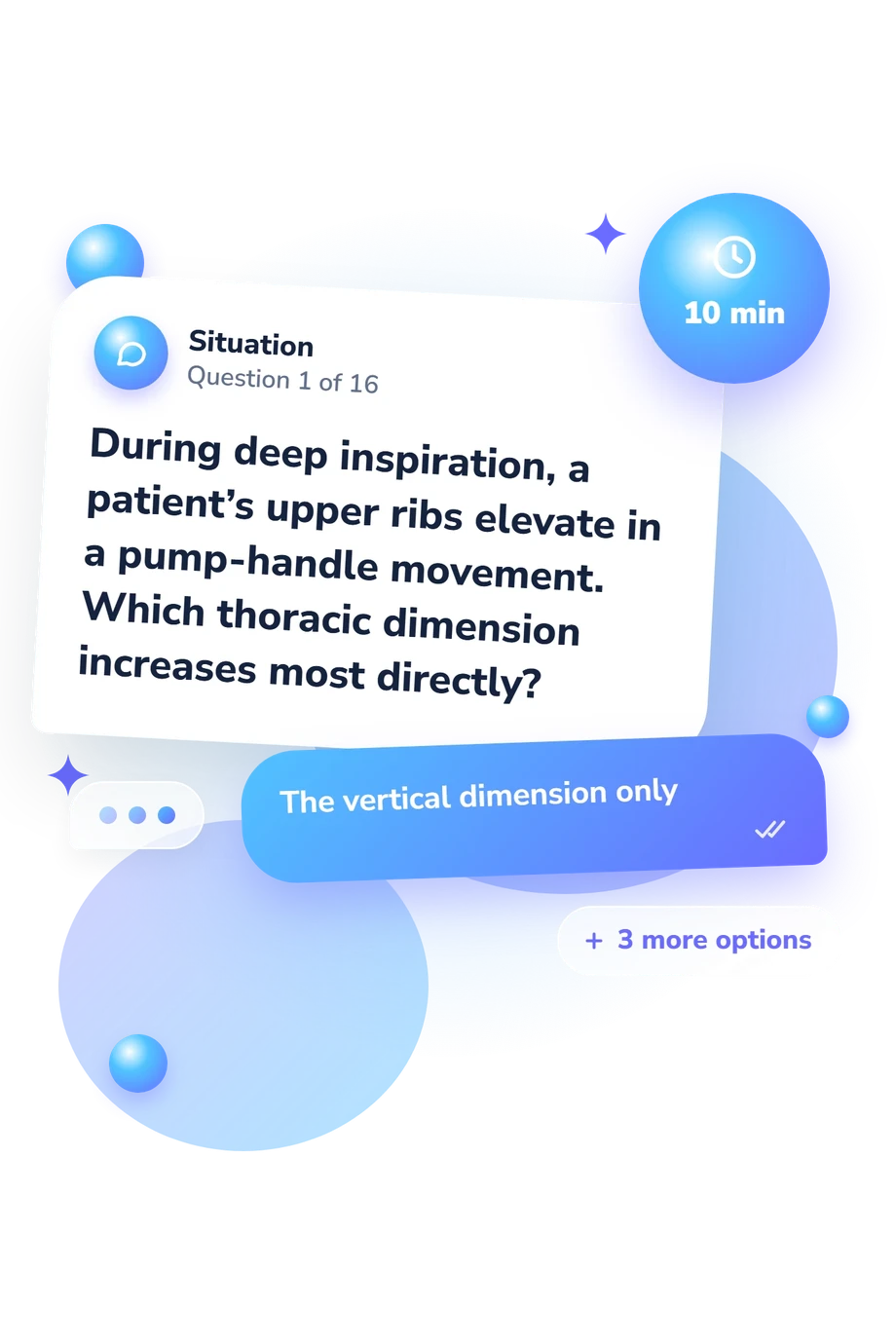
Example Questions From the Test
- The first sternocostal joint
- The second sternocostal joint
- The fifth sternocostal joint
- The seventh sternocostal joint
- The sternum moves inferiorly toward the abdomen
- The thoracic cavity becomes shorter vertically
- The costal cartilages become rigid and immobile
- The transverse diameter of the thorax increases
- The transverse processes of two neighboring vertebrae
- Only the body of the vertebra immediately below it
- The spinous process of the corresponding vertebra
- The bodies of the corresponding vertebra and the vertebra above
Ribs Quiz - Description and methodology of the test
Students, trainees, and independent learners who want to check how well they connect thoracic structures with function can use this assessment as a focused ribs quiz. A rib anatomy quiz can help reveal whether review is needed in osteology, joints, respiratory mechanics, or clinically relevant landmarks. Its purpose is to turn recall into a practical map of strengths and topics that deserve another pass.
What This Assessment Explores
The assessment measures knowledge of the ribs, sternum, costal cartilages, vertebral articulations, intercostal spaces, and breathing movements. It suits learners revising thoracic anatomy who want to connect structure with function.
Items test recognition, classification, relationships, and brief clinical applications, including landmarks, joint types, rib groupings, and changes in thoracic dimensions. Used as a thoracic anatomy quiz, it favors connected understanding over isolated naming.
The result brings together three practical themes:
- Rib classification and osteology show how typical, first, true, and floating ribs differ in form, attachment, and articulation.
- Sternal and costal landmarks show whether major features can be located and related to neighboring structures.
- Joint mechanics and clinical anatomy reflect understanding of thoracic movement, neurovascular arrangement, and intercostal access.
Together, these themes make the result a study checkpoint: stronger performance suggests more accurate structural and functional connections, while weaker performance identifies topics for review.
Methodology and Scientific Basis
Each question uses four answer choices and asks for the best anatomical response. Alongside rib labeling quiz tasks, it asks about movement, joints, palpation, and safer clinical access, combining direct recall with applied reasoning.
Results are organized under Ribs and Sternum Knowledge, with a score range of 0-16. Foundational (0-6) indicates a need to review classifications, sternal parts, and landmarks; Developing (7-12) reflects core knowledge with gaps in structural connections, movement, or clinical use; Strong (13-16) indicates accurate, well-connected knowledge. These are educational bands, not population norms or clinical cutoffs.
Methodologically, this is an educational anatomy knowledge check. Its content is conceptually consistent with Moore's Clinically Oriented Anatomy (Dalley and Agur, 2023) and the student anatomy text by Drake, Vogl, and Mitchell (2023), which provide relevant structural and clinical frameworks. The breathing items also align with thoracic kinematics described by Bastir and colleagues (2017).
Those sources support the anatomical interpretation, but this questionnaire is not presented as an adaptation or validation of any of them. Performance can vary with prior instruction, recall, and test-taking context, so the result is best used to target further study.
- Dalley, Arthur F., II, and Agur, Anne M. R. Moore's Clinically Oriented Anatomy. 9th ed. Wolters Kluwer, 2023. ISBN 9781975154066.
- Drake, Richard L., Vogl, A. Wayne, and Mitchell, Adam W. M. Gray's Anatomy for Students. 5th ed. Elsevier, 2023. ISBN 9780323934237.
- Bastir, Markus, Daniel García-Martínez, Nicole Torres-Tamayo, Juan Alberto Sanchis-Gimeno, Paul O'Higgins, Cristina Utrilla, Isabel Torres Sánchez, and Francisco García Río. “In Vivo 3D Analysis of Thoracic Kinematics: Changes in Size and Shape During Breathing and Their Implications for Respiratory Function in Recent Humans and Fossil Hominins.” The Anatomical Record 300, no. 2 (2017): 255-264. DOI 10.1002/ar.23503.
Updated: