
Connective Tissue Quiz
How the Scales are Structured
Who Usually Takes This Test?
See How You Compare
Below is a preview of how scores are typically distributed across each scale.
Example Questions From the Test
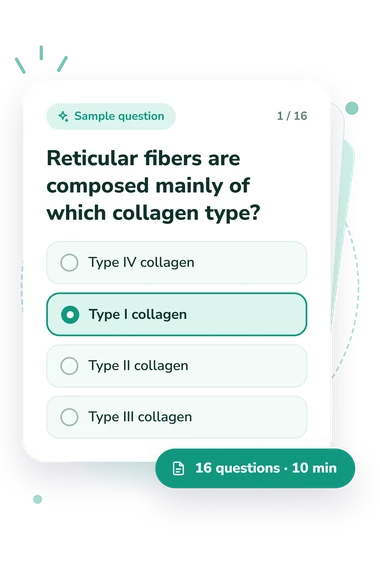
- Type IV collagen
- Type I collagen
- Type II collagen
- Type III collagen
- Mast cell
- Fibrocyte
- Chondrocyte
- Osteocyte
- Macrophage
- Fibroblast
- Adipocyte
- Plasma cell
Connective Tissue Quiz - Description and methodology of the test
Students revising basic histology can use this assessment to connect microscopic appearance with cellular function, matrix composition, and tissue mechanics. The connective tissue quiz is intended for learners who want a focused check of foundational knowledge before further study or practical review. It also works as a connective tissue identification quiz, because many prompts ask you to distinguish tissues from their cells, fibers, and locations.
What This Assessment Explores
The assessment measures whether learners can recognize connective-tissue components and connect them with function, location, and mechanical demands. It concentrates on cells, fibers, ground substance, and tissue architecture, making it suitable for foundational histology review.
The specimen descriptions make this connective-tissue quiz with pictures useful for translating visual findings into tissue identifications.
As a connective tissue knowledge test, it examines three connected themes:
- Cell recognition links microscopic features with secretion, phagocytosis, inflammation, or bone resorption.
- Fiber and matrix knowledge relates collagen, elastic fibers, glycosaminoglycans, hydration, strength, and compression resistance.
- Tissue classification uses arrangement, lacunae, vascularity, and matrix appearance to identify specimens.
The result is Connective Tissue Knowledge: 0-16. Foundations to Review (0-6) signals concepts to revisit; Developing Knowledge (7-12) shows core recognition with some links still developing; Strong Knowledge (13-16) reflects solid understanding in specimen-based situations.
Methodology and Scientific Basis
Each item offers four answer choices covering facts about connective-tissue cells, fibers, matrix, development, and tissue appearance. Some prompts ask you to combine several microscopic clues, while others test direct factual recall about a structure or function.
The content is conceptually consistent with Ross and Pawlina’s histology textbook, which links cells, fibers, ground substance, and tissue functions. Mescher’s textbook provides a comparable account, while McKee’s extracellular-matrix review supports the relationship between matrix composition and tissue properties. These works support the quiz’s histology content, not its own reliability, norms, or validation.
Questions in this histology-focused connective-tissue quiz cover cells, fibers, matrix, development, and tissue appearance; the questionnaire reports one total score in three displayed bands. No further answer-weighting rule, population norms, reliability coefficients, or clinical cutoffs are stated. Performance can vary with prior coursework, terminology familiarity, wording, and guessing, so missed concepts are best treated as study targets rather than a fixed measure of ability.
- Pawlina W, Ross MH. Histology: A Text and Atlas: With Correlated Cell and Molecular Biology. 8th ed. Philadelphia, PA: Wolters Kluwer; 2020. ISBN 9781496383426.
- Mescher AL. Junqueira's Basic Histology: Text and Atlas. 16th ed. New York, NY: McGraw Hill; 2021. ISBN 9781260462982.
- McKee TJ, Perlman G, Morris M, Komarova SV. Extracellular matrix composition of connective tissues: a systematic review and meta-analysis. Scientific Reports. 2019;9:10542. DOI 10.1038/s41598-019-46896-0.