
Cat Quiz
How the Scales are Structured
Who Usually Takes This Test?
See How You Compare
Below is a preview of how scores are typically distributed across each scale.
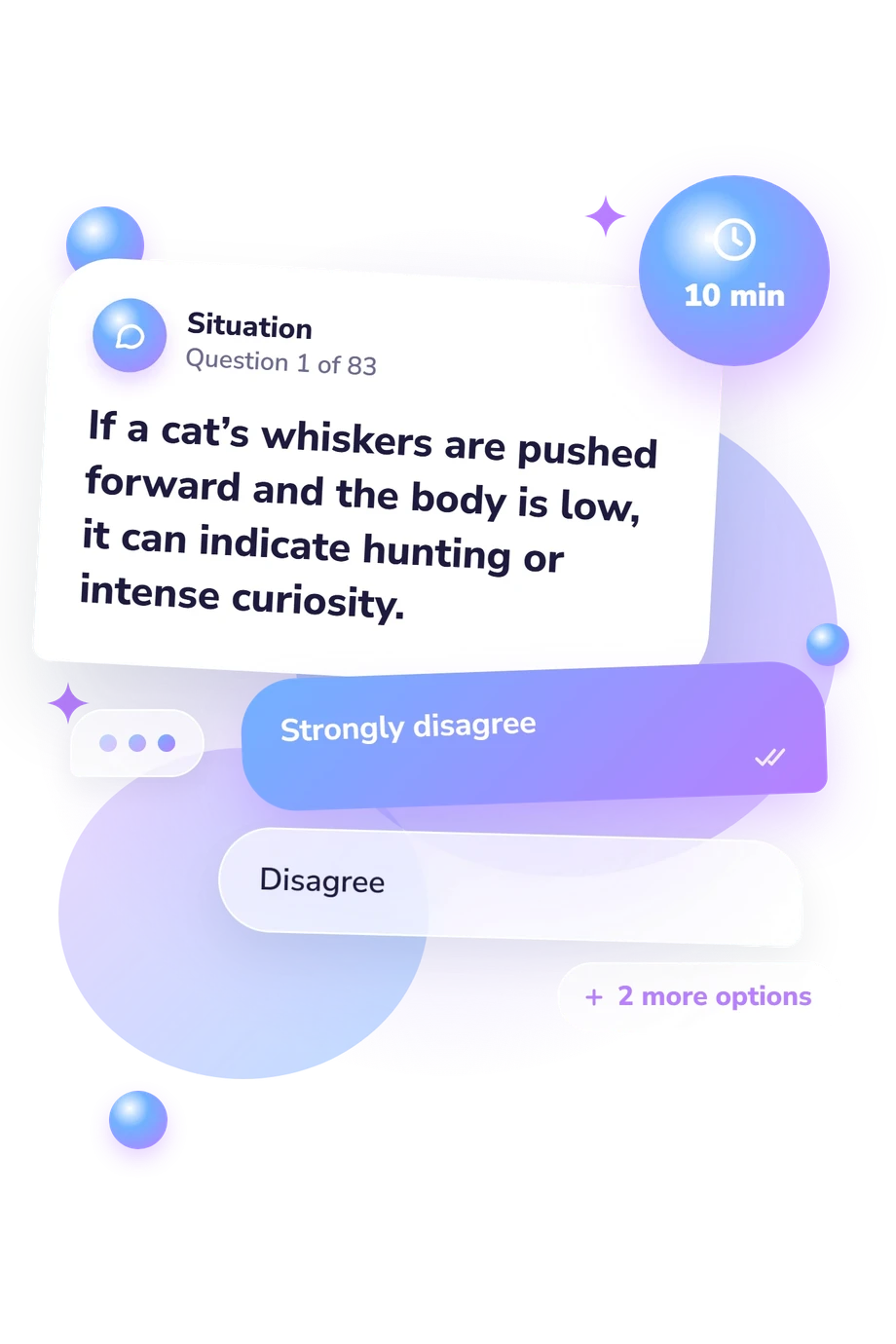
Example Questions From the Test
- Strongly disagree
- Disagree
- Not sure
- Agree
- Definitely false
- Probably false
- Not sure
- Probably true
- Strongly disagree
- Disagree
- Not sure
- Agree
Cat Quiz - Description and methodology of the test
People who want a clearer picture of their practical cat knowledge can use this cat quiz to examine how confidently they read feline signals and evaluate everyday care claims. As a feline knowledge test, it suits current owners, prospective adopters, and learners who prefer applied knowledge to a personality label. The result gives owners and adopters a focused way to review which feline signals and care claims need more attention.
What This Assessment Explores
The questions focus on feline communication, welfare, everyday care, and breed facts without assigning a breed or personality type. They ask respondents to interpret pupils, ears, tails, whiskers, vocalizations, rubbing, hiding, purring, avoidance, and posture, while judging claims about introductions, enrichment, grooming, litter habits, feeding, weight, parasites, and myths. That scope makes this cat behavior quiz practical for owners, adopters, and learners.
These are the result dimensions shown to the respondent:
- Behavior & Body Language (0-10) reflects understanding of signals and habits: Developing Reader (0-3), Moderate Insight (4-7), Strong Interpreter (8-10).
- Care & Myth Busting (0-10) reflects accurate care and myth recognition: Basic (0-3), Developing (4-7), Confident (8-10).
- Feline Knowledge Score (0-30) counts correct answers across the quiz, including behavior, body language, care basics, breed facts, and common myths: Curious Kitten (0-10), Cozy Companion (11-20), True Cat Whisperer (21-30).
Methodology and Evidence Base
Representative items use four response options. Some assess agreement with an interpretation; others ask whether a claim is definitely or probably false or true, with an unsure choice. This format tests judgment as well as recall.
Scoring reports the two topic scales and overall correct-answer count. The ranges define result spans, but the questionnaire does not specify how each response option contributes to topic-scale scores, so no extra formula should be inferred. This cat care quiz covers everyday decisions; the overall result includes behavior and general knowledge.
Conceptually, the content is consistent with Domestic Cat Behaviour (Bradshaw et al., 2012) on communication, habits, and human-cat interactions. Care and enrichment themes align with AAFP and ISFM guidance on feline environmental needs, while Humphrey and colleagues (2020) are relevant to eye-narrowing and slow-blinking items. Together, these sources provide context for the signals and routines covered here.
Results are a snapshot of current knowledge: guessing, prior experience, wording, and personal context can affect performance. The displayed bands classify performance within this questionnaire, and a higher score means more accurate answers here, not complete cat-care competence.
- Bradshaw, John W. S., Rachel A. Casey, and Sarah L. Brown. The Behaviour of the Domestic Cat. 2nd ed., CABI, 2012. ISBN 9781845939922.
- Ellis, Sarah L. H., Ilona Rodan, Hazel C. Carney, Sarah Heath, Irene Rochlitz, Lorinda D. Shearburn, Eliza Sundahl, and Jodi L. Westropp. AAFP and ISFM feline environmental needs guidelines. Journal of Feline Medicine and Surgery, vol. 15, no. 3, 2013, pp. 219-230. 10.1177/1098612X13477537.
- Humphrey, Tasmin, Leanne Proops, Jemma Forman, Rebecca Spooner, and Karen McComb. The role of cat eye narrowing movements in cat-human communication. Scientific Reports, vol. 10, article 16503, 2020. 10.1038/s41598-020-73426-0.
Updated: