
Business Management Quiz
How the Scales are Structured
Who Usually Takes This Test?
See How You Compare
Below is a preview of how scores are typically distributed across each scale.
Example Questions From the Test
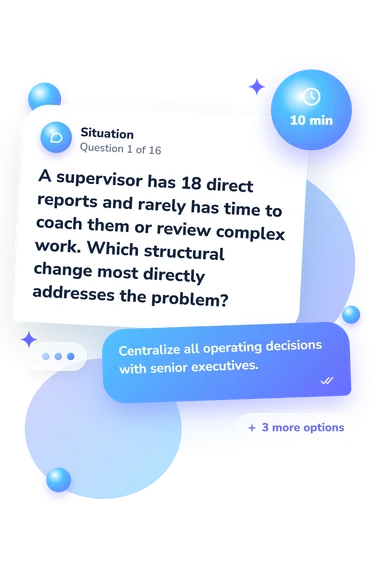
- Centralize all operating decisions with senior executives.
- Create team-lead roles so the supervisor has fewer direct reports.
- Increase the number of goals assigned to each employee.
- Move all employees into separate specialist departments.
- Let the employee define the required outcome after beginning the work.
- Transfer the task and final accountability completely to the employee.
- Specify every action the employee must take and require approval at each step.
- Clarify the outcome, grant suitable authority, set checkpoints, and retain managerial accountability.
- 400 units
- 343 units
- 240 units
- 600 units
Business Management Quiz - Description and methodology of the test
People reviewing core business management principles or applying them in workplace contexts can use this business management quiz to check how confidently they handle common workplace decisions. It offers a structured snapshot of practical understanding rather than a personality profile or leadership-style inventory. As a business management knowledge test, it presents short scenarios whose answers clarify which concepts are secure and which need review.
What This Assessment Measures
The result describes management knowledge rather than personality or leadership style. In a business management assessment, it shows how readily a respondent can recognize sound principles and apply them to short workplace cases. A higher result indicates broader command of the sampled concepts; a lower result points to foundations for review.
The questionnaire covers four connected areas:
- Planning and strategy show whether the respondent can set SMART goals, classify SWOT factors, assess competitive positioning, and choose resources.
- Finance shows whether the respondent can calculate break-even points, separate future costs from sunk spending, analyze budget variance, and recognize cash-flow timing.
- Operations show whether the respondent can identify bottlenecks, economies of scale, maintenance indicators, and inventory requirements.
- People management shows whether the respondent can recognize effective delegation, constructive conflict handling, consistent selection, and intrinsic motivation.
The result uses one 0-16 scale with three bands: Foundation to build (0-6), Developing knowledge (7-12), and Strong knowledge (13-16).
Methodology and Evidence Base
Each item presents a short business scenario followed by four answer choices. The respondent selects the option that best fits the management principle or calculation being tested. This objective knowledge format differs from rating feelings, habits, or self-perceptions: it samples applied recognition, so definitions matter alongside decisions made under stated constraints.
The selected responses are summarized in the displayed Business Management Knowledge result. Viewed as a business management test, the result represents performance on this selected set of concepts, not a complete estimate of managerial ability or readiness for a particular role. The Basic Business Knowledge Scale (Bernal-Guerrero et al., 2020) is the closest subject-matter comparison. The A*S*K Institute assessment and OPM guidance on job-knowledge testing support the broader objective knowledge-testing format, not this questionnaire’s business-management content. These sources provide conceptual context; any norms or validation associated with them do not apply automatically to this questionnaire.
Preparation, guessing, attention, and familiarity with business vocabulary can affect online performance. Current work context and self-awareness can also shape choices. Use the outcome to target review and compare it with practical experience or broader evidence when making important educational or employment decisions.
- Bernal-Guerrero, Antonio, Antonio Ramón Cárdenas-Gutiérrez, and Elisabet Montoro-Fernández. Basic business knowledge scale for secondary education students. Development and validation with Spanish teenagers. PLOS ONE 15, no. 7 (2020): e0235681. 10.1371/journal.pone.0235681
- A*S*K Institute. A*S*K Institute Concepts of Business Management. Test Code 9606, Version 01. NOCTI Partner Assessment, 2025.
- U.S. Office of Personnel Management. Job Knowledge Tests. Assessment and Selection.