
Business Analyst Quiz
How the Scales are Structured
Who Usually Takes This Test?
See How You Compare
Below is a preview of how scores are typically distributed across each scale.
Example Questions From the Test
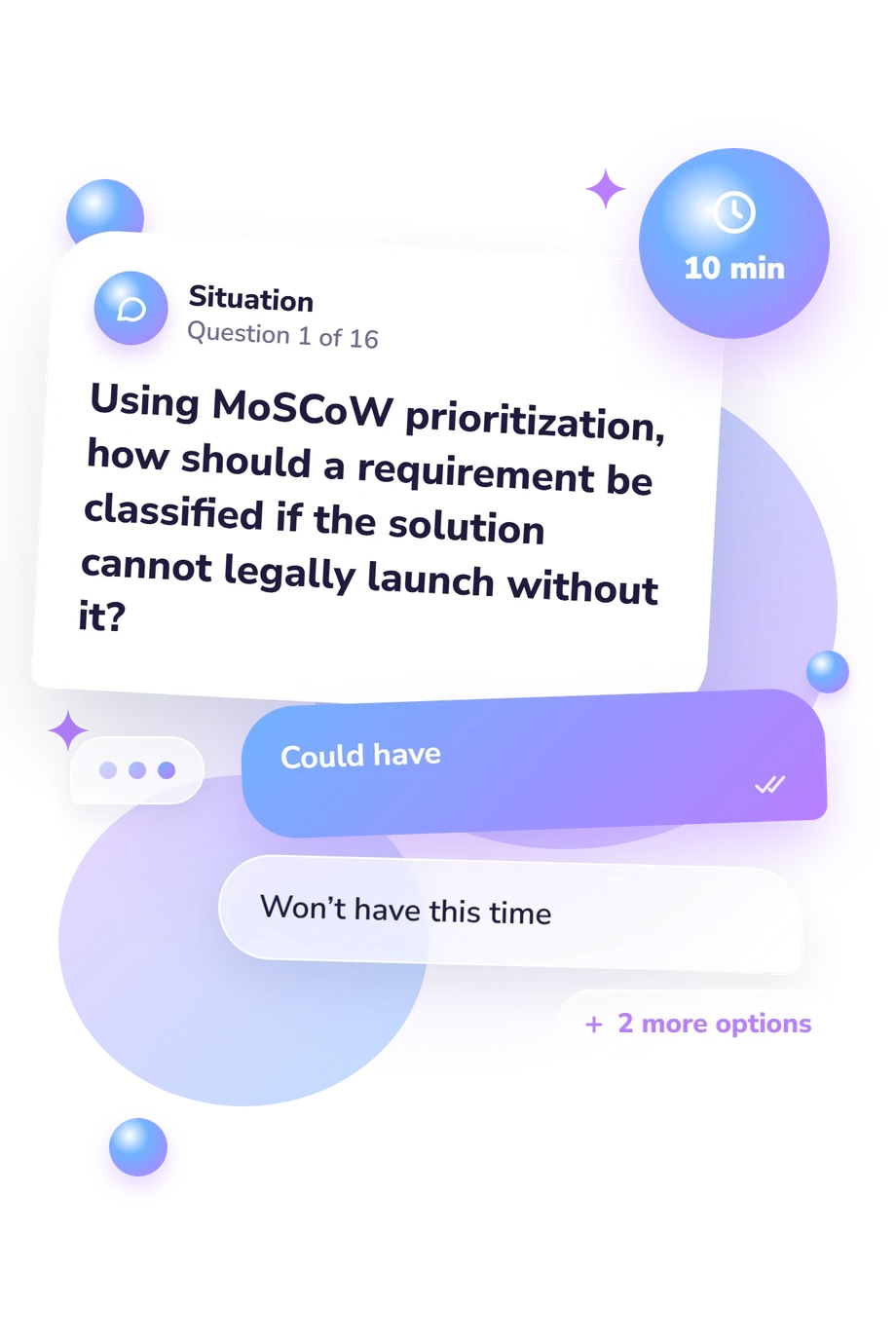
- Could have
- Won’t have this time
- Must have
- Should have
- A transition requirement
- A non-functional requirement
- A stakeholder requirement
- A business rule
- A gateway
- An event
- A pool
- A message flow
Business Analyst Quiz - Description and methodology of the test
Professionals entering analysis work, preparing for a role, or checking their foundations can use this business analyst quiz to see how well they recognize and apply common concepts. The business analysis quiz tests applied business analysis alongside key terminology through scenarios about requirements and delivery decisions. Its result summarizes performance across the tested material and indicates whether broader review may be useful.
What This Assessment Explores
The questions target judgment across the business analysis life cycle: identifying needs, eliciting information, prioritizing requirements, modeling processes and data, managing change, and checking whether a solution meets needs. They suit learners and practitioners seeking a business analyst assessment of knowledge rather than job performance or seniority.
The displayed scale is Business Analyst Knowledge (0-16). It counts correct answers and reports Foundation (0-6), Developing (7-12), or Strong (13-16). These bands describe performance on this quiz and should not be treated as a general measure of professional seniority or competence.
The areas are:
- Requirements practice shows whether you can classify needs, make statements testable, and connect them to acceptance.
- Stakeholder work shows how you elicit information, manage disagreement, and clarify outcomes.
- Analysis and modeling shows whether you can map processes, recognize data relationships, and investigate causes.
- Delivery and validation shows how you handle prioritization, change, traceability, refinement, and acceptance testing.
Methodology and Evidence Base
Each item presents a workplace scenario with four answer choices. The score is the total number of correct responses, so it summarizes performance across the tested concepts rather than producing separate trait scores. This format makes the exercise a compact business analysis skills check.
The quiz’s themes and terminology are conceptually consistent with Jarzębowicz and Marciniak (2017), whose survey examines recurring problems in business analysis. The BABOK Guide and PMI’s business analysis guidance supply established terminology for elicitation, requirements, prioritization, traceability, change, and validation; Wiegers and Beatty reinforce the focus on clear, testable requirements. This quiz is not a published adaptation or validated version of those works, but it uses comparable practical language for scenarios about analysis and delivery.
Interpret the result as coverage of this quiz’s material: Strong indicates broad recognition, Developing indicates partial command, and Foundation identifies topics for structured review. The score has no stated population norms, reliability estimate, or certification meaning. Since performance can vary with wording, prior exposure, and context, read it alongside practical experience rather than as a complete measure of competence.
- Jarzębowicz, Aleksander, and Piotr Marciniak. "A Survey on Identifying and Addressing Business Analysis Problems." Foundations of Computing and Decision Sciences 42, no. 4 (2017): 315-337. 10.1515/fcds-2017-0016.
- International Institute of Business Analysis. A Guide to the Business Analysis Body of Knowledge (BABOK Guide), Version 3.0. Toronto, Ontario: International Institute of Business Analysis, 2015. ISBN 978-1-927584-02-6.
- Project Management Institute. The PMI Guide to Business Analysis. Newtown Square, Pennsylvania: Project Management Institute, 2017. ISBN 978-1-62825-198-2.
- Wiegers, Karl, and Joy Beatty. Software Requirements, 3rd ed. Redmond, Washington: Microsoft Press, 2013. ISBN 978-0-7356-7966-5.
Updated: