
Body Type Quiz
How the Scales are Structured
Who Usually Takes This Test?
See How You Compare
Below is a preview of how scores are typically distributed across each scale.
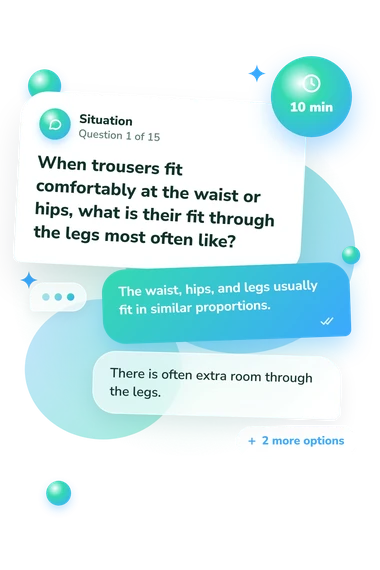
Example Questions From the Test
- It follows pronounced curves through the torso or hips.
- It creates a mostly straight line with a little shaping.
- It emphasizes a strong shoulder-to-waist taper.
- It hangs in a distinctly straight, vertical line.
- It often needs extra room at the waist or hips.
- It is usually balanced through the shoulders and waist.
- It often leaves substantial extra room at the waist.
- It may leave a little room at the waist, but not consistently.
- They look broad or full relative to my height.
- They look neither notably narrow nor broad.
- They look somewhat narrow relative to my height.
- Both areas look distinctly narrow relative to my height.
Body Type Quiz - Description and methodology of the test
For readers who want a neutral way to describe clothing fit and visible silhouette, the body type quiz organizes observations about proportion, curve, and frame structure. It suits personal style reflection when several features coexist rather than one ideal shape dominating. If you are asking what is my body type, the result offers a visual profile without making claims about health, fitness, or body composition.
What This Assessment Explores
The prompts examine silhouette as seen in relaxed posture and ordinary clothing, covering length, width, curve, softness, contour, taper, and shoulder-led structure. Someone asking what's my body type can use the profile to name dominant or mixed features.
The three displayed scales are separate visual affinities:
- Ectomorph (0-15) reflects a long, narrow, or lightly built silhouette: Limited affinity (0-5) means few matches; Partial affinity (6-10) suggests a mixed pattern; Strong affinity (11-15) indicates consistent linearity.
- Endomorph (0-15) reflects rounded, softly contoured, or fuller features: Limited affinity (0-5) means few matches; Partial affinity (6-10) suggests mixed fullness; Strong affinity (11-15) indicates consistent softness.
- Mesomorph (0-15) reflects sturdiness, contours, or a shoulder-led outline: Limited affinity (0-5) means few matches; Partial affinity (6-10) suggests mixed structure; Strong affinity (11-15) indicates a consistent structured profile.
Methodology and Scientific Basis
Each item offers four descriptions, and the respondent selects the one that best matches ordinary fit, posture, or silhouette. The groups address proportion, linearity, softness, fullness, structure, and taper. A free quiz for body-type reflection produces a comparative profile without requiring measurements.
Three separate totals are displayed, but no point value is stated for each response. A higher total means more selected observations matched that description; it does not establish a biological category.
Methodologically, the framework is Heath-Carter somatotyping (Carter & Heath, 1990), alongside the modified method described by Heath and Carter (1967). Sheldon, Stevens, and Tucker’s earlier model provides historical context. The questionnaire is conceptually consistent with these frameworks, but its wording, response structure, and bands are not a validated or standardized reproduction of either method.
Readers asking what body type am I can use the result for style-oriented self-description. No population norms, reliability estimates, or clinical interpretation are stated, and self-report may shift with clothing, posture, current context, or personal interpretation. It is not a diagnostic method.
- Carter, J. E. Lindsay, and Barbara Honeyman Heath. Somatotyping: Development and Applications. Cambridge University Press, 1990.
- Heath, Barbara Honeyman, and J. E. Lindsay Carter. “A Modified Somatotype Method.” American Journal of Physical Anthropology, vol. 27, no. 1, 1967, pp. 57-74. 10.1002/ajpa.1330270108
- Sheldon, William Herbert, with Stanley Smith Stevens and William Boose Tucker. The Varieties of Human Physique: An Introduction to Constitutional Psychology. Harper, 1940.
Updated: