
Bedwetting Quiz
How the Scales are Structured
Who Usually Takes This Test?
See How You Compare
Below is a preview of how scores are typically distributed across each scale.
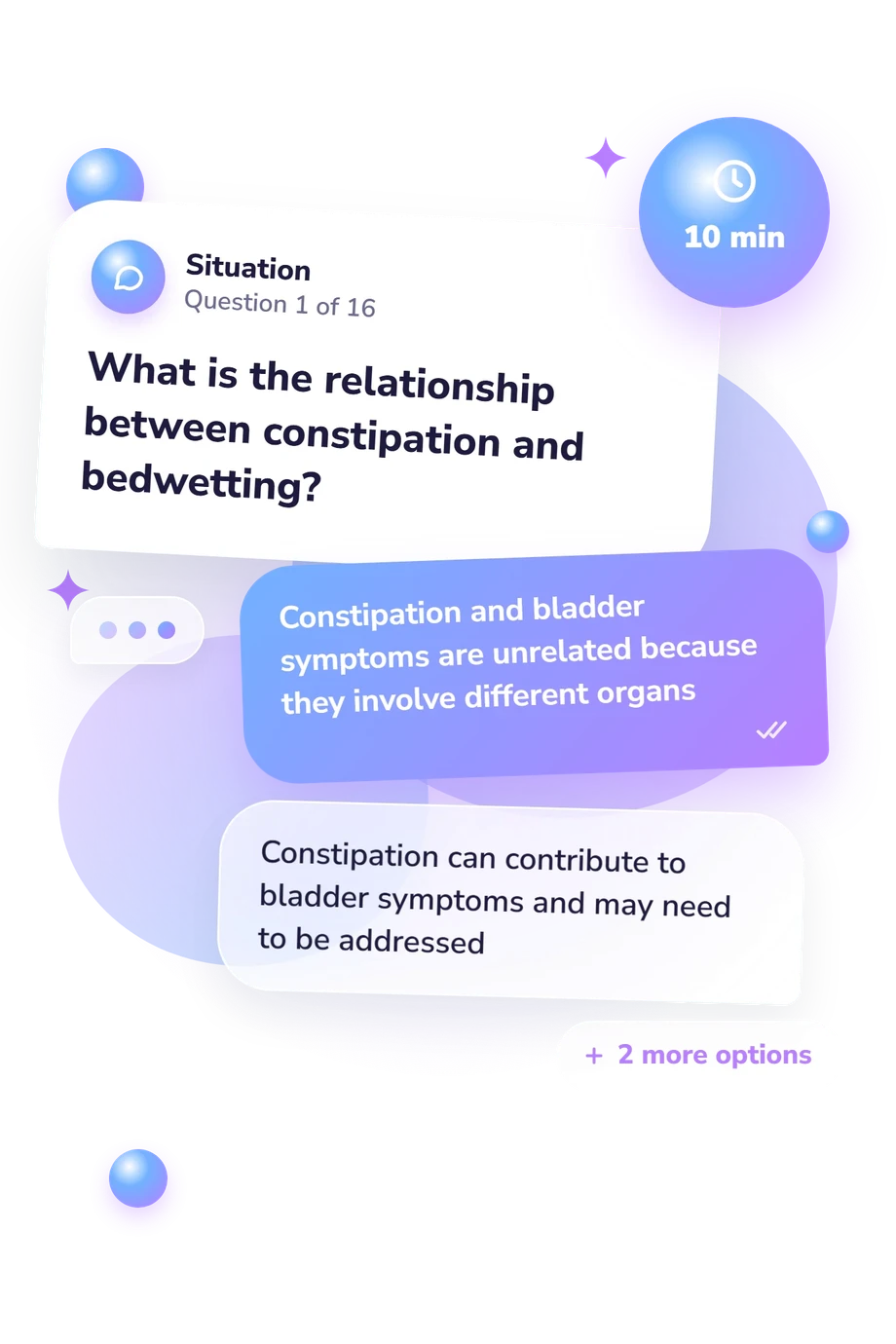
Example Questions From the Test
- Constipation and bladder symptoms are unrelated because they involve different organs
- Constipation can contribute to bladder symptoms and may need to be addressed
- Bedwetting generally causes constipation by interrupting sleep
- Treating constipation guarantees that every case of bedwetting will stop
- It is usually a deliberate attempt to gain attention
- It is caused solely by drinking after dinner
- It can involve several factors, including maturation, nighttime urine production, bladder function, and difficulty waking
- It always indicates an emotional disorder
- They normally develop at exactly the same time
- The order depends only on how strictly training is enforced
- Nighttime dryness must develop first for daytime training to work
- Nighttime dryness may develop later than reliable daytime control
Bedwetting Quiz - Description and methodology of the test
Parents, caregivers, and adults supporting a child can use this assessment to check whether their understanding of nighttime wetting matches supportive clinical guidance. The bedwetting quiz focuses on practical recognition rather than blame, helping readers notice what they know about causes, warning signs, communication, and management choices. As a bedwetting assessment, it can prepare a family to discuss a child’s pattern clearly with a healthcare professional.
What This Assessment Explores
Nighttime wetting is framed as involuntary urination during sleep when nighttime dryness would generally be expected. The questions also distinguish primary and secondary patterns, notice daytime urgency or accidents, and connect constipation, urine production, bladder function, maturation, and waking ability without assigning a case a single cause.
The result covers:
- Definitions and patterns, including how nocturnal enuresis differs from daytime leakage.
- Contributing factors, including constipation and coexisting bladder symptoms.
- Supportive responses that reduce shame and protect privacy.
- Management choices involving alarms, desmopressin, fluid routines, and warning signs.
Readers can use this knowledge result to interpret these distinctions without treating it as a symptom score. On the Bedwetting Knowledge scale, 0-6 is Foundations to build, 7-12 is Developing knowledge, and 13-16 is Strong knowledge. This score describes quiz knowledge, not a cause or treatment plan.
Methodology and Evidence Base
Each item uses a multiple-choice format with several answer options, asking the reader to identify the response that best matches established enuresis guidance. The topics move from definitions and causes to assessment clues, supportive communication, alarms, desmopressin, fluid habits, and situations that warrant prompt medical attention. Scoring functions as a knowledge summary: the questionnaire places performance into the displayed knowledge bands rather than estimating symptom severity.
Its clinical vocabulary follows the ICCS enuresis standardization document (Nevéus et al., 2020), and its practical emphasis is consistent with Vande Walle et al. (2012). These publications provide terminology and management principles; the online questionnaire is conceptually consistent with them, not an adaptation or validation of either source.
Used as an enuresis knowledge quiz, this format can reveal gaps before a healthcare discussion, while results may vary with attention, reading comprehension, self-awareness, and current circumstances. The displayed score is unvalidated, so it cannot diagnose a cause or determine treatment; instead, it helps readers recognize knowledge gaps and warning signs identified in the quiz, including new wetting after sustained dryness, daytime urinary symptoms, pain, fever, or a child who seems unwell.
- Tryggve Nevéus, Eliane Garcez da Fonseca, Israel Franco, Akihiro Kawauchi, Larisa Kovacevic, Anka Nieuwhof-Leppink, Ann Raes, Serdar Tekgül, Stephen Shei-Dei Yang, and Søren Rittig. Management and treatment of nocturnal enuresis-an updated standardization document from the International Children's Continence Society. Journal of Pediatric Urology. 2020;16(1):10-19. 10.1016/j.jpurol.2019.12.020
- Johan Vande Walle, Soren Rittig, Stuart Bauer, Paul Eggert, Daniela Marschall-Kehrel, and Serdar Tekgul. Practical consensus guidelines for the management of enuresis. European Journal of Pediatrics. 2012;171(6):971-983. 10.1007/s00431-012-1687-7
Updated: