
Anatomical Landmarks Quiz
How the Scales are Structured
Who Usually Takes This Test?
See How You Compare
Below is a preview of how scores are typically distributed across each scale.
Example Questions From the Test
- C7
- L4 or the L4-L5 interspace
- T4
- S2
- Pubic symphysis
- Umbilicus
- Xiphoid process
- Right anterior superior iliac spine
- Occipital bone
- Sphenoid bone
- Zygomatic bone
- Temporal bone
Anatomical Landmarks Quiz - Description and methodology of the test
Students, trainees, and curious readers who want to check their grasp of surface anatomy can use this anatomical landmarks quiz to connect named structures with locations used in examination and clinical description. As a surface anatomy quiz, it offers a focused snapshot of recall rather than a measure of practical palpation skill. The result places overall landmark knowledge in a band that can guide general review.
What This Assessment Explores
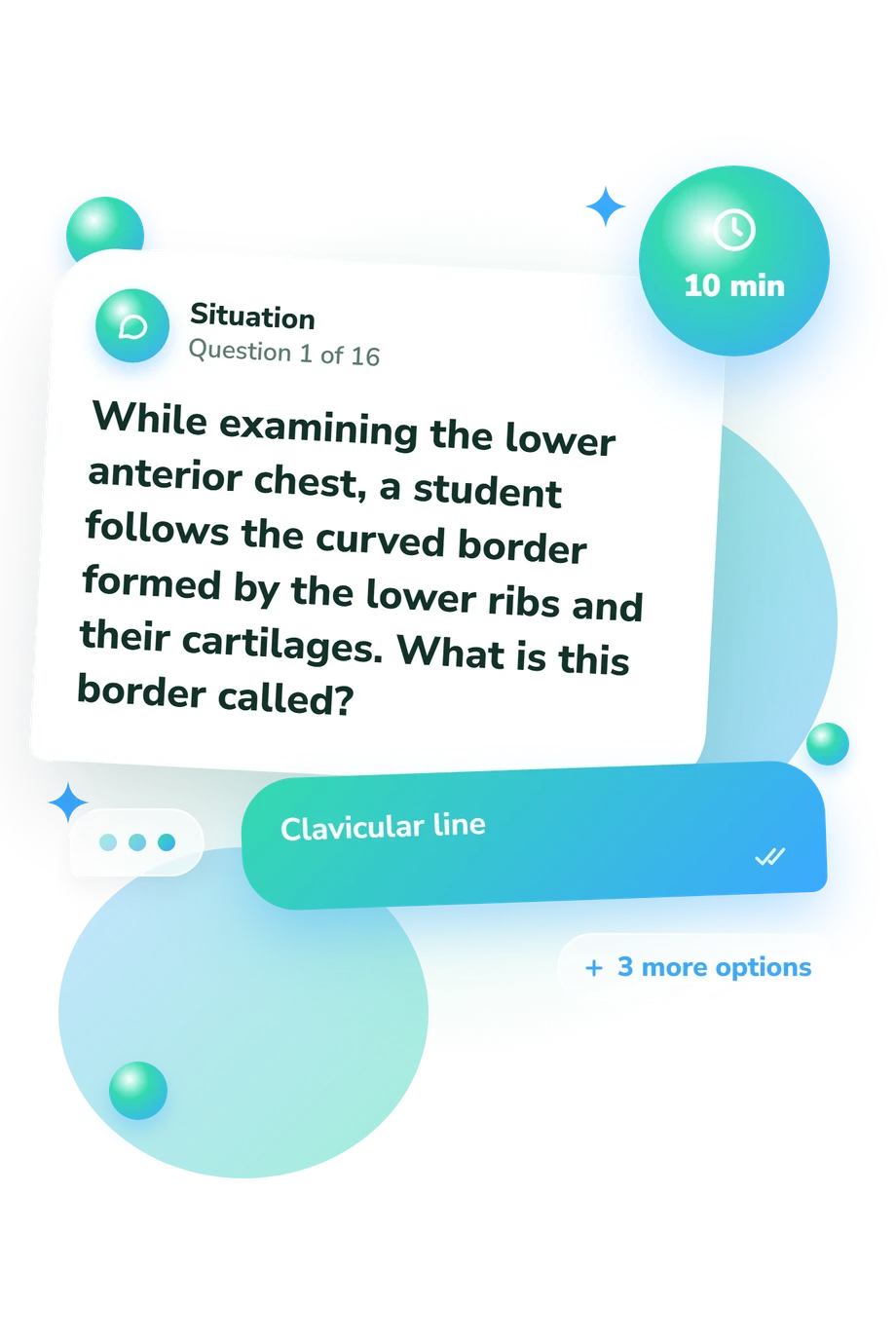
The questions examine anatomical orientation through palpable bones and projections, surface lines and points, named regions, and relationships used to locate deeper structures. Examples include the costal margin, vertebral levels, abdominal quadrants, bony prominences, pulse locations, and McBurney’s point. As a body landmarks quiz, this assessment tests spatial relationships as well as anatomical vocabulary.
The result is reported on the Anatomical Landmarks Knowledge scale (0-16), which reflects recognition of landmark names, regions, basic relationships, and applied locations. Its educational bands are:
- Foundations to reinforce (0-6) indicates that basic landmark knowledge needs review.
- Developing knowledge (7-12) shows recognition of many landmarks but room for more applied practice.
- Strong knowledge (13-16) indicates consistent command of major landmarks and spatial relationships.
Methodology and Scientific Basis
Each item presents a situation with four answer choices. The prompts identify borders, bones, regions, surface points, vertebral levels, and structures used to locate a pulse or vessel. This anatomical landmark test emphasizes recognition and applied spatial reasoning rather than extended explanation or image-based palpation.
The result places performance in one educational profile with the displayed learning bands. This item-based, multiple-choice method samples recall and location reasoning through short scenarios, then presents a learning indicator rather than a separate clinical index. The content is conceptually consistent with Dalley and Agur (2023), whose reference describes clinically important surface landmarks and regional relationships.
The questionnaire is not an adaptation of that reference or of the palpation studies by Kilby, Heneghan and Maybury (2012) and Cho and Reckelhoff (2019); those studies address the importance and difficulty of locating landmarks, not this score. The score is presented as an educational result with learning bands for interpreting current knowledge. Coursework, attention, and self-confidence can affect recall. It is not a clinical credential or medical assessment and should not be used to evaluate an injury or symptom; supervised practice is needed to judge palpation skill.
- Dalley AF II, Agur AMR. Moore's Clinically Oriented Anatomy. 9th ed. Philadelphia: Wolters Kluwer; 2023.
- Kilby J, Heneghan NR, Maybury M. Manual palpation of lumbo-pelvic landmarks: a validity study. Manual Therapy. 2012;17(3):259-262. 10.1016/j.math.2011.08.008.
- Cho JC, Reckelhoff K. The impact on anatomical landmark identification after an ultrasound-guided palpation intervention: a pilot study. Chiropractic & Manual Therapies. 2019;27:47. 10.1186/s12998-019-0269-4.
Updated: