
Am I Too Obsessed with My Boyfriend Quiz
How the Scales are Structured
Who Usually Takes This Test?
See How You Compare
Below is a preview of how scores are typically distributed across each scale.
Example Questions From the Test
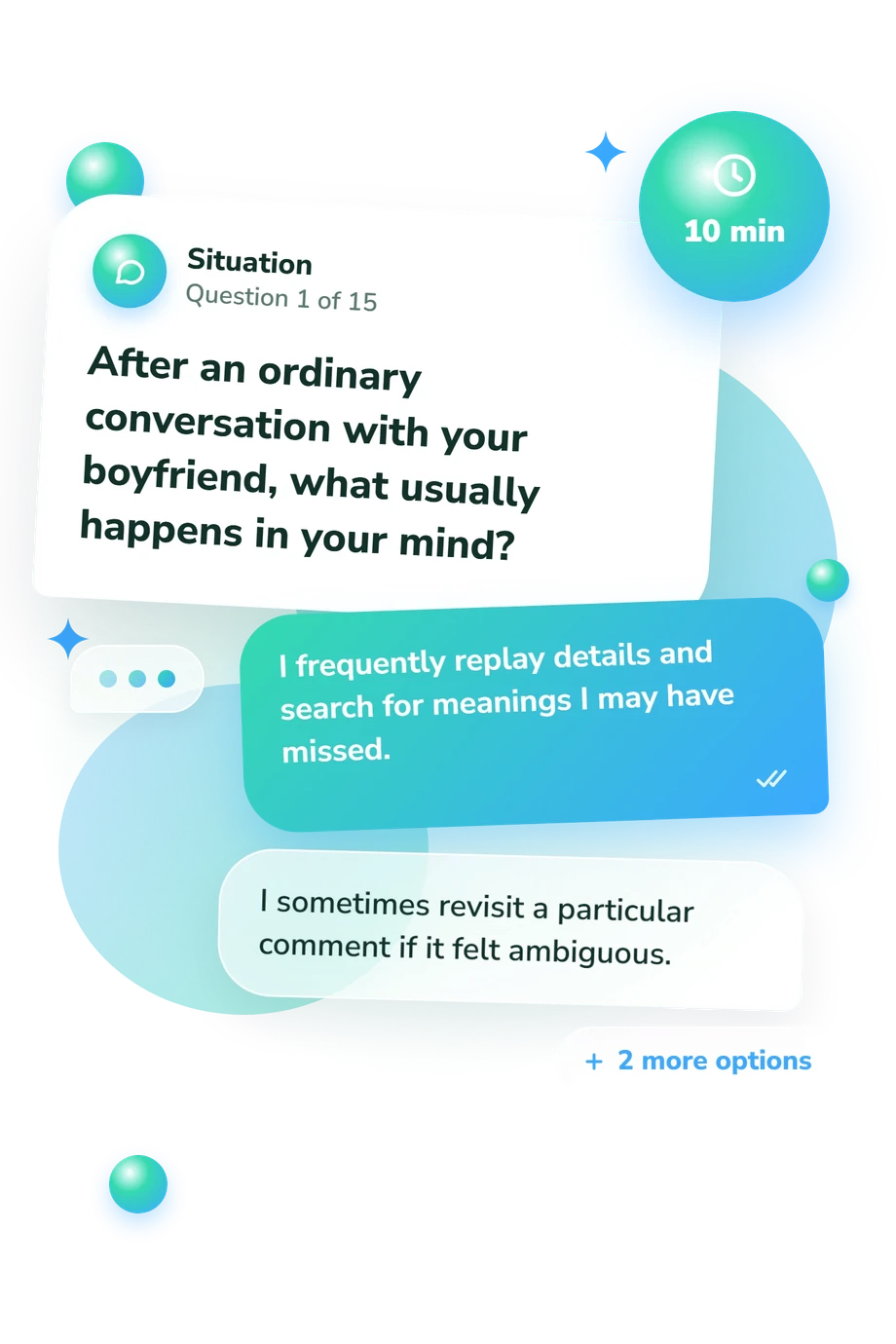
- I frequently replay details and search for meanings I may have missed.
- I sometimes revisit a particular comment if it felt ambiguous.
- I often replay parts of it and wonder whether his tone signaled something.
- I generally let the conversation pass unless there was a clear issue.
- I enjoy telling him, but I can also simply experience the moment or share it elsewhere.
- He is usually my first thought, though waiting to tell him feels easy.
- The moment can feel incomplete until I have shared it with him.
- I struggle to enjoy or process the moment if I cannot reach him promptly.
- I reflect on whether there is a specific issue, then raise it directly if needed.
- I ask for reassurance once and can usually accept his response.
- I ask in several ways because one answer does not settle the doubt for long.
- I repeatedly test, question, or provoke him to obtain convincing proof.
Am I Too Obsessed with My Boyfriend Quiz - Description and methodology of the test
People who notice that romantic attachment is affecting their choices, concentration, or sense of independence can use the Am I Too Obsessed with My Boyfriend Quiz to examine those patterns more clearly. It is intended for personal reflection when closeness feels difficult to regulate, especially around contact, privacy, separate plans, or uncertainty. A relationship obsession test result highlights tendencies worth examining rather than reducing the experience to one label.
What This Assessment Explores
Scenarios ask how you respond when contact is delayed, plans compete, privacy feels uncertain, or attention shifts from daily tasks. The focus is whether the relationship narrows choices, raises reassurance pressure, or dominates attention.
Its structure also makes the questionnaire a boyfriend obsession test that separates three patterns. The result uses these dimensions:
- Personal Balance (0-15) shows whether the relationship displaces independent plans, priorities, interests, and connections: Independent Footing (0-5), Relationship-Led Tradeoffs (6-10), or Narrowed Balance (11-15).
- Reassurance and Monitoring (0-15) reflects checking, repeated confirmation, or pressure around privacy: Room for Uncertainty (0-5), Reassurance Loop (6-10), or Boundary Pressure (11-15).
- Relationship Preoccupation (0-15) reflects how persistently thoughts about him affect attention and mood, not how genuine your love is: Flexible Focus (0-5), Strong Mental Pull (6-10), or Consuming Focus (11-15).
Together, these dimensions distinguish strong attachment from reduced flexibility around it.
Methodology and Scientific Basis
The items use first-person situations with four ordered response options, moving from flexible, boundary-respecting reactions toward self-sacrifice, repeated checking, pressure for access, or difficulty shifting attention. You select the description that best matches your usual pattern rather than an observed rating.
The displayed ranges organize the result, but the questionnaire does not state a per-answer weighting rule, so point values should not be inferred from the ranges alone.
The evidence is conceptual, not a claim that this online questionnaire reproduces or adapts a published scale. Its closest named reference is Love Addiction Inventory (Costa et al., 2021), a relevant framework for excessive relational preoccupation. Davis, Shaver, and Vernon (2003) situate emotional and behavioral reactions around separation, while Shaver, Schachner, and Mikulincer (2005) address excessive reassurance seeking within attachment-related relationship processes.
Interpretation remains limited because this online obsessive relationship patterns assessment has no stated population norms, clinical cutoffs, or demonstrated validation for this exact version. Scores may shift with conflict, time apart, mood, memory, and candor. Read them as prompts for noticing patterns and considering respectful changes in boundaries, independent activity, or communication, not as a diagnosis.
- Costa, S., Barberis, N., Griffiths, M. D., Benedetto, L., & Ingrassia, M. (2021). The Love Addiction Inventory: Preliminary Findings of the Development Process and Psychometric Characteristics. International Journal of Mental Health and Addiction, 19, 651-668. 10.1007/s11469-019-00097-y
- Davis, D., Shaver, P. R., & Vernon, M. L. (2003). Physical, emotional, and behavioral reactions to breaking up: The roles of gender, age, emotional involvement, and attachment style. Personality and Social Psychology Bulletin, 29(7), 871-884. 10.1177/0146167203029007006
- Shaver, P. R., Schachner, D. A., & Mikulincer, M. (2005). Attachment Style, Excessive Reassurance Seeking, Relationship Processes, and Depression. Personality and Social Psychology Bulletin, 31(3), 343-359. 10.1177/0146167204271709
Updated: