
Am I Prude Quiz
How the Scales are Structured
Who Usually Takes This Test?
See How You Compare
Below is a preview of how scores are typically distributed across each scale.
Example Questions From the Test
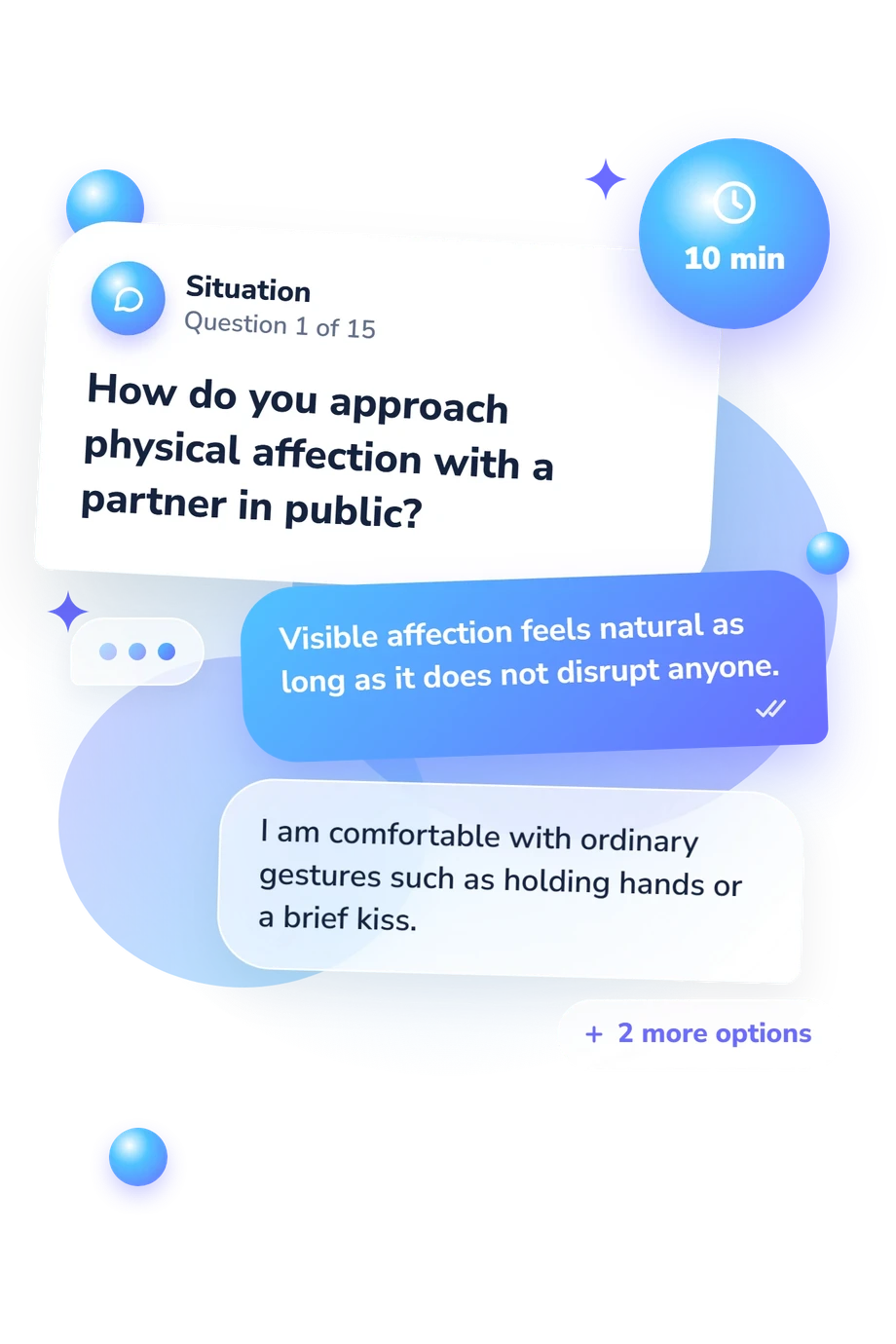
- Visible affection feels natural as long as it does not disrupt anyone.
- I am comfortable with ordinary gestures such as holding hands or a brief kiss.
- I prefer affection to be subtle and very brief in public.
- I prefer to keep nearly all physical affection private.
- I remain engaged because the subject itself does not bother me.
- I participate only in parts that feel relevant and comfortable.
- I become quieter and wait for a different topic.
- I move elsewhere or leave the conversation.
- It is not an important factor if I otherwise like the show.
- I am comfortable with it when it serves the characters or story.
- I would prefer less of it and might skip some scenes.
- I would choose a different show to avoid that content.
Am I Prude Quiz - Description and methodology of the test
For readers who want to examine how privacy, openness, and social expectations shape their reactions, the Am I Prude Quiz offers a focused self-reflection exercise. It suits people comparing their comfort with intimate topics across conversations, public affection, clothing, media, and dating norms. It identifies patterns across situations instead of assigning a single identity label.
What This Assessment Explores
At its core, the assessment examines responses when intimacy becomes visible, discussable, or socially judged. Scenarios in the questionnaire cover private conversations, public affection, changing spaces, clothing, sexual media, dating arrangements, and other adults’ consensual choices. The profile describes privacy preferences, comfort, and convention patterns, not correct or incorrect preferences.
The three displayed scales explain what each part of the profile represents:
- Intimate Conversation Comfort (0-15) measures openness around intimate topics: Open Style (0-5), Selective Style (6-10), or Private Style (11-15). It reflects boundaries, not maturity or knowledge.
- Personal Modesty Preferences (0-15) reflects preferred privacy, coverage, and restraint: Relaxed (0-5), Situational (6-10), or Strong (11-15); no band is better.
- Social Convention Preference (0-15) measures the influence of convention on public expression and consensual adult choices: Pluralistic Lens (0-5), Contextual Lens (6-10), or Traditional Lens (11-15).
Methodology and Scientific Basis
Each item presents a social situation with four ordered responses, moving from greater ease or openness toward more privacy, restraint, or discomfort. The options let you indicate how your reaction fits the trust, setting, and convention described in that situation. The four choices are phrased as distinct degrees of comfort, disclosure, privacy, or restraint rather than requiring a single label.
Responses form a three-part profile, with each dimension reported in its displayed range and band. Read each band as a description of the tendency represented by its scale; bands are not pass/fail categories or judgments of maturity. They should be read separately because they describe different aspects of the profile rather than combining into one general score.
The questionnaire is conceptually consistent with selected themes in MMCS1, especially comfort discussing sexuality. It has narrower thematic similarities to Fisher and Hall’s work on sexual attitudes and Snell and colleagues’ work on sexual self-disclosure; these relationships describe shared themes, not a claimed adaptation or validation.
Current context can also shape self-reported intimacy preferences. Relationships, privacy concerns, self-awareness, and social pressure may influence answers, so the profile is best read alongside the specific situations that prompted them.
- Tromovitch, P. (2011). The Multidimensional Measure of Comfort with Sexuality (MMCS1). In T. D. Fisher, C. M. Davis, W. L. Yarber, & S. L. Davis (Eds.), Handbook of Sexuality-Related Measures (3rd ed., pp. 34-39). Routledge.
- Fisher, T. D., & Hall, R. G. (1988). A scale for the comparison of the sexual attitudes of adolescents and their parents. The Journal of Sex Research, 24(1), 90-100. 10.1080/00224498809551400
- Snell, W. E., Jr., Belk, S. S., Papini, D. R., & Clark, S. (1989). Development and validation of the Sexual Self-Disclosure Scale. Annals of Sex Research, 2(4), 307-334. 10.1007/BF00849749
Updated: