
Am I Pregnant Quiz
How the Scales are Structured
Who Usually Takes This Test?
See How You Compare
Below is a preview of how scores are typically distributed across each scale.
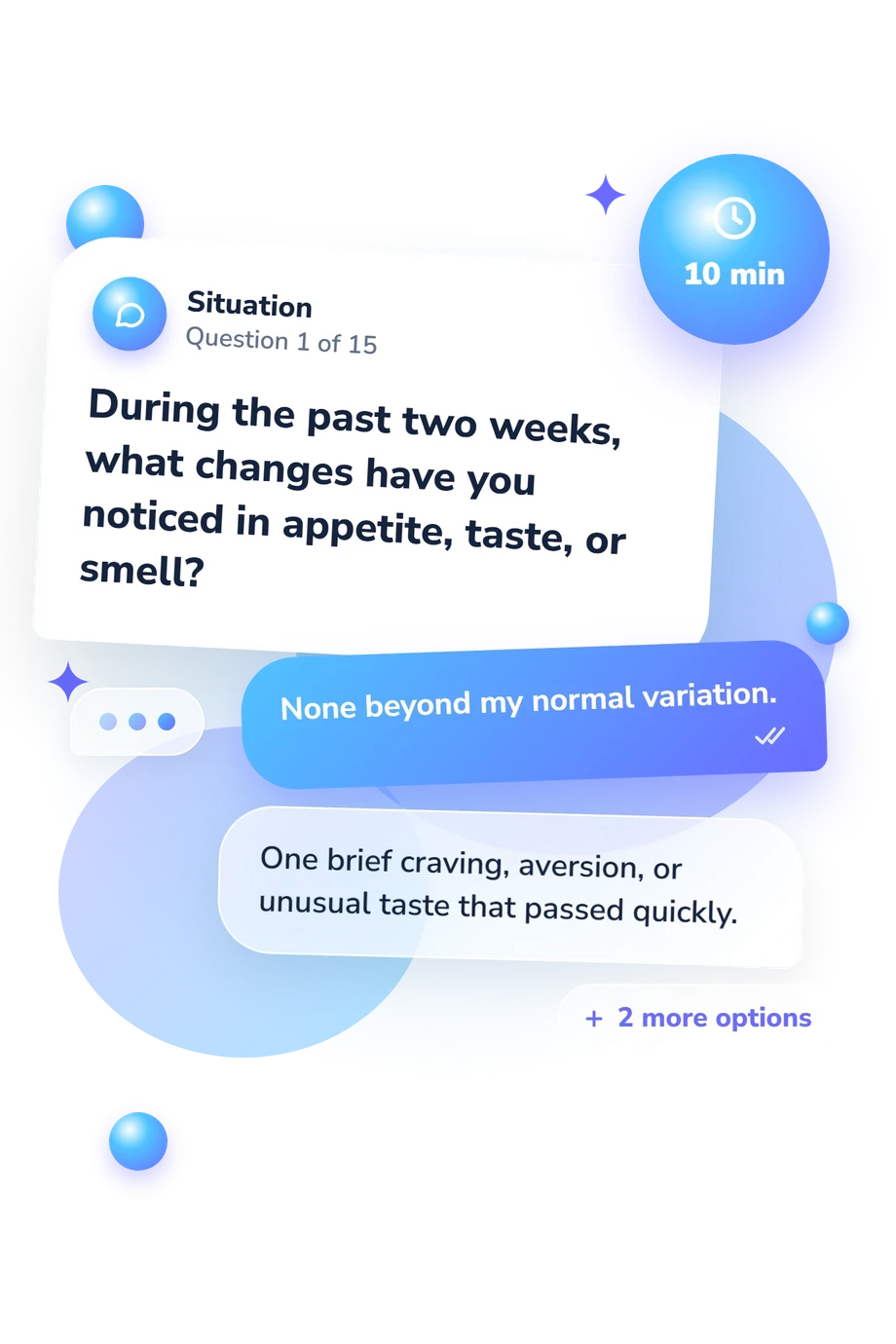
Example Questions From the Test
- None beyond my normal variation.
- One brief craving, aversion, or unusual taste that passed quickly.
- Repeated cravings, aversions, a metallic taste, or stronger-than-usual smells.
- Marked changes occur most days and regularly alter what I can eat or tolerate.
- There has been no noticeable change.
- I have occasionally gone sooner than usual.
- I am going more often on several days or waking at night more than usual.
- The increase is persistent and clearly disrupting sleep, travel, or daily activities.
- A clearly normal period occurred after that exposure, and there has been no possible exposure since.
- It appears to have happened well outside my likely fertile days, and my cycles are usually predictable.
- The timing is difficult to estimate because my cycles vary or I do not track them.
- It happened during the five days before, on, or shortly after my estimated ovulation day.
Am I Pregnant Quiz - Description and methodology of the test
People turn to the Am I Pregnant Quiz when a possible pregnancy must be considered alongside sexual exposure, cycle timing, a late period, physical changes, or a home-test result. It organizes those details for someone who wants a clearer next step. As a pregnancy quiz, it helps distinguish reasons to test from signals needing follow-up or urgent care.
What This Assessment Explores
The result is organized into three displayed dimensions:
- Conception Context (0-15) reads exposure, contraception, period timing, and test history. No scored indicator (0), Some possibility (1-2), and Testing warranted (3-15) frame when to test; they do not confirm or rule out pregnancy.
- Confirmation and Care Signals (0-15) covers positive or unclear tests, medication or condition concerns, substance questions, and warning signs. No scored care signal (0), Follow-up useful (1-2), and Act now (3-15) apply; red flags override totals.
- Pregnancy-Compatible Body Changes (0-15) summarizes appetite, smell, urination, fatigue, breast changes, nausea, and related symptoms. No scored changes (0-0), Limited changes (1-2), and Check and monitor (3-15) do not estimate pregnancy likelihood or severity.
The questions compare current changes with the respondent’s usual premenstrual pattern, making this a PMS vs pregnancy symptoms quiz without treating either pattern as proof.
Methodology and Evidence Base
This self-report presents ordered choices, moving from no change or exposure to marked symptoms, higher-risk timing, a positive test, or urgent concern. Topics cover contraception, cycle timing, symptoms, home tests, medicines, substances, hydration, and pain or bleeding.
The displayed result uses unvalidated reflective bands, not clinical cutoffs or a pregnancy-probability calculation, keeping this could-I-be-pregnant quiz focused on next steps. Read each label with individual answers: the bands organize testing and care but do not produce a percentage.
Exposure, cycle timing, and testing dates should be considered together when deciding whether you could be pregnant. The result organizes uncertainty around testing needs and care signals. A concerning answer matters regardless of the total: severe one-sided pain, heavy bleeding, shoulder pain, fainting, confusion, or inability to keep fluids down are red flags requiring urgent medical help.
The symptom questions are conceptually consistent with Sayle et al. (2002), while testing-timing guidance is consistent with Wilcox et al. (2001). Urgent warning signs align with ACOG Practice Bulletin No. 193.
The questionnaire is conceptually consistent with these sources, not an adaptation or validated reproduction; current context can affect self-report.
- Sayle AE, Wilcox AJ, Weinberg CR, Baird DD. A prospective study of the onset of symptoms of pregnancy. Journal of Clinical Epidemiology. 2002;55(7):676-680. 10.1016/S0895-4356(02)00402-X
- Wilcox AJ, Baird DD, Dunson D, McChesney R, Weinberg CR. Natural limits of pregnancy testing in relation to the expected menstrual period. JAMA. 2001;286(14):1759-1761. 10.1001/jama.286.14.1759
- American College of Obstetricians and Gynecologists' Committee on Practice Bulletins-Gynecology. ACOG Practice Bulletin No. 193: Tubal Ectopic Pregnancy. Obstetrics & Gynecology. 2018;131(3):e91-e103. 10.1097/AOG.0000000000002560
Updated: