
Abbreviation Quiz
How the Scales are Structured
Who Usually Takes This Test?
See How You Compare
Below is a preview of how scores are typically distributed across each scale.
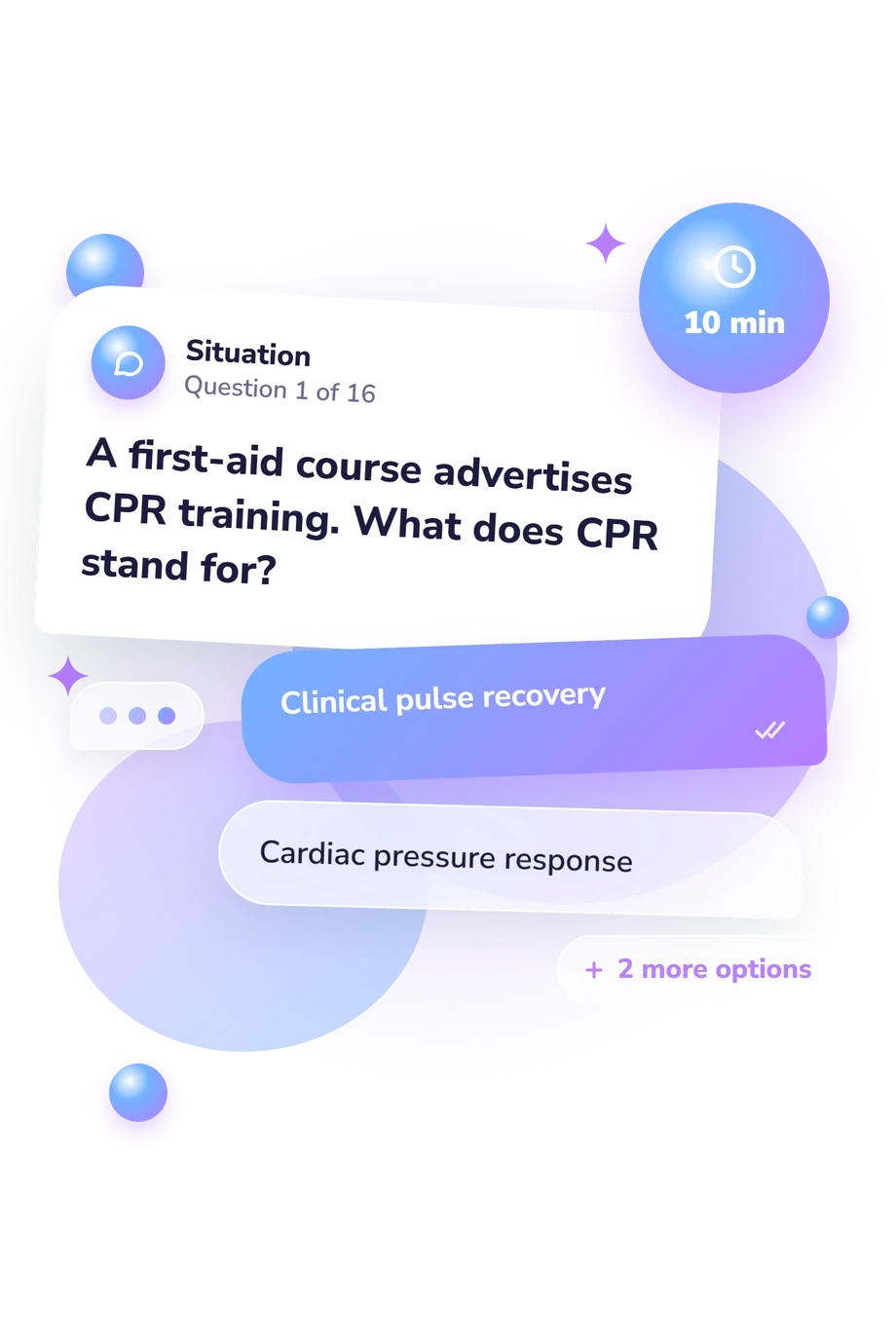
Example Questions From the Test
- Clinical pulse recovery
- Cardiac pressure response
- Circulatory patient rescue
- Cardiopulmonary resuscitation
- Printed data file
- Portable Document Format
- Portable download folder
- Public document format
- Estimated time of arrival
- Expected tracking activity
- Estimated transit allowance
- Electronic transport authorization
Abbreviation Quiz - Description and methodology of the test
People who regularly encounter shortened terms in messages, forms, work instructions, and websites can use this practical abbreviation test to check everyday comprehension. This abbreviation quiz shows how accurately you connect common letter combinations with their meanings in context. The result can help learners, employees, and independent users spot areas where unfamiliar shorthand may slow reading or communication.
What This Assessment Measures
These items measure recognition and interpretation of shortened terms in practical settings, making the questionnaire an abbreviation skills test rather than a task of inventing new forms. Prompts use contexts such as first aid, email, delivery, recipes, office directories, websites, payments, and forms, showing whether the respondent can select meaning from context.
The single scale is Abbreviation Knowledge (0-16), with these result bands:
- Foundational (0-6) indicates familiarity with some common forms but a need to review everyday shorthand.
- Developing (7-12) indicates solid knowledge of many familiar terms, with occasional uncertainty in less familiar contexts.
- Strong (13-16) indicates accurate interpretation across a wide range of practical situations.
This single-score result suits learners, employees, and independent readers who want targeted self-reflection. It describes performance on these kinds of abbreviations, not overall reading ability.
Methodology and Evidence Base
Each item presents a real-world prompt with four answer choices. The contexts include health, documents, timing, writing conventions, work roles, invitations, email, websites, payments, and registration, so the respondent must choose the meaning that fits the abbreviation in context.
The questionnaire functions as a direct answer-key score: each correct response contributes one point, and the total receives a descriptive band. The displayed result assigns the raw total to a descriptive band and provides no percentile interpretation. This keeps the outcome focused on how many of the tested, everyday terms the respondent identified correctly.
Relevant research on written shorthand includes McCrobie (1986), who examined acronym use in written text, and Kreiner and Davis (2011), who reported an association between knowledge of text-message abbreviations and spelling ability. These studies provide construct context rather than validation of this online abbreviation knowledge test, which is not an adaptation of either study. English-language exposure, workplace familiarity, education, and current context can affect performance, so a lower result may reflect unfamiliar examples rather than broad language difficulty.
- McCrobie, Daniel. (1986). An analysis of Acronyms in Written Text. Proceedings of the Human Factors Society Annual Meeting, 30(9), 936-940. 10.1177/154193128603000920
- Kreiner, David S., and Danielle L. Davis. (2011). Knowledge of text message abbreviations as a predictor of spelling ability. Perceptual and Motor Skills, 112(1), 295-309. 10.2466/13.28.PMS.112.1.295-309
Updated: