
9th Grade Math Quiz
How the Scales are Structured
Who Usually Takes This Test?
See How You Compare
Below is a preview of how scores are typically distributed across each scale.
Example Questions From the Test
- 2 units by 20 units
- 4 units by 10 units
- 6 units by 7 units
- 5 units by 8 units
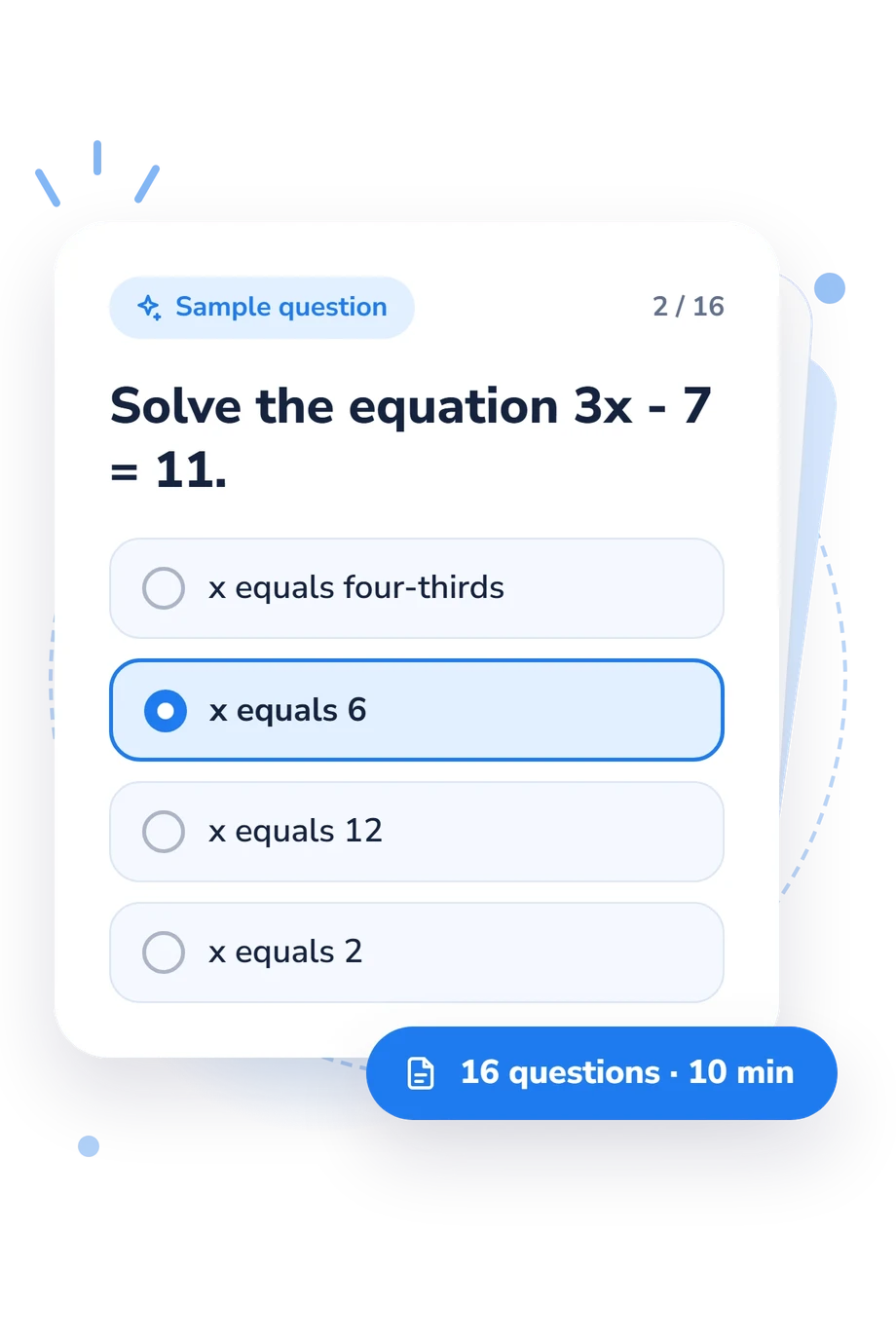
- x equals four-thirds
- x equals 6
- x equals 12
- x equals 2
- Positive 11
- Negative 5
- Negative 1
- Positive 5
9th Grade Math Quiz - Description and methodology of the test
Students, parents, and teachers who want a quick picture of sampled secondary-school mathematics can use this assessment to check readiness across several Grade 9 topics. The 9th grade math quiz turns classroom-style problems into a practical snapshot. Its result gives one overall score based on correct answers across the sample. This math quiz for grade 9 gives learners a concrete starting point for planning practice.
What This Assessment Explores
This assessment suits learners, families, or educators seeking a broad snapshot of representative Grade 9 mathematics. It samples symbolic manipulation, quantitative reasoning, spatial relationships, chance, and data interpretation rather than one isolated skill.
The questions provide thematic coverage across several areas:
- Algebra and functions cover equations, factors, expressions, and graphs.
- Geometry and quantitative reasoning address area, triangles, slope, angles, discounts, and sequences.
- Probability and data reasoning involve selection chances, medians, and ordered information.
Learners planning Grade 9 math practice can treat these themes as sampled material, not separate domains. The catalogue reports one scale: 9th Grade Math Knowledge (0-16), equal to the number correct. Foundations to Revisit (0-6) calls for review; Developing Knowledge (7-12) reflects many central ideas; Strong Knowledge (13-16) indicates strong command of the sample. Reviewing individual questions can guide practice, while the result remains one overall score.
Methodology and Evidence Base
Each problem is presented as a multiple-choice item with four answer options. The respondent selects the option that best solves or interprets it, and the total equals the number answered correctly. With this maths quiz for class 9, learners gain more by reviewing missed reasoning than by treating the score as a fixed label.
The content is conceptually aligned with the 2010 Common Core mathematics framework, especially its algebra, functions, geometry, probability, statistics, and modeling domains. It also fits the proficiency perspective in Adding It Up, linking procedural fluency with conceptual understanding, strategic competence, adaptive reasoning, and productive disposition. These sources define the framework; they do not make this online questionnaire an official standards assessment or an adaptation of either publication.
Interpret the result as a focused snapshot of performance on selected questions. It can guide targeted practice in equation setup, diagram reasoning, or probability steps. The questionnaire produces a raw number-correct total with catalogue bands, not a norm-referenced estimate; preparation, familiarity, care, and calculation slips can influence performance.
- National Governors Association Center for Best Practices & Council of Chief State School Officers. (2010). Common Core State Standards for Mathematics. Washington, DC: Authors.
- National Research Council. (2001). Adding It Up: Helping Children Learn Mathematics. Jeremy Kilpatrick, Jane Swafford, and Bradford Findell (Eds.). Washington, DC: National Academy Press. 10.17226/9822.
Updated: