
206 Bones of the Body Quiz
How the Scales are Structured
Who Usually Takes This Test?
See How You Compare
Below is a preview of how scores are typically distributed across each scale.
Example Questions From the Test
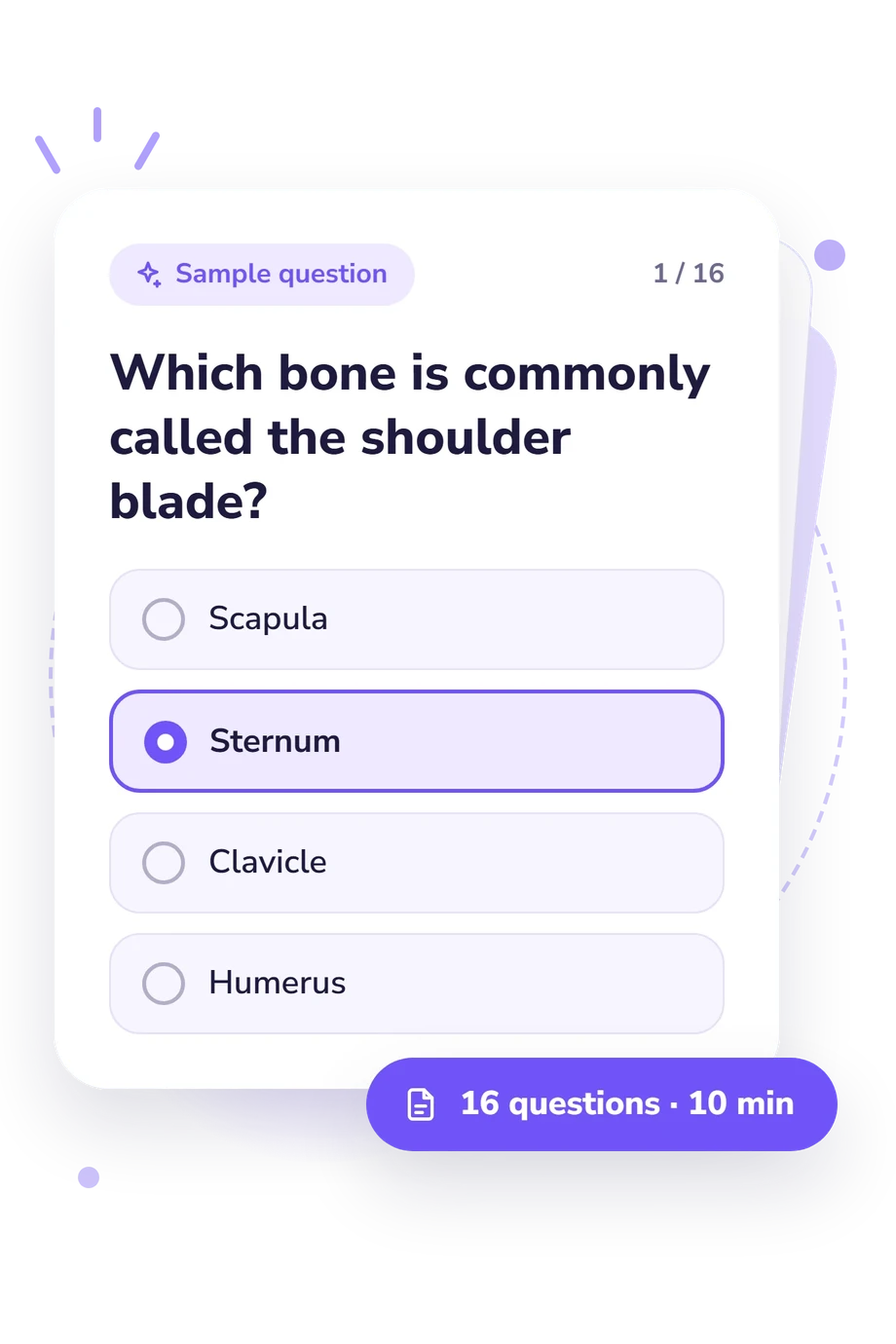
- Scapula
- Sternum
- Clavicle
- Humerus
- Two instead of three
- Three instead of two
- Four instead of three
- One instead of two
- Tibia
- Fibula
- Femur
- Calcaneus
206 Bones of the Body Quiz - Description and methodology of the test
Students and curious adults can use the 206 Bones of the Body Quiz to check how well they recognize skeletal structures and relationships. Presented as an all 206 bones quiz about the adult skeleton and its conventional 206-bone count, the assessment suits anyone revising anatomy through practical recall rather than isolated names. The result offers a starting point for reviewing the skeleton and identifying topics where study may be useful.
What This Assessment Explores
These questions test recognition of named bones, their locations, neighboring structures, and basic anatomical relationships in short positional or clinical scenarios. The content suits students, beginners, and anyone revising human anatomy. The result reflects factual and applied knowledge rather than examination skill, making the 206 bones quiz useful for focused anatomy revision.
The result is useful for deciding whether to revisit regional anatomy, terminology, or relationships among bones before moving to more advanced study.
The displayed scale, 206 Bones of the Body Knowledge (0-16), uses three result bands:
- Foundation (0-6) indicates recognition of some major bones and points to review of skeletal regions and relationships.
- Developing (7-12) indicates useful working knowledge, with less familiar structures and comparisons still needing practice.
- Strong (13-16) indicates broad, accurate knowledge of the typical adult skeleton in common anatomy scenarios.
Methodology and Evidence Base
Each item uses a single-best-answer format with four options. The prompts move between everyday names and formal anatomical terms, positional distinctions, bone groupings, counts, and short applied situations such as fractures or clinical references. This arrangement tests recognition and basic transfer of knowledge rather than extended written explanation.
The 206 bones in the body quiz reports one overall 0-16 knowledge score rather than separate trait profiles. It describes performance on the sampled anatomy content, not independent dimensions or complete anatomical competence.
Content is conceptually consistent with Neumann and Gest (2020), who discuss the conventional adult count and how definitions and development affect totals. Betts et al. (2022) and Drake, Vogl, and Mitchell (2020) support the regional terminology, axial-appendicular organization, and bone descriptions used in the questions. The cited anatomy texts provide context but do not validate this online questionnaire.
Performance may also reflect prior coursework, memory, terminology familiarity, and current concentration. A single knowledge score cannot capture hands-on identification or complete anatomical competence, so the result works best as a focused revision guide.
- Neumann, Paul E., and Thomas R. Gest. 2020. "How many bones? Every bone in my body." Clinical Anatomy 33(2): 187-191. 10.1002/ca.23425.
- Betts, J. Gordon, Kelly A. Young, James A. Wise, Eddie Johnson, Brandon Poe, Dean H. Kruse, Oksana Korol, Jody E. Johnson, Mark Womble, and Peter DeSaix. 2022. Anatomy and Physiology 2e. Houston, TX: OpenStax, Chapter 7, The Skeletal System.
- Drake, Richard L., A. Wayne Vogl, and Adam W. M. Mitchell. 2020. Gray's Anatomy for Students. 4th ed. Philadelphia, PA: Elsevier.
Updated: