
Yaoi Quiz
How the Scales are Structured
Who Usually Takes This Test?
See How You Compare
Below is a preview of how scores are typically distributed across each scale.
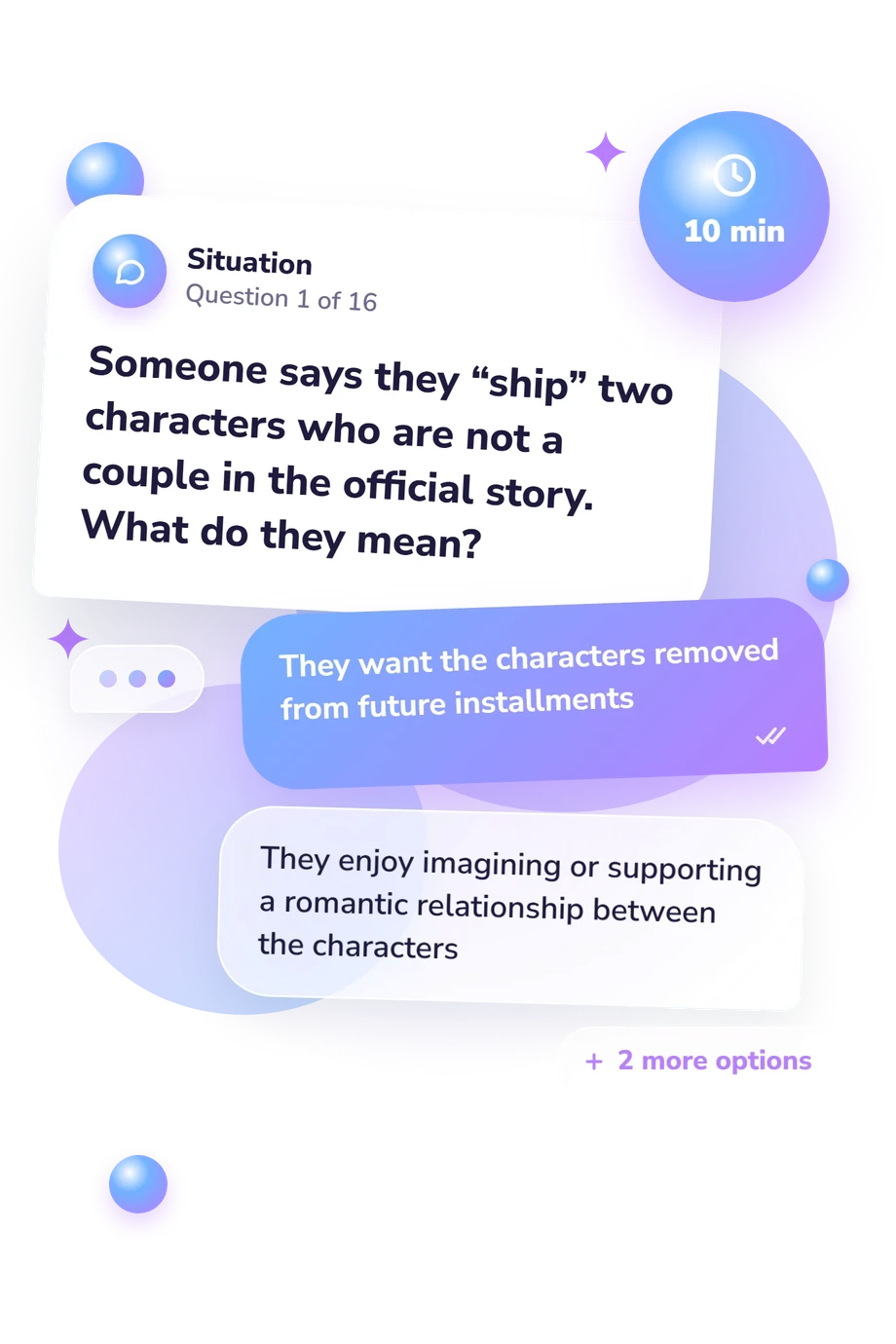
Example Questions From the Test
- They want the characters removed from future installments
- They enjoy imagining or supporting a romantic relationship between the characters
- They have purchased international distribution rights for the story
- They believe the characters must be related by family
- Fanon
- Canon
- Localization
- Serialization
- A publisher-approved digital edition released simultaneously worldwide
- A fan-produced scan and translation, often distributed without official authorization
- A creator’s preliminary scan submitted to an editor
- A visual technique for converting manga into animation
Yaoi Quiz - Description and methodology of the test
Readers who want to check their grasp of BL culture can use this yaoi quiz to assess how accurately they handle common terms and interpretive distinctions. It works as a BL knowledge quiz, evaluating demonstrated understanding rather than identity, orientation, or personal taste. The result offers a single judgment of quiz knowledge rather than a personality profile.
What This Assessment Explores
Questions move beyond vocabulary recall. They ask readers to separate canon from fanon, recognize scanlation and dōjinshi, understand BL and yaoi usage, and consider how licensing, localization, publication demographics, and adaptation affect interpretation. It suits anyone seeking an informed grasp of this media and fan culture, making it a useful BL terminology quiz.
The questions cover these thematic areas:
- Terminology and fandom language show whether concepts such as shipping, canon, fanon, seme, uke, and yaoi’s origin are understood in context.
- Publication and access covers editions, ratings, licensing, and respectful ways to obtain works.
- Media literacy considers how tropes, translation, adaptation, and narrative framing shape meaning.
All question themes contribute to the single Yaoi Knowledge scale, scored from 0 to 16; its bands are Foundational 0-6, Developing 7-12, and Strong 13-16.
Methodology and Evidence Base
Each item uses a selected-response format with four answer choices. A prompt may test a term, a publishing situation, or an interpretive judgment, and the respondent chooses the most accurate option. The total is read as quiz performance on the knowledge scale, while the displayed bands describe levels of understanding.
Conceptually, the content aligns with Suzuki’s 2015 discussion of yaoi and BL terminology and classifications, helping explain distinctions among professional labels, fan usage, historical terms, and overlapping categories. Welker’s 2015 work provides historical context for shifts among shōnen’ai, yaoi, and Boys’ Love. Lee’s 2009 study supports the questions about scanlation, authorization, and copyright. The questionnaire is conceptually consistent with these discussions but is not an adaptation or validation of any one published instrument.
Because this is an online yaoi knowledge test, results can vary with memory, cultural familiarity, current attention, and willingness to interpret each scenario carefully. The score is a structured snapshot of quiz performance, reflecting responses to terminology, publishing contexts, and media interpretation; it can guide further reading about adaptations and ethical access to works.
- Suzuki, Kazuko. "What Can We Learn from Japanese Professional BL Writers?: A Sociological Analysis of Yaoi/BL Terminology and Classifications." In Boys Love Manga and Beyond: History, Culture, and Community in Japan, edited by Mark McLelland, Kazumi Nagaike, Katsuhiko Suganuma, and James Welker, 93-118. Jackson: University Press of Mississippi, 2015. 10.14325/mississippi/9781628461190.003.0005
- Welker, James. "A Brief History of Shōnen'ai, Yaoi, and Boys Love." In Boys Love Manga and Beyond: History, Culture, and Community in Japan, edited by Mark McLelland, Kazumi Nagaike, Katsuhiko Suganuma, and James Welker, 42-75. Jackson: University Press of Mississippi, 2015. 10.14325/mississippi/9781628461190.003.0003
- Lee, Hye-Kyung. "Between Fan Culture and Copyright Infringement: Manga Scanlation." Media, Culture & Society 31, no. 6 (2009): 1011-1022. 10.1177/0163443709344251
- Zsila, Ágnes, Dru Pagliassotti, Róbert Urbán, Gábor Orosz, Orsolya Király, and Zsolt Demetrovics. "Loving the Love of Boys: Motives for Consuming Yaoi Media." PLOS ONE 13, no. 6 (2018): e0198895. 10.1371/journal.pone.0198895
Updated: