
Which Tragic Greek Figure Are You Quiz
How the Scales are Structured
Who Usually Takes This Test?
See How You Compare
Below is a preview of how scores are typically distributed across each scale.
Example Questions From the Test
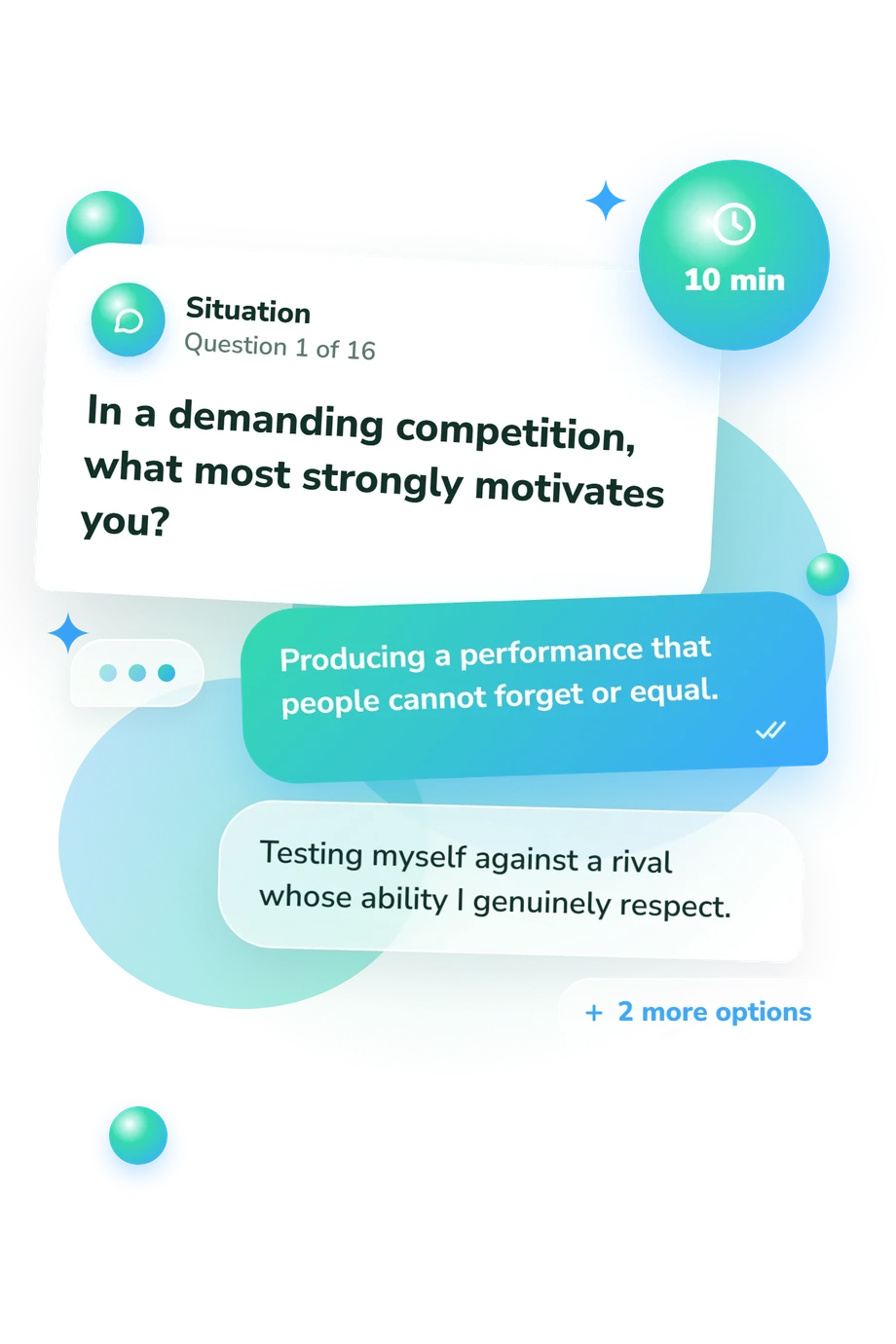
- Producing a performance that people cannot forget or equal.
- Testing myself against a rival whose ability I genuinely respect.
- Surpassing the standard I previously set for myself.
- Taking part in a meaningful experience with other competitors.
- Concentrate on what can still be improved rather than revisiting my personal role.
- Examine the shared circumstances so responsibility is placed in context.
- Make repairs while recognizing that I acted with limited knowledge.
- Hold myself to a severe standard and confront my responsibility without softening it.
- Interrupt the occasion and voice the warning immediately.
- Tell the organizer privately so that person can decide how to proceed.
- Verify the sign before risking unnecessary alarm.
- Stay observant and prepare to help if the concern becomes real.
Which Tragic Greek Figure Are You Quiz - Description and methodology of the test
Readers who enjoy classical literature and want to examine their own choices may find this tragic Greek figure quiz useful when considering a difficult decision or recurring reaction. The Which Tragic Greek Figure Are You Quiz can support self-observation by organizing those responses into a profile, helping curious readers avoid reducing a complex person to one permanent identity. It is especially suited to self-directed exploration.
What This Assessment Explores
Across its scenarios, the questionnaire examines recognition, rivalry, responsibility, family obligation, public crisis, ignored warnings, and unsettling discoveries. It maps choices made when values collide rather than testing classical knowledge.
The four patterns compare responses associated with four mythic or tragic figures, making this a quiz about mythic figures rather than a contest to name one winner. The dimensions are:
- Achilles (0-12) measures honor, distinction, attachment, and pride; Collective Contributor (0-4), Proud Competitor (5-8), Achilles Affinity (9-12).
- Antigone (0-12) measures conscience, family loyalty, and costly resistance; Contextual Loyalist (0-4), Conscience Advocate (5-8), Antigone Affinity (9-12).
- Cassandra (0-12) measures foresight, warning, and persistence when doubted; Present-Focused Observer (0-4), Evidence-Minded Sentinel (5-8), Cassandra Affinity (9-12).
- Oedipus (0-12) measures inquiry, responsibility, command, and self-judgment; Stability Keeper (0-4), Determined Inquirer (5-8), Oedipus Affinity (9-12).
The profile describes thematic resemblance, not a fixed identity.
Methodology and Evidence Base
Each item presents a dilemma with four response options, covering competition, responsibility, leadership, family duty, authority, warnings, recognition, grief, and discovery. The selected stance is compared across four dimensions, producing a separate profile rather than one winner.
Each scale receives a separate score within its displayed range, but the answer-to-point mapping is not stated, so an individual response’s contribution cannot be reconstructed. Results should be read through the named bands, which describe tendencies associated with each range rather than a single overall type.
Conceptually, the questionnaire offers a personality profile drawn from mythology consistent with Gill’s literary perspective linking personality in Greek literature to choices, relationships, conflict, and responsibility. Homeric epic supplies the honor-and-attachment reference point; Aeschylean tragedy supplies Cassandra’s warning under pressure; Sophoclean Theban drama supplies Antigone’s conscience-led resistance and Oedipus’s inquiry. The literary parallels identify thematic correspondences, not evidence that this online questionnaire itself has been standardized or validated.
Interpretation depends on honest self-report, current circumstances, and self-awareness. It is an interpretive reflection tool rather than a clinical diagnosis and cannot establish future behavior.
- Christopher Gill, Personality in Greek Epic, Tragedy, and Philosophy: The Self in Dialogue. Clarendon Press, 1996. 10.1093/oso/9780198146766.001.0001.
- Homer, The Iliad. Translated by Robert Fagles; introduction and notes by Bernard Knox. Penguin Classics, 1991.
- Aeschylus, The Oresteia. Translated by Robert Fagles; introduction, notes, and glossary by Robert Fagles and W. B. Stanford. Penguin Classics, 1984.
- Sophocles, The Three Theban Plays. Translated by Robert Fagles; introduction and notes by Bernard Knox. Penguin Classics, 1984.
Updated: