
What Kind of Toy Are You Quiz
How the Scales are Structured
Who Usually Takes This Test?
See How You Compare
Below is a preview of how scores are typically distributed across each scale.
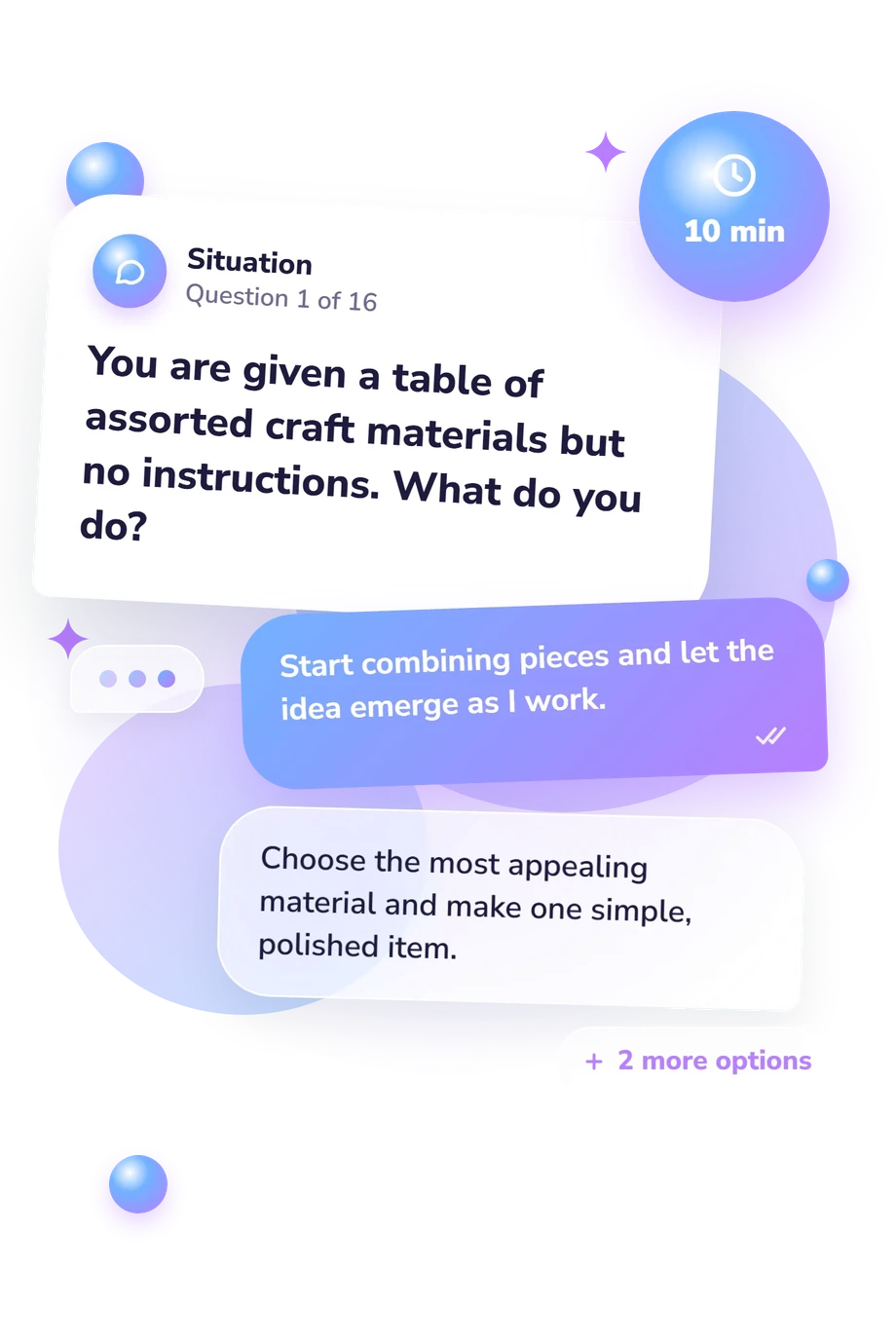
Example Questions From the Test
- Let them pass unless they change the emotional impact.
- Form a theory and reread earlier parts to test it.
- Imagine alternative scenes that could connect the details.
- Mention them to someone and compare first impressions.
- The explorer who moves the story forward through daring choices.
- The strategist who studies clues before revealing the plan.
- The inventive builder who creates tools and changes the setting.
- The trusted companion who gives the group a sense of home.
- Pick one main purpose and make the room feel complete around it.
- Create movable zones that can be recombined as needs change.
- Study how each activity flows and design one precise arrangement.
- Give the room a bold theme that makes using it feel exciting.
What Kind of Toy Are You Quiz - Description and methodology of the test
Readers wondering what toy they are most like can use this questionnaire in the what toy are you quiz format to reflect on choices in situations involving initiative, problem-solving, creativity, and care. It may suit anyone curious about how they respond when plans change, a group needs help, or an activity invites exploration. The What Kind of Toy Are You Quiz returns a leading affinity or close blend.
What This Assessment Explores
Toy imagery keeps the exercise approachable, while the situations connect preferences with acting, making, investigation, and companionship. The exercise answers the what toy am i quiz question by showing how responses fall along four continuums.
The four result dimensions are:
- Action Figure (0-12) spans reflection, comfort, or construction to momentum, bold choices, and hands-on adventure: Quiet Observer (0-4), Ready for a Quest (5-8), or Action Figure Affinity (9-12).
- Building Blocks (0-12) spans finished forms to combining, rebuilding, and making from simple parts: Finished-Form Fan (0-4), Flexible Maker (5-8), or Building Blocks Affinity (9-12).
- Puzzle (0-12) spans big-picture movement to patient investigation and precise connections: Big-Picture Mover (0-4), Curious Solver (5-8), or Puzzle Affinity (9-12).
- Teddy Bear (0-12) spans independent contribution to reassurance, loyalty, and quiet companionship: Independent Spirit (0-4), Cozy Streak (5-8), or Teddy Bear Affinity (9-12).
Methodology and Scientific Basis
Each prompt presents an everyday or imaginative situation with four response options. Choices contrast novelty, structure, challenge, social energy, and support; select what feels natural rather than objectively desirable. In a what type of toy are you quiz format, asking which toy best matches you produces a profile across four affinities rather than one result label.
Scores remain separate by dimension. The highest score represents the strongest affinity, and outcomes within one point are shown as a blended result. The displayed bands organize interpretation; they are not clinical cutoffs or a diagnosis.
Conceptually, the profile is consistent with the OLIW questionnaire (Proyer, 2017), which describes adult playfulness through other-directed, lighthearted, intellectual, and whimsical tendencies. This questionnaire is presented as its own four-scale profile, not as a direct adaptation or validation of OLIW. Davis and Boone’s 2021 Rasch analysis concerns the published OLIW instrument, so its psychometric findings cannot be transferred to these four toy scales or treated as evidence of their reliability, norms, or validity.
Self-reported answers can shift with mood, context, self-awareness, and response bias; the strongest affinity is a snapshot, not a fixed trait.
- Proyer, René T. (2017). A new structural model for the study of adult playfulness: Assessment and exploration of an understudied individual differences variable. Personality and Individual Differences, 108, 113-122. 10.1016/j.paid.2016.12.011
- Davis, Darrel R., and Boone, William J. (2021). Using Rasch analysis to evaluate the psychometric functioning of the other-directed, lighthearted, intellectual, and whimsical (OLIW) adult playfulness scale. International Journal of Educational Research Open, 2, 100054. 10.1016/j.ijedro.2021.100054
Updated: