
What Colour Suits My Horse Quiz
How the Scales are Structured
Who Usually Takes This Test?
See How You Compare
Below is a preview of how scores are typically distributed across each scale.
Example Questions From the Test
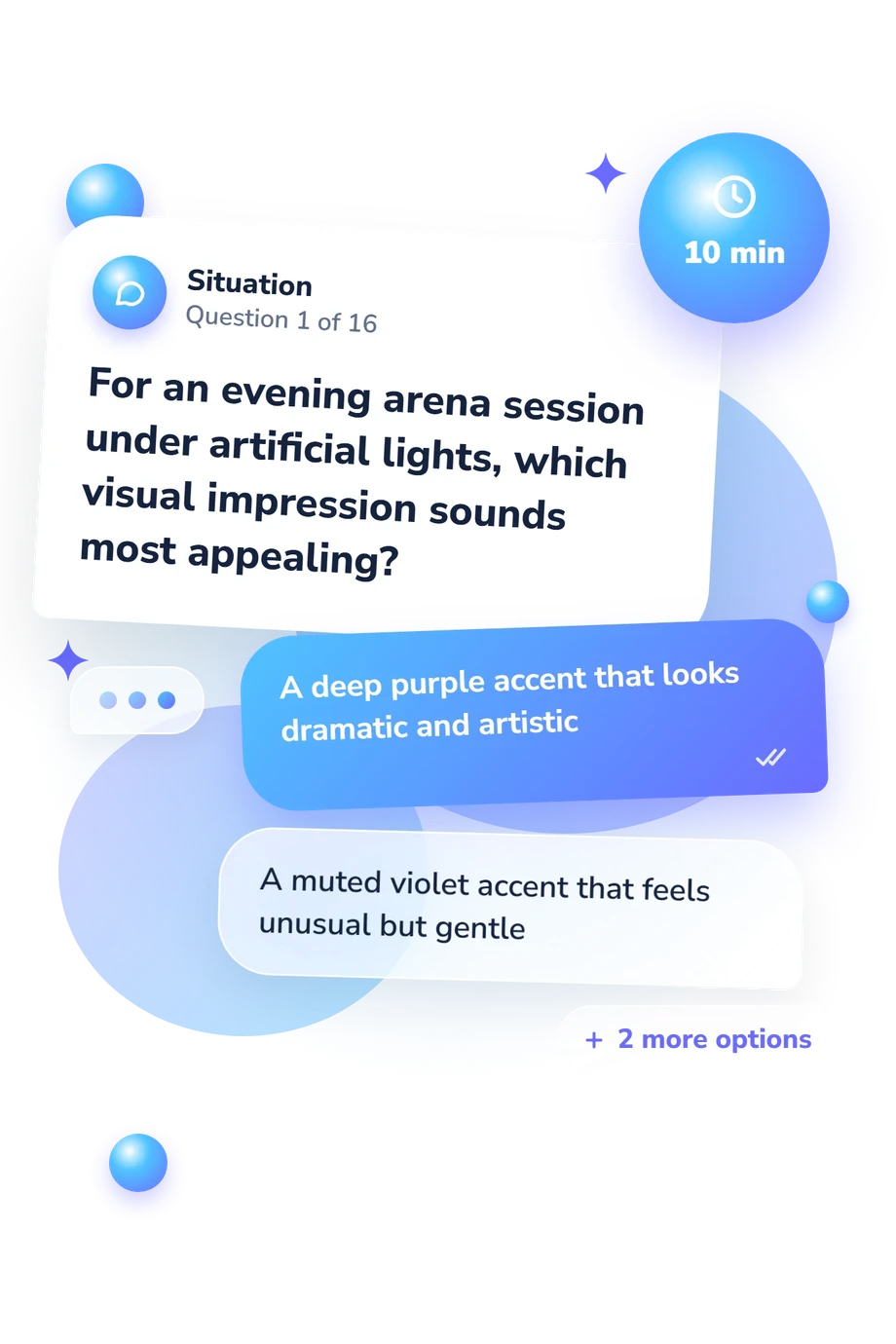
- A deep purple accent that looks dramatic and artistic
- A muted violet accent that feels unusual but gentle
- A wine-red accent that creates warm richness
- A navy accent that keeps the outfit crisp and conventional
- Polished and timeless, with navy as the anchor
- Fresh and sporty, led by brighter blue
- Dramatic and artistic, with a jewel-toned accent
- Rustic and sun-warmed, with natural colours
- Forest green for a grounded contrast with the black
- Pine green that is nearly as dark as the tack
- Navy for a more formal, cool-toned combination
- Burgundy for a warmer, dressier combination
What Colour Suits My Horse Quiz - Description and methodology of the test
Riders who want their horse’s equipment to feel coordinated can use the What Colour Suits My Horse Quiz to clarify a preferred visual direction rather than choose by trend alone. As a horse color quiz, it helps riders compare how navy, plum, forest green, and burgundy may express mood, formality, individuality, and connection with the setting.
What This Assessment Explores
The items place colour choices in riding contexts, from artificial light and woodland to muddy weather, leather, lessons, shows, and portraits. They examine whether your preferred turnout feels composed, creative, grounded, or warm.
The four result dimensions are:
- Classic Navy (0-12) reflects a polished, cool-toned direction: 0-4 Other Colours Lead; 5-8 Versatile Option; 9-12 Strong Navy Affinity.
- Expressive Plum (0-12) reflects creative jewel-tone appeal: 0-4 Subtle Accent Only; 5-8 Plum Possibility; 9-12 Strong Plum Affinity.
- Forest Green (0-12) reflects a grounded outdoor direction: 0-4 Another Palette Fits; 5-8 Green Potential; 9-12 Strong Forest Affinity.
- Rich Burgundy (0-12) reflects warm, sophisticated depth: 0-4 Different Direction; 5-8 Burgundy Possibility; 9-12 Strong Burgundy Affinity.
Together, these bands support a colour choice for your horse without ranking your horse or your taste.
Methodology and Scientific Basis
Each prompt offers four answer choices built around situations such as arena lighting, a trail ride, existing tack, or a special event. The four choices connect style preferences with colour in use, making horse tack colour choices useful for planning combinations.
The result presents a score for each colour direction and displays the bands for preference strength, without specifying how individual answers contribute. Read these results comparatively rather than as a formula. As a self-report questionnaire, it can reflect mood, familiarity, the horse’s coat, tack, or imagined setting, so use the profile to compare ideas rather than treat a band as a universal rule.
The questionnaire is conceptually consistent with Schloss et al. (2013) on colour preference and valued qualities in objects, and with Jonauskaite et al. (2016) on object context; it is not an adaptation of those studies and is not validated by them. Palmer and Schloss’s ecological valence framework also helps explain how associated experiences can shape preference.
Use the profile to compare ideas and guide practical trials with pads, bonnets, trim, or accents, choosing what works with your horse, tack, and setting.
- Schloss, Karen B., Eli D. Strauss, and Stephen E. Palmer. “Object color preferences.” Color Research & Application 38, no. 6 (2013): 393-411. 10.1002/col.21756
- Jonauskaite, Domicele, Christine Mohr, Jean-Philippe Antonietti, Peter M. Spiers, Betty Althaus, Selin Anil, and Nele Dael. “Most and Least Preferred Colours Differ According to Object Context: New Insights from an Unrestricted Colour Range.” PLOS ONE 11, no. 3 (2016): e0152194. 10.1371/journal.pone.0152194
- Palmer, Stephen E., and Karen B. Schloss. “An ecological valence theory of human color preference.” Proceedings of the National Academy of Sciences 107, no. 19 (2010): 8877-8882. 10.1073/pnas.0906172107
Updated: