
What Book Am I Quiz
How the Scales are Structured
Who Usually Takes This Test?
See How You Compare
Below is a preview of how scores are typically distributed across each scale.
Example Questions From the Test
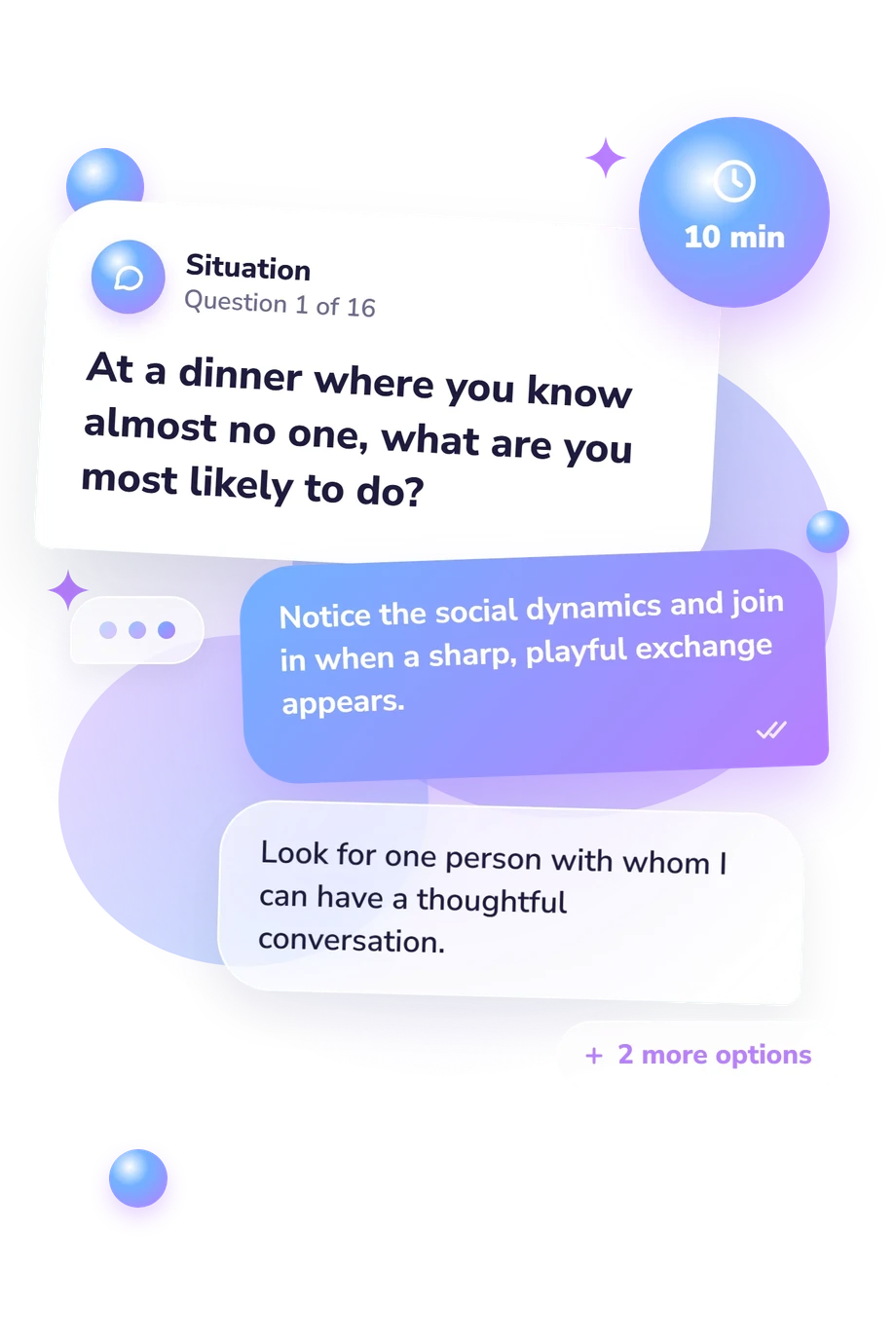
- Notice the social dynamics and join in when a sharp, playful exchange appears.
- Look for one person with whom I can have a thoughtful conversation.
- Help with practical details so I have a comfortable role in the gathering.
- Remain fairly quiet, enjoy the atmosphere, and leave before it gets late.
- Create warmth through a small tradition, shared activity, or imaginative distraction.
- Take care of an overlooked practical task that will ease the pressure.
- Give everyone space and check in once emotions have settled.
- Protect my own routine so the household mood does not absorb me.
- Moving immediately toward the next challenge before life becomes routine.
- Returning to ordinary comforts with a broader view of the world.
- Using the experience to gain greater recognition or influence.
- Building a new lifestyle that permanently leaves old routines behind.
What Book Am I Quiz - Description and methodology of the test
Readers who want to reflect on relationships, creative goals, social impressions, uncertainty, and adventure can use the What Book Am I Quiz as a playful set of everyday scenarios. Rather than testing literary knowledge, this book personality quiz invites choices about how you respond when plans change, dreams evolve, or other people need you. It suits curious readers seeking a literary lens on familiar decisions and ideals.
What This Assessment Explores
Everyday dilemmas explore belonging, creativity, judgment, reinvention, longing, courage, and care. The result maps each world's resonance with your choices; scores within one point form a blended match.
The quiz asks what book you are through four literary profiles:
- Little Women (0-12) reflects creative ambition, family devotion, practical care, and moral growth; Different household (0-4), Kindred spirit (5-8), Strong match (9-12).
- Pride and Prejudice (0-12) reflects social perception, wit, revised judgment, and equal partnership; Different chapter (0-4), Partial connection (5-8), Strong match (9-12).
- The Great Gatsby (0-12) reflects reinvention, spectacle, longing, social performance, and idealized dreams-not approval of its characters’ decisions; Different vision (0-4), Glimpse of the green light (5-8), Strong match (9-12).
- The Hobbit (0-12) reflects comfort, curiosity, loyalty, and courage under pressure; Different road (0-4), Reluctant traveler (5-8), Strong match (9-12).
Methodology and Evidence Base
Each item presents a situation and four response options. Choices concern likely reactions, not literary knowledge, so the method relies on self-observation. Answers produce four scores, interpreted through the displayed band; scores within one point may form a blended match.
The approach is conceptually consistent with the Literary Response Questionnaire (Miall and Kuiken, 1995), which examines subjective literary response rather than factual expertise; that connection does not establish this questionnaire as an adaptation. Keith Oatley’s work addresses emotional responses and identification in fiction, treating atmosphere, longing, attachment, and tension as narrative features. Hoeken, Kolthoff, and Sanders (2016) examine identification through story perspective and character similarity; Huang and Fung (2024) offer a framework for identification with narrative characters.
Together, these works are conceptual reference points; they do not establish standardized norms, validation, or scoring for these four profiles. As a self-report literary character quiz, results can reflect mood, self-presentation, and limited self-awareness. Read them as thematic resonance with selected literary worlds, not a diagnosis or fixed identity.
- David S. Miall and Don Kuiken (1995). Aspects of Literary Response: A New Questionnaire. Research in the Teaching of English, 29(1), 37-58. 10.58680/rte199515356
- Keith Oatley (1995). A Taxonomy of the Emotions of Literary Response and a Theory of Identification in Fictional Narrative. Poetics, 23(1-2), 53-74. 10.1016/0304-422X(94)P4296-S
- Hans Hoeken, Matthijs Kolthoff, and José Sanders (2016). Story Perspective and Character Similarity as Drivers of Identification and Narrative Persuasion. Human Communication Research, 42(2), 292-311. 10.1111/hcre.12076
- Kate Y. Huang and Helene H. Fung (2024). Measuring identification with narrative characters: the development and validation of a new scale. Current Psychology, 43, 24835-24849. 10.1007/s12144-024-06191-2
Updated: