
Signs of Autism in 2 Year Old Quiz
How the Scales are Structured
Who Usually Takes This Test?
See How You Compare
Below is a preview of how scores are typically distributed across each scale.
Example Questions From the Test
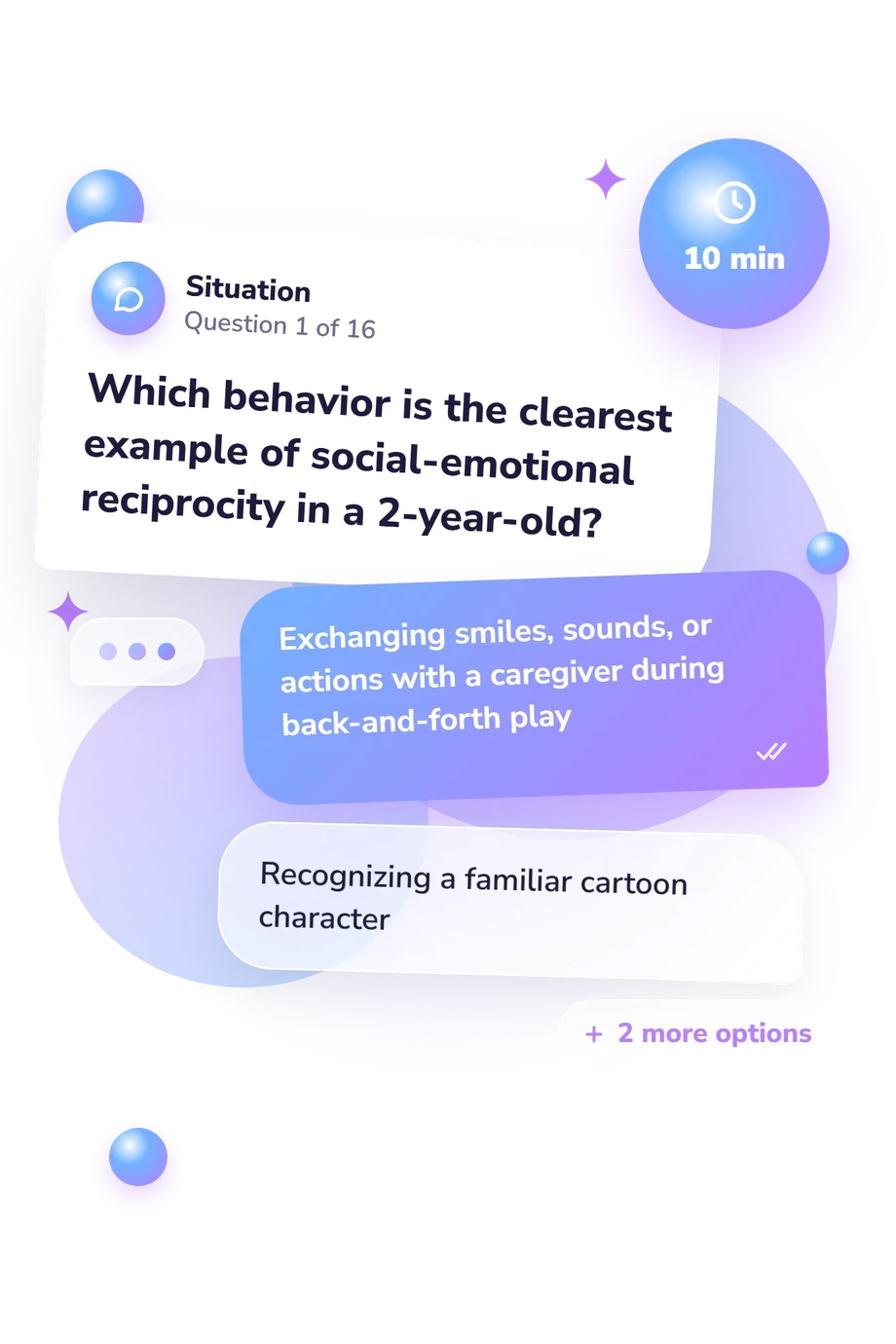
- Exchanging smiles, sounds, or actions with a caregiver during back-and-forth play
- Recognizing a familiar cartoon character
- Sitting near another child while each plays separately
- Stacking blocks alone for several minutes
- The child has received a formal autism diagnosis
- The child will necessarily need lifelong intensive support
- The result is meaningless unless every listed sign is present
- Follow-up questions or a professional evaluation may be appropriate
- Confirm autism without any additional assessment
- Identify children who may benefit from further evaluation
- Rule out autism whenever the score is below a cutoff
- Determine which treatment a child will need
Signs of Autism in 2 Year Old Quiz - Description and methodology of the test
Caregivers who want a structured way to review age-relevant autism information may find the Signs of Autism in 2 Year Old Quiz useful. It functions as an autism screening knowledge test, examining developmental patterns and what screening can and cannot show. The questions test whether a reader can distinguish general developmental information from conclusions about an individual child. The result reflects knowledge of signs and screening concepts, not a judgment about a particular child.
What This Assessment Explores
Rather than asking caregivers to rate a child, the items test whether a respondent can distinguish an isolated observation from a broader pattern. They cover reciprocity, joint attention, communication, repetitive behavior, sensory reactivity, regression, hearing, context, and follow-up. This helps adults organize early developmental concerns and understand toddler autism signs without treating one sign as decisive.
The main thematic areas are:
- Social communication shows how reciprocity, shared enjoyment, response to people, and joint attention are understood.
- Repetitive and sensory patterns cover repeated play, inflexibility, and unusually strong reactions.
- Screening decisions show why context, hearing, history, and professional follow-up matter.
The catalogue reports Signs of Autism in 2-Year-Olds Knowledge, 0-16: Foundations to build (0-6), Developing knowledge (7-12), and Strong knowledge (13-16). These unvalidated bands describe knowledge, not whether a child is autistic.
Methodology and Evidence Base
Each item presents a developmental scenario with four answer choices and asks for the best interpretation. The format rewards attention to patterns, frequency, intensity, context, and next steps rather than recognition of one autism sign. It also tests whether respondents can separate screening from diagnosis and understand why hearing, developmental history, and observations across settings may matter.
The framework is conceptually consistent with Zwaigenbaum et al. (2015), which emphasizes developmental surveillance, screening, and timely evaluation. Hyman et al. (2020) supports considering social communication, restricted or repetitive patterns, developmental history, and co-occurring explanations. Robins et al. (2014) offers a toddler screening example, but this questionnaire is not an adaptation of the M-CHAT-R/F and does not use its scoring or validation.
Since this is an online knowledge assessment, results can be affected by familiarity with developmental concepts, reading of scenarios, and guessing. The questionnaire has no direct observation, clinical history, or standardized norms. A high score indicates stronger knowledge of screening versus diagnosis and supports responsible interpretation of autism screening results; a lower score points to topics for review. Regression or developmental concern still warrants discussion with a pediatrician or developmental professional.
- Zwaigenbaum L, Bauman ML, Stone WL, et al. Early Identification of Autism Spectrum Disorder: Recommendations for Practice and Research. Pediatrics. 2015;136(Suppl 1):S10-S40. 10.1542/peds.2014-3667C
- Hyman SL, Levy SE, Myers SM; Council on Children with Disabilities, Section on Developmental and Behavioral Pediatrics. Identification, Evaluation, and Management of Children With Autism Spectrum Disorder. Pediatrics. 2020;145(1):e20193447. 10.1542/peds.2019-3447
- Robins DL, Casagrande K, Barton M, et al. Validation of the Modified Checklist for Autism in Toddlers, Revised With Follow-up (M-CHAT-R/F). Pediatrics. 2014;133(1):37-45. 10.1542/peds.2013-1813
Updated: