
Reading Level Quiz
How the Scales are Structured
Who Usually Takes This Test?
See How You Compare
Below is a preview of how scores are typically distributed across each scale.
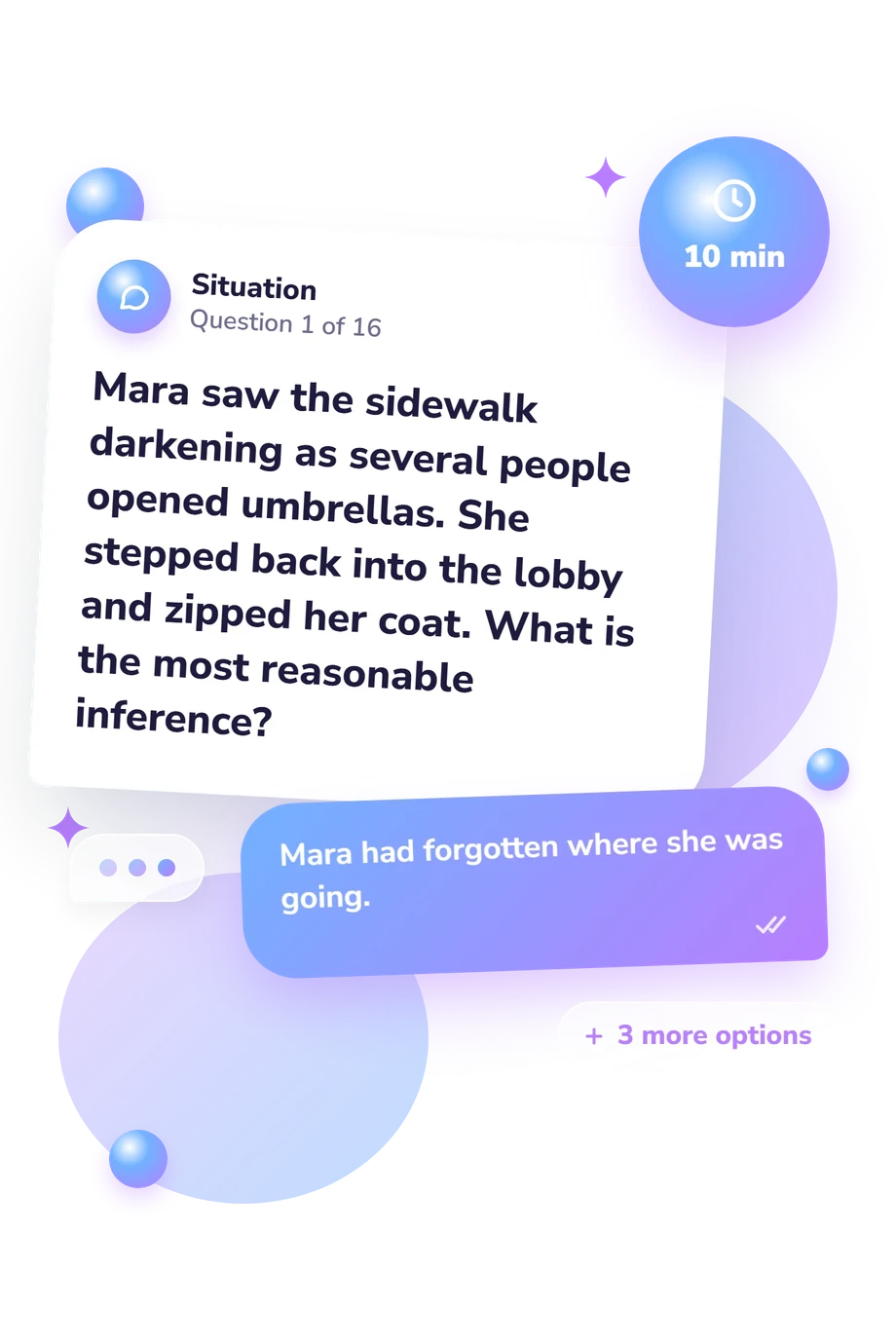
Example Questions From the Test
- Mara had forgotten where she was going.
- Rain had begun or was about to begin.
- The lobby was colder than the sidewalk.
- The building was closing for the day.
- The poetry reading takes place on Thursday and Friday.
- The reading begins after the café’s Friday closing time.
- The café closes at 8:00 p.m. every night.
- The café should still be open when the Friday reading begins.
- The museum opened its new west wing in May 2018.
- The west wing is the museum’s most beautiful space.
- The architect made an unwise design choice.
- Every visitor should spend at least two hours there.
Reading Level Quiz - Description and methodology of the test
Readers who want a focused snapshot of passage comprehension can use this reading level quiz to examine how they draw meaning from written information. A reading comprehension assessment can help people who study, read for work, or want to identify skills worth practising. It describes performance on these passages rather than assigning a school-grade placement.
What This Assessment Explores
Rather than measuring reading speed or establishing a school-grade reading level, the questionnaire examines how a reader builds meaning from short passages, notices relationships, and checks answers against stated evidence. Its situations include notices, policies, explanations, narratives, and informational texts, so the result reflects practical comprehension demands.
The test also highlights reading comprehension skills that support accurate interpretation. The question set samples these demands:
- Inference and evidence items show how you connect clues and combine statements.
- Main-idea, sequence, and purpose items show how you organize a passage’s message.
- Vocabulary, reference, tone, and fact-versus-opinion items show how you interpret language and stance.
Reading Level Knowledge (0-16) summarizes performance across the quiz. Its bands are Building Foundations (0-6), Developing Comprehension (7-12), and Strong Comprehension (13-16).
Methodology and Evidence Base
Each prompt presents a short passage or practical statement with four answer choices. The best-supported option may require locating information, integrating details, interpreting a word or pronoun, identifying purpose, or evaluating a conclusion. This makes the format a reading comprehension quiz focused on passage understanding, not words per minute.
The displayed result combines performance across the items into one score and describes performance within this 16-question quiz. No school-grade conversion or point-by-point weighting rule is stated, so the score is a summary of responses to these passage-based tasks, not as a converted grade level.
The item themes are conceptually consistent with ACE, the PISA 2018 reading framework, and the RAND reader-text-activity model, but this questionnaire is not identified as an adaptation of those sources. ACE uses passage-based questions; PISA 2018 emphasizes understanding, using, evaluating, and reflecting on texts; and RAND describes comprehension as an interaction among reader, text, and activity.
Interpretation can shift with topic familiarity, attention, vocabulary, and test-taking strategy. Honest, careful responses make the snapshot more useful, yet the score cannot explain a difficulty or represent every kind of reading.
- Severino, Lori, Mary Jean Tecce DeCarlo, Toni Sondergeld, Meltem Izzetoglu, and Alia Ammar. “A Validation Study of a Middle Grades Reading Comprehension Assessment.” RMLE Online 41, no. 10 (2018): 1-16. 10.1080/19404476.2018.1528200
- OECD. PISA 2018 Assessment and Analytical Framework. Paris: OECD Publishing, 2019. 10.1787/b25efab8-en
- RAND Reading Study Group. Reading for Understanding: Toward an R&D Program in Reading Comprehension. Santa Monica, CA: RAND Corporation, 2002. MR-1465-OERI. ISBN 0-8330-3105-8
Updated: