
Kidney Quiz
How the Scales are Structured
Who Usually Takes This Test?
See How You Compare
Below is a preview of how scores are typically distributed across each scale.
Example Questions From the Test
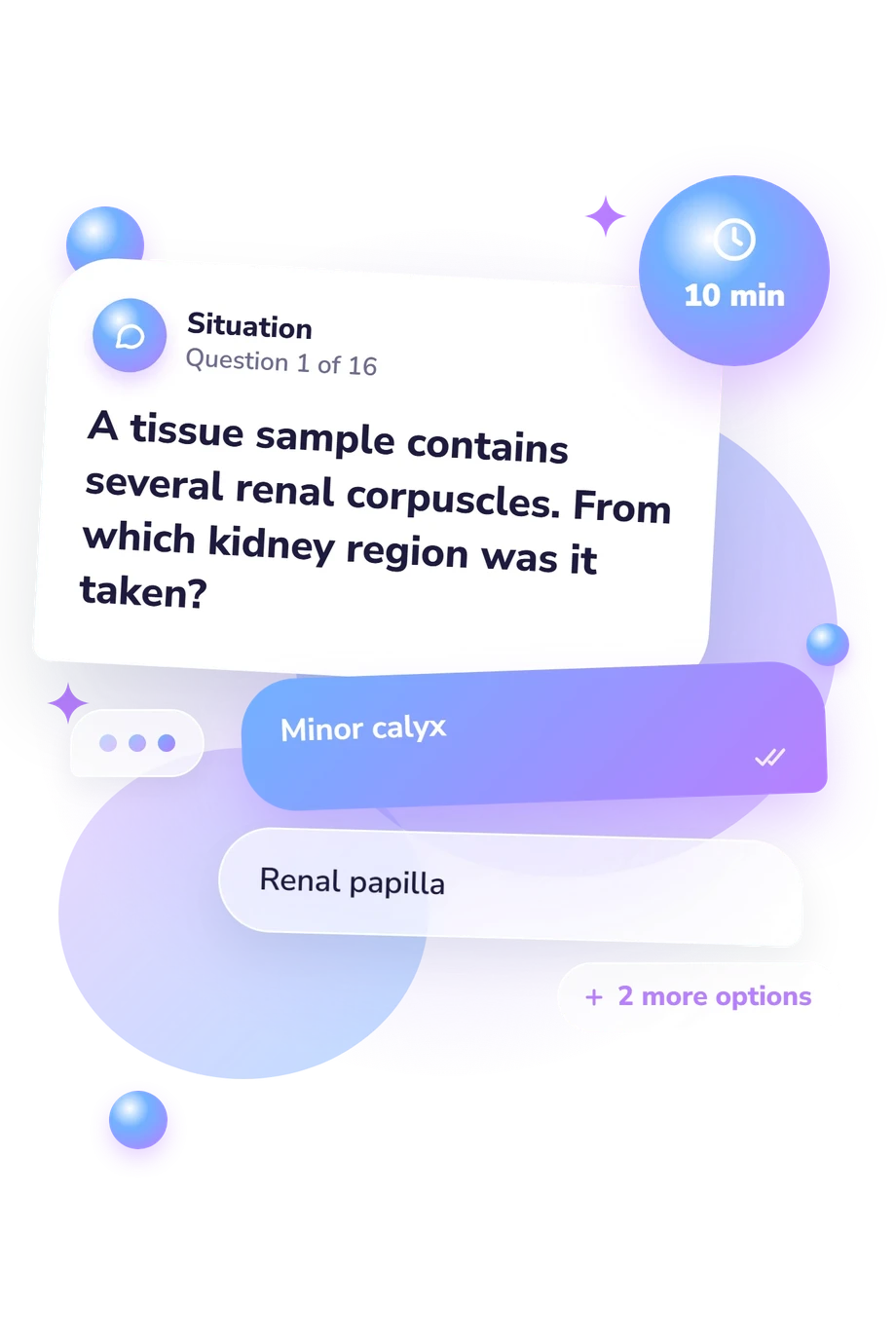
- Minor calyx
- Renal papilla
- Renal cortex
- Renal pelvis
- The wall of the proximal tubule
- The epithelium of the renal pelvis
- The wall of the collecting duct
- The glomerular filtration barrier
- The right ureter is substantially shorter
- The liver occupies space above the right kidney
- The spleen pushes the left kidney downward
- The bladder pulls the right kidney toward the pelvis
Kidney Quiz - Description and methodology of the test
Learners deciding whether to begin or revisit renal anatomy can use this kidney quiz as a quick readiness check. Students, educators, and curious readers can use the kidney anatomy test to choose which structures, pathways, or physiological links to study first. It is most useful when a reader wants to test recall before a lesson or identify gaps while revising.
What This Assessment Measures
The content covers gross anatomy, microscopic structures, filtration, tubular transport, hormonal regulation, and urine drainage. Questions ask readers to identify regions and vessels, distinguish nephron segments, trace filtrate, and connect antidiuretic hormone with water reabsorption. Rather than asking about symptoms or personal health history, this urinary system quiz tests factual and functional understanding of renal anatomy.
The result uses one educational scale, Kidney Anatomy Knowledge (0-16), with three bands:
- Foundations to review (0-6) means core location, structures, or nephron pathways need reinforcement.
- Developing knowledge (7-12) means many concepts are understood, while finer distinctions merit review.
- Strong knowledge (13-16) indicates a well-developed grasp of kidney anatomy and urine formation.
These bands describe anatomy performance, not kidney health or clinical cutoffs.
Methodology and Source Material
Each item in this renal anatomy assessment uses a self-administered, single-best-answer format with four alternatives. Prompts cover tissue identification, anatomical relationships, vessel sequences, nephron physiology, and urine flow, so selecting an option requires linking structure with function. Scoring produces a total knowledge result; the questionnaire does not specify an additional point-per-answer rule.
The source support is conceptual rather than psychometric. Betts and colleagues supply the urinary system's core organization, while Hall and Hall support filtration, concentration, and hormone-regulated water balance. Mescher addresses renal corpuscles, podocytes, and filtration barriers, and Guyton places the kidneys within long-term blood-pressure and body-fluid regulation. These anatomy and physiology works support the subject matter but do not establish psychometric properties for this online questionnaire. It is conceptually consistent with them, not a reproduction or validated adaptation of any one source.
For readers using the result to study, the score is a snapshot of recall and application. Performance can reflect prior coursework, anatomical vocabulary, guessing, question wording, and current concentration; reviewing missed answers and their reasoning can turn the result into a practical study plan.
- Betts JG, Young KA, Wise JA, Johnson E, Poe B, Kruse DH, Korol O, Johnson JE, Womble M, DeSaix P. Anatomy and Physiology 2e, Chapter 25: The Urinary System. Houston, TX: OpenStax; 2022.
- Hall JE, Hall ME. Guyton and Hall Textbook of Medical Physiology. 14th ed. Philadelphia, PA: Elsevier; 2021.
- Mescher AL. Junqueira's Basic Histology: Text and Atlas. 16th ed. New York, NY: McGraw Hill; 2021.
- Guyton AC. Blood pressure control--special role of the kidneys and body fluids. Science. 1991;252(5014):1813-1816. 10.1126/science.2063193
Updated: