
What Color Is My Soul Quiz
How the Scales are Structured
Who Usually Takes This Test?
See How You Compare
Below is a preview of how scores are typically distributed across each scale.
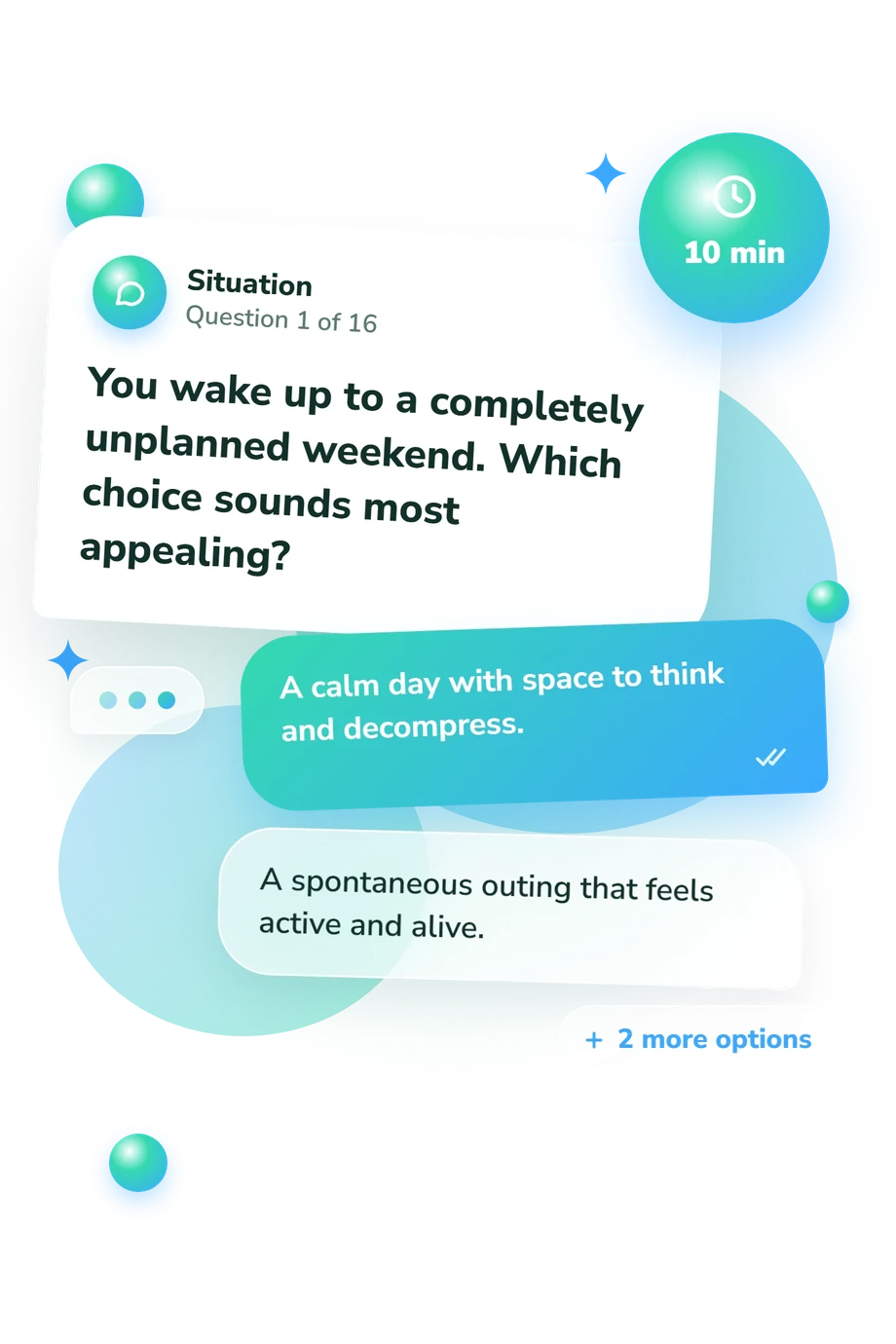
Example Questions From the Test
- A calm day with space to think and decompress.
- A spontaneous outing that feels active and alive.
- A hands-on project or time in a familiar local place.
- An unusual cultural event or creative experiment.
- Help them spot an imaginative new way to understand it.
- Make room for their feelings and listen for what is left unsaid.
- Look for one practical action that could ease the situation.
- Try to lift their energy and get them moving again.
- Research it carefully and notice how I feel before deciding.
- Check whether it supports a stable and worthwhile direction.
- Imagine the unexpected paths it could open.
- Step toward it and trust myself to adapt along the way.
What Color Is My Soul Quiz - Description and methodology of the test
For readers weighing how they spend time, support others, respond to uncertainty, or choose between competing possibilities, the What Color Is My Soul Quiz offers a symbolic vocabulary for everyday decisions. As a soul color quiz, it can help you notice which approaches feel natural and use that awareness when planning, communicating, or balancing action with rest.
What This Assessment Explores
The scenarios cover free time, decisions, support, creativity, routines, uncertainty, and unfamiliar settings. Together, they explore the question at the heart of the What Color Is Your Soul Quiz-how a person meets experience rather than identifying a fixed type.
The four displayed dimensions are:
- Blue Soul (0-12) reflects calm observation, depth, and thoughtful connection; bands are Bright Contrast (0-4), Blue Current (5-8), and Deep Blue (9-12).
- Green Soul (0-12) reflects grounded growth, care, continuity, and practical connection; bands are Roaming Roots (0-4), Growing Green (5-8), and Deep Green (9-12).
- Purple Soul (0-12) reflects imagination, symbolism, intuition, and unconventional meaning; bands are Clear Horizon (0-4), Violet Glimmer (5-8), and Rich Purple (9-12).
- Red Soul (0-12) reflects passion, courage, immediacy, and energetic action; bands are Measured Spark (0-4), Steady Flame (5-8), and Vivid Red (9-12).
Methodology and Evidence Base
Each item presents an everyday scenario with four response choices. The alternatives point toward reflection, grounded care, imagination, or energetic action; choose what feels natural. This soul colour quiz compares the four profiles rather than treating each choice as a separate judgment.
The highest score marks the strongest current affinity, while colors within one point may form a blended result. The bands describe degrees of affinity rather than universal personality types.
Its conceptual evidence base is closest to color-personality research. Jue and Ha (2022) reported associations between personality and color preferences, whereas Jonauskaite et al. (2021) found that favorite color alone says little about personality. Palmer and Schloss’s ecological valence theory and Elliot and Maier’s review emphasize context and psychological processes in color responses. These sources support conceptual consistency, not validation of this questionnaire.
As an online self-report questionnaire, it compares relative color affinities across four styles and provides no established normative interpretation or diagnostic validation for the patterns it elicits. Mood, circumstances, self-awareness, candor, and cultural associations can affect responses. Read the profile as a snapshot and allow mixed or changing patterns.
- Juliet Jue and Jung Hee Ha (2022). Exploring the relationships between personality and color preferences. Frontiers in Psychology, 13, 1065372. 10.3389/fpsyg.2022.1065372
- Domicele Jonauskaite, Amber Gayle Thalmayer, Lauriane Müller, and Christine Mohr (2021). What Does Your Favourite Colour Say About Your Personality? Not Much. Personality Science, 2, e6297. 10.5964/ps.6297
- Stephen E. Palmer and Karen B. Schloss (2010). An ecological valence theory of human color preference. Proceedings of the National Academy of Sciences of the United States of America, 107(19), 8877-8882. 10.1073/pnas.0906172107
- Andrew J. Elliot and Markus A. Maier (2014). Color psychology: Effects of perceiving color on psychological functioning in humans. Annual Review of Psychology, 65, 95-120. 10.1146/annurev-psych-010213-115035
Updated: