
Following Directions Quiz
How the Scales are Structured
Who Usually Takes This Test?
See How You Compare
Below is a preview of how scores are typically distributed across each scale.
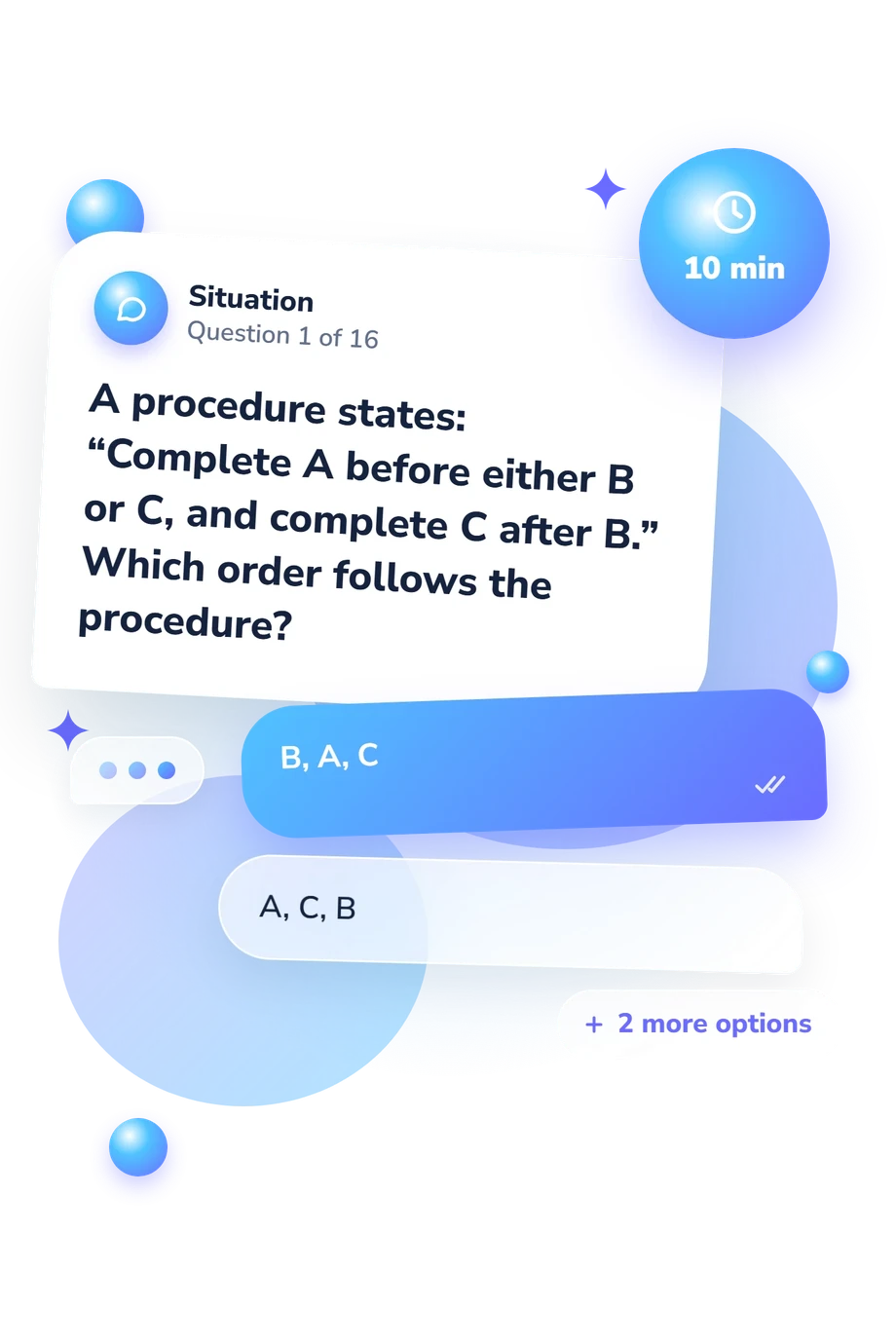
Example Questions From the Test
- B, A, C
- A, C, B
- A, B, C
- C, A, B
- Submit the completed report as a PDF by 3:00 p.m. Friday.
- Send the report promptly in a suitable format.
- Complete the report carefully when time allows.
- Try to deliver the report near the end of the week.
- Send it whenever your other work is finished.
- Ask for a specific deadline or priority.
- Assume “soon” means by the end of the week.
- Choose a deadline yourself without mentioning it.
Following Directions Quiz - Description and methodology of the test
People who want to improve accuracy with written or spoken directions can use this assessment to examine how they approach instruction-based decisions. The following directions quiz suits learners, employees, and anyone reviewing habits that affect reliable performance. As a quiz about following instructions, it offers a structured profile of knowledge and decision-making rather than a broad judgment about ability.
What This Assessment Explores
This assessment measures knowledge of strategies for interpreting and following written or spoken directions. Its scenarios cover order, conditions, exceptions, measurable requirements, safety responses, clarification, and final checks. The focus is recognizing requirements before acting, not speed or obedience.
The situations can be grouped into these knowledge areas:
- Interpreting conditions shows whether you distinguish requirements, permissions, exceptions, and limits.
- Sequencing actions shows whether you preserve order and dependencies.
- Clarifying ambiguity shows whether you seek a deadline, priority, or confirmation.
- Verifying completion shows whether you compare finished work with every requirement.
- Safety scenarios show whether you recognize when directions require pausing and seeking guidance.
Some scenarios require reading directions, so the assessment also works as a reading directions quiz, while the broader profile covers spoken and general instruction-following; the result describes knowledge for self-reflection rather than direct real-world performance.
Methodology and Evidence Base
Each item presents a situation with four answer choices. The respondent chooses the option that best satisfies the condition, sequence, safety requirement, or verification standard; this is a comprehension task rather than a personality questionnaire.
Scoring gives one point per correct answer and reports Following Directions Knowledge (0-16): Foundation 0-6, Developing 7-12, and Strong 13-16. These bands describe questionnaire performance, not competence in every setting.
Conceptually, the questionnaire is consistent with Engle, Carullo, and Collins (1991) on working-memory demands in following directions. Dixon (1982) addresses planning complex written tasks; Zeitlin (1994), safety communication; and Cao, Chan, and Elkamel (2019), procedural adherence. These studies concern working memory, planning, safety communication, and procedural adherence; they do not validate or standardize this questionnaire.
These bands are descriptive rather than norm-referenced, and no reliability evidence is reported for this questionnaire. Attention, language comprehension, procedure familiarity, and careful reading can affect results. Distractors reward attention to conditions and exceptions; this is not a trick quiz on following directions, because correct answers follow from the stated directions. Your score reflects accuracy on these problems at testing.
- Engle, Randall W., Julie J. Carullo, and Kathryn W. Collins. “Individual Differences in Working Memory for Comprehension and Following Directions.” The Journal of Educational Research 84, no. 5 (1991): 253-262. 10.1080/00220671.1991.10886025
- Dixon, Peter. “Plans and Written Directions for Complex Tasks.” Journal of Verbal Learning and Verbal Behavior 21, no. 1 (1982): 70-84. 10.1016/S0022-5371(82)90456-X
- Zeitlin, L. R. “Failure to Follow Safety Instructions: Faulty Communication or Risky Decisions.” Human Factors 36, no. 1 (1994): 172-181. 10.1177/001872089403600111
- Cao, Shi, Keziah Chan, and Ali Elkamel. “A Controlled Experiment Investigating the Effects of Explanatory Manual on Adherence to Operating Procedures.” Safety 5, no. 2 (2019): 19. 10.3390/safety5020019
Updated: