
Psoriasis Quiz
How the Scales are Structured
Who Usually Takes This Test?
See How You Compare
Below is a preview of how scores are typically distributed across each scale.
Example Questions From the Test
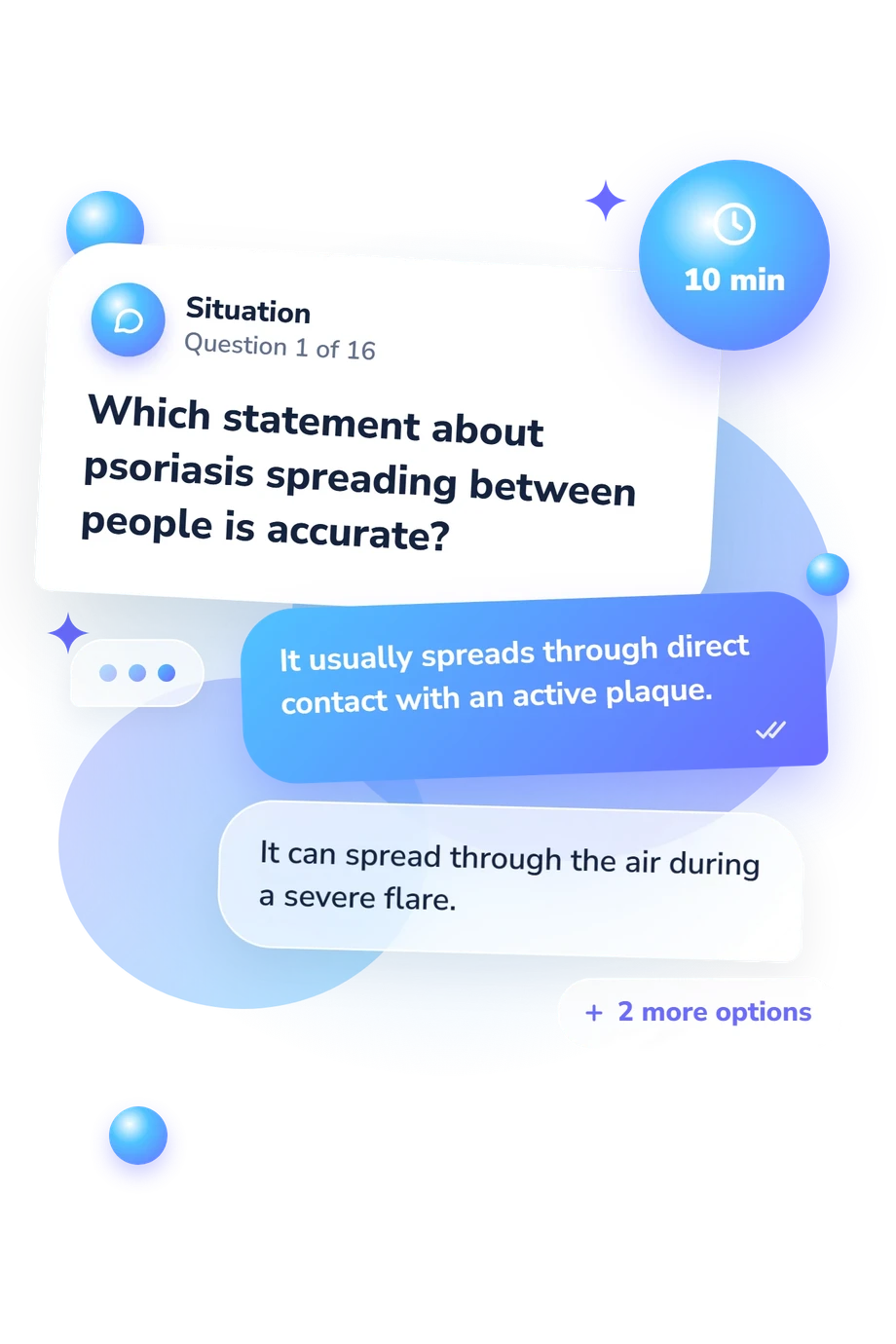
- It usually spreads through direct contact with an active plaque.
- It can spread through the air during a severe flare.
- It is commonly transmitted by sharing towels or bedding.
- It is not contagious and cannot be caught from another person.
- A topical corticosteroid selected and used as directed
- Antibiotics prescribed for every flare
- An oral antihistamine as the only treatment for the plaques
- An antifungal shampoo applied to every affected body area
- Temporary raised welts that disappear within hours
- Well-defined, raised patches with a dry silvery scale
- Ring-shaped patches with clearer skin in the center
- Greasy yellow flakes concentrated in oily areas
Psoriasis Quiz - Description and methodology of the test
Readers who want to decide what to learn next about psoriasis can use this psoriasis quiz as a focused check of their current understanding. The assessment suits people reviewing psoriasis care questions before choosing which topics deserve closer attention. Its result supports that choice without turning uncertainty about symptoms into a conclusion.
What This Assessment Measures
The questionnaire tests practical knowledge, not personal symptom history. Items cover how psoriasis develops, whether it is contagious, what classic plaques look like, where lesions occur, and how subtypes present. Other questions address infection as a trigger, the Koebner phenomenon, nail involvement, possible psoriatic arthritis, diagnosis, treatment, and urgent patterns needing prompt care. This makes the questionnaire useful for self-study or for reviewing psoriasis signs and symptoms before a clinician conversation.
The result uses one educational scale, Psoriasis Knowledge: 0-16. Its displayed bands mean:
- Foundations to build (0-6) indicates that characteristic signs, triggers, and care options may need review.
- Developing knowledge (7-12) shows understanding of essentials with gaps around subtypes, complications, or treatment.
- Strong knowledge (13-16) reflects a solid grasp of common presentations and care concepts.
Methodology and Evidence Base
Each question uses four answer choices and asks for the most accurate statement. The items sample recognition of clinical patterns and care concepts rather than symptom severity or treatment response.
The Psoriasis Knowledge Assessment Questionnaire addresses a similar emphasis on psoriasis knowledge. This online questionnaire is conceptually consistent with that instrument, not a direct adaptation or validated version. Work by Wahl and colleagues supports examining disease and treatment understanding, while Boehncke and Schön provide clinical context for immune involvement, subtypes, triggers, and therapies.
Results use the educational scale described above; no separate diagnostic cutoff or item-by-item weighting rule is specified. The resulting score is unvalidated and cannot establish psoriasis; a higher result reflects stronger performance on these knowledge questions rather than disease activity.
Reading, comprehension, guessing, and attention can affect a self-administered result. Reviewing the psoriasis test results helps prioritize learning by directing attention to signs and triggers, subtypes and complications, or treatment concepts.
- Shreya Srinivasan, Duttala Indira Reddy, Sivaramakrishnan Sangaiah, N. Ashok Kumar. A study using psoriasis knowledge assessment questionnaire in psoriasis affected patients. IP Indian Journal of Clinical and Experimental Dermatology. 2021;7(4):280-283. 10.18231/j.ijced.2021.054
- Astrid Klopstad Wahl, Torbjørn Moum, Hilde Stendal Robinson, Eva Langeland, Marie Hamilton Larsen, Anne Lene Krogstad. Psoriasis Patients’ Knowledge about the Disease and Treatments. Dermatology Research and Practice. 2013;2013:921737. 10.1155/2013/921737
- Wolf-Henning Boehncke, Michael P. Schön. Psoriasis. The Lancet. 2015;386(9997):983-994. 10.1016/S0140-6736(14)61909-7
Updated: