
Frankenstein Quiz
How the Scales are Structured
Who Usually Takes This Test?
See How You Compare
Below is a preview of how scores are typically distributed across each scale.
Example Questions From the Test
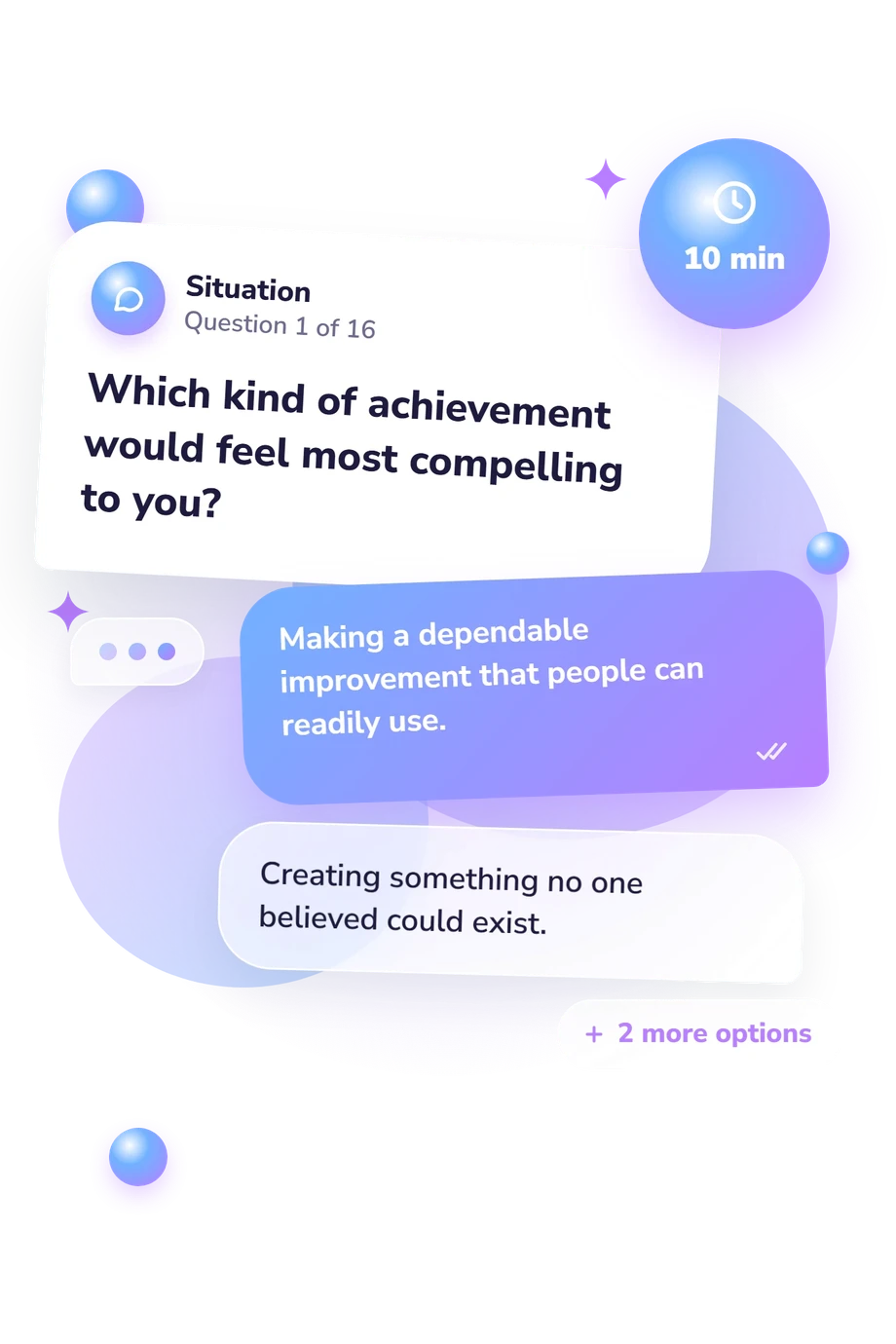
- Making a dependable improvement that people can readily use.
- Creating something no one believed could exist.
- Helping a group accomplish something none of us could do alone.
- Solving a difficult question primarily for the satisfaction of understanding it.
- I switch off and give the other parts of my life their proper attention.
- I preserve regular routines but reserve extra time for the work.
- I enter a focused sprint and postpone some plans until the key stage is complete.
- I become so absorbed that meals, messages, and relationships can fade into the background.
- I join the shared activity and let familiarity develop without forcing closeness.
- I introduce myself openly and see who responds with warmth.
- I look for one approachable person who might help me understand the group.
- I quietly study how people speak and relate before revealing much about myself.
Frankenstein Quiz - Description and methodology of the test
Readers interested in literary self-reflection can use the Frankenstein Quiz to explore how they relate to Frankenstein’s central figures. This literary character quiz suits anyone interested in ambition, isolation, compassion, discovery, or the pull between solitary achievement and shared responsibility. Rather than assigning a fixed identity, it shows which character perspectives echo your choices and where your profile may be mixed.
What This Assessment Explores
It examines how readers respond to ambition, discovery, isolation, recognition, friendship, and responsibility when ideals meet consequences. As a Frankenstein character quiz, it turns those reactions into literary affinities with four figures rather than judgments of virtue, pathology, or behavior. The displayed scales are:
- Henry Clerval (0-12) reflects warmth, culture, companionship, and imaginative humanism; Task-centered realist (0-4), Humane adventurer (5-8), and Generous humanist (9-12) mark increasing affinity.
- Robert Walton (0-12) reflects curiosity, distant horizons, correspondence, and admiration for exceptional lives; Familiar-ground navigator (0-4), Purposeful voyager (5-8), and Romantic explorer (9-12) mark increasing affinity.
- The Creature (0-12) reflects sensitivity, exclusion, recognition, companionship, and justice; Self-contained observer (0-4), Searching outsider (5-8), and Wounded seeker (9-12) mark increasing affinity.
- Victor Frankenstein (0-12) reflects private ambition, intense investigation, and boundary-crossing discovery; Grounded collaborator (0-4), Driven investigator (5-8), and Promethean striver (9-12) mark increasing affinity.
Methodology and Evidence Base
Each prompt presents a situation and four response options, inviting the choice that feels most personally recognizable. The alternatives cover practical limits, collaboration, curiosity, belonging, and solitary intensity, so the profile reflects patterns across decisions rather than a single plot event.
Responses are tallied across the four profiles: the highest score identifies the strongest single affinity, while scores within one point of it indicate a blended profile combining affinities. This character-affinity quiz offers a structured comparison of literary outlooks.
The Dark Character Scale provides limited conceptual context because it examines attraction to morally dark fictional characters and related imaginative responses. It is a conceptual parallel, not a source, adaptation, or validation of this questionnaire. Mary Shelley’s Frankenstein supplies the character contrasts, while Cohen’s identification framework offers context for recognizing oneself in fictional figures.
Self-report remains a limitation: current mood, reading memories, self-awareness, and impression management can influence choices. Use the profile as a reflection prompt, with a blended result indicating a combination of affinities, not an inconsistency.
- Black, Jessica E., Yomna Helmy, Olivia Robson, and Jennifer L. Barnes. (2019). "Who Can Resist a Villain? Morality, Machiavellianism, Imaginative Resistance and Liking for Dark Fictional Characters." Poetics, 74, 101344. 10.1016/j.poetic.2018.12.005
- Shelley, Mary Wollstonecraft. (1982). Frankenstein, or the Modern Prometheus: The 1818 Text. Edited by James Rieger. University of Chicago Press.
- Cohen, Jonathan. (2001). "Defining Identification: A Theoretical Look at the Identification of Audiences With Media Characters." Mass Communication and Society, 4(3), 245-264. 10.1207/S15327825MCS0403_01
Updated: