
Werewolf Quiz
How the Scales are Structured
Who Usually Takes This Test?
See How You Compare
Below is a preview of how scores are typically distributed across each scale.
Example Questions From the Test
- Man-wolf or human-wolf
- Moon-wolf
- Cursed wolf
- Wolf spirit
- Wendigo
- Loup-garou
- Berserker
- Kitsune
- Retain a human mind during the transformation
- Avoid transforming as long as the potion is taken monthly
- Transform at will without waiting for a full moon
- Permanently remove lycanthropy after several doses
Werewolf Quiz - Description and methodology of the test
Readers who want a practical way to check their grasp of werewolf traditions and fictional canons can use this werewolf quiz to test recall and source awareness. Curious fans, folklore readers, and anyone preparing to discuss or compare stories can use this folklore knowledge quiz to identify gaps, settle uncertain details, and choose what to revisit.
What This Assessment Explores
Questions distinguish inherited motifs from later conventions and identify the cultural or fictional source behind each claim. As a quiz about werewolves, it measures subject knowledge rather than belief in literal transformation. Items move across regional lore, terminology, novels, films, and contemporary canons.
The result shows whether knowledge is introductory, developing, or connected across sources, helping fans check details before discussing legends or comparing story rules.
These are the main areas it examines:
- Folklore and mythology show whether you distinguish older traditions from modern inventions.
- Terminology shows whether you separate broad human-animal transformation from wolf-specific language.
- Literature and film show whether you match characters, motifs, and rules to their canon.
The sole scale is Werewolf Knowledge, scored 0-16. Curious Newcomer covers 0-6, Lore Tracker 7-12, and Moonlit Scholar 13-16. These bands indicate command of material, not personality, biology, or supernatural status.
Methodology and Evidence Base
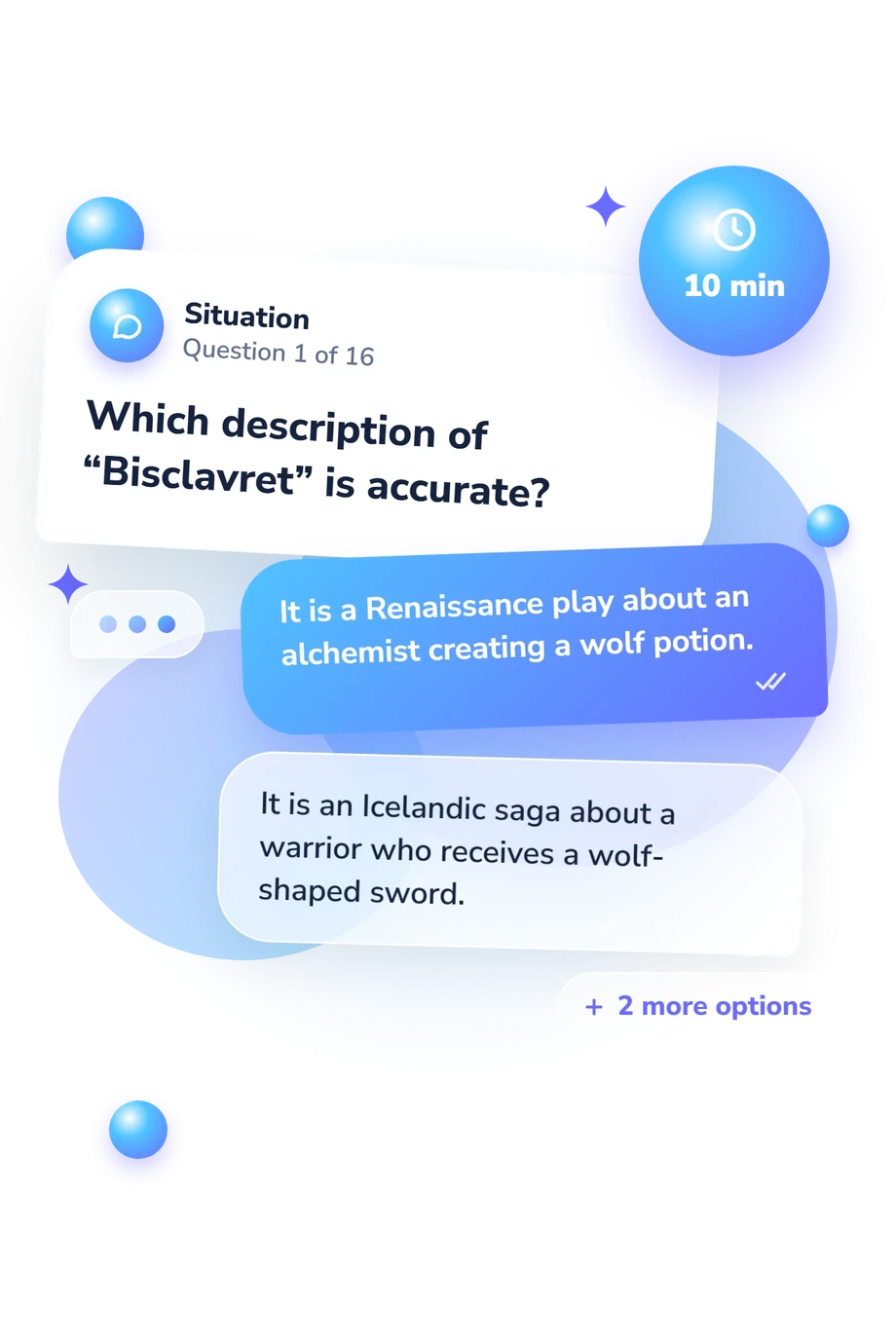
Each item presents a factual question with four answer choices. The alternatives may differ by period, region, terminology, or fictional canon, so answering requires source-sensitive comparison rather than one universal rule. The questionnaire reports a knowledge result interpreted through the stated bands.
Methodologically, the questionnaire is conceptually consistent with Sconduto (2008), whose literary-historical work frames older transformation narratives and recurring motifs. It is not presented as an adaptation of that work. De Blécourt and Mencej (2023) support keeping regional traditions distinct, while Mann (2020) helps explain why film conventions such as full moons or silver weapons should not be generalized to every tradition.
This knowledge-quiz format tests recognition of details tied to particular sources. The questionnaire is an online self-assessment organized around a displayed knowledge scale and result bands, so the outcome is best read as a snapshot of current familiarity. Guessing, prior media exposure, language familiarity, and current reading can affect performance; use the band for self-reflection and further study.
- Leslie A. Sconduto. Metamorphoses of the Werewolf: A Literary Study from Antiquity through the Renaissance. McFarland, 2008.
- Willem de Blécourt and Mirjam Mencej, editors. Werewolf Legends. Palgrave Macmillan, 2023. 10.1007/978-3-031-06082-3.
- Craig Ian Mann. Phases of the Moon: A Cultural History of the Werewolf Film. Edinburgh University Press, 2020. 10.3366/edinburgh/9781474441117.001.0001.
Updated: