
Gambling Addiction Quiz
How the Scales are Structured
Who Usually Takes This Test?
See How You Compare
Below is a preview of how scores are typically distributed across each scale.
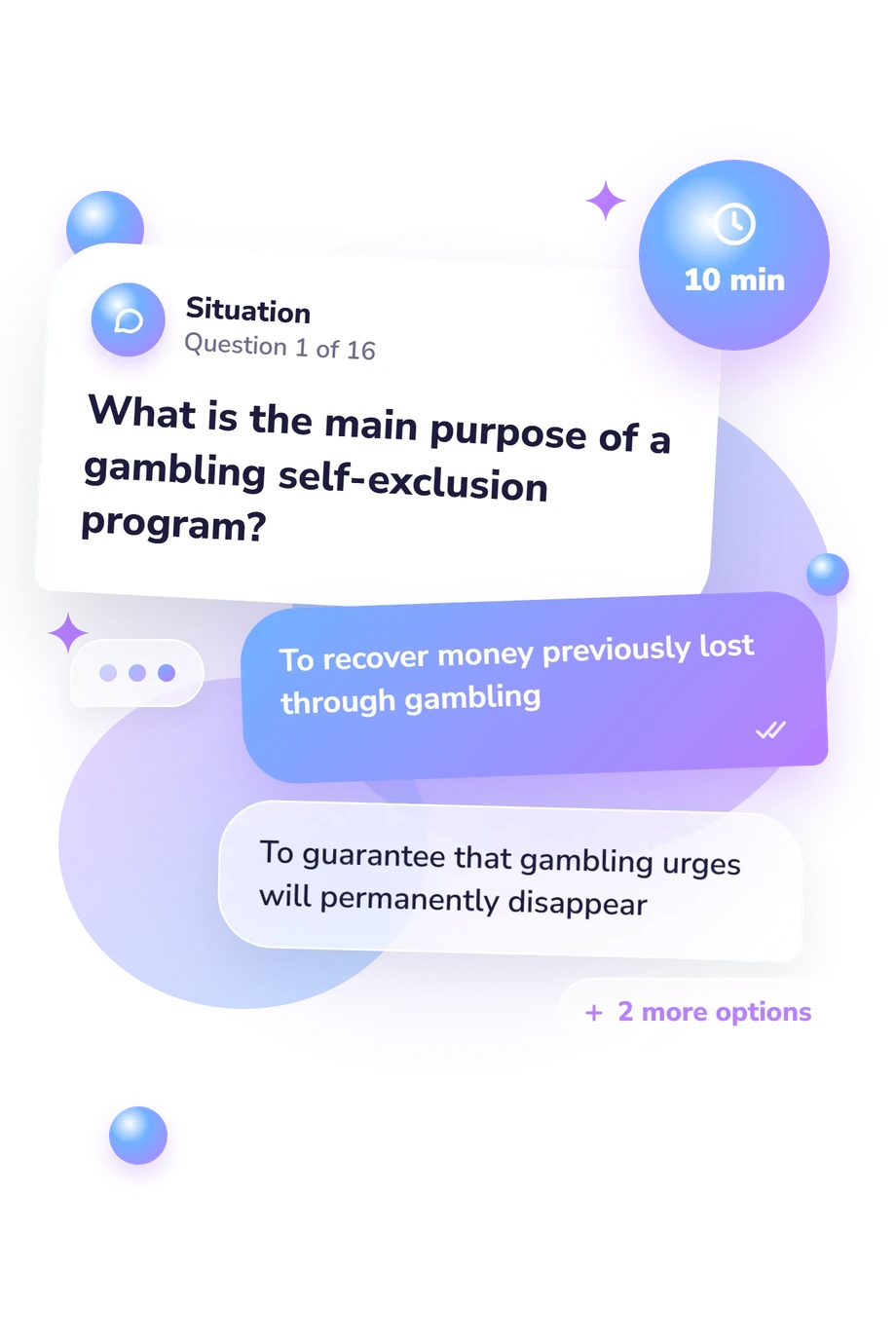
Example Questions From the Test
- Setting a planned entertainment budget
- Chasing losses
- Using self-exclusion
- Comparing gambling products
- The illusion of control
- Selective memory for wins
- Overestimating personal skill
- The gambler’s fallacy
- A suitably qualified clinician using a proper assessment
- Any friend who has observed one gambling session
- A numerical score from an educational knowledge quiz by itself
- The person’s preferred gambling operator
Gambling Addiction Quiz - Description and methodology of the test
For readers trying to understand gambling-related harm, this gambling addiction quiz offers an educational check of core concepts rather than a personal symptom assessment. It is useful for someone seeking clearer language about whether they have an addiction to gambling, especially when they want to understand warning signs, safeguards, support, and common misconceptions. The intended outcome is a more informed starting point for reflection, not a personal label.
What This Assessment Explores
The questionnaire checks whether a respondent can recognize gambling-harm concepts and choose practical responses. It treats harm as broader than money lost, including effects on relationships, emotional wellbeing, safety, and access to gambling.
The questions cover four related areas:
- Warning signs identify chasing losses, secrecy, tolerance, withdrawal-like experiences, and mistaken beliefs about chance.
- Safeguards explain self-exclusion, payment blocks, limits, and planning for high-risk moments.
- Support examines constructive conversations, combined concerns, treatment approaches, and peer help.
- Impact and urgency address effects on others, financial strain, damaged trust, and immediate safety.
The result is Gambling Addiction Knowledge, scored from 0-16. Foundations to build (0-6) signals gaps in warning signs, misconceptions, or support options; Developing knowledge (7-12) shows recognition of core patterns with room to strengthen safeguards; Strong knowledge (13-16) reflects broad understanding of harm and support. For someone asking whether I have a gambling problem, it reports knowledge of educational content rather than personal circumstances.
Methodology and Scientific Basis
Items use multiple-choice questions built around definitions, scenarios, misconceptions, and decisions. Several ask for the most appropriate response, so the assessment tests applied understanding as well as recall. The displayed score is a knowledge total; guessing, wording, and previous exposure to gambling-harm information can affect it.
Its closest conceptual reference is QABQ (Ferland et al., 2002), a published approach concerned with correcting misconceptions and increasing gambling knowledge. This questionnaire is conceptually consistent with that work, not an adaptation or validation of it. Langham et al. (2016) supports viewing harm across financial, relational, emotional, and social domains, while Weinstock and Rash (2014) helps distinguish recognizing risk patterns from assessing gambling disorder under DSM-5 criteria.
The result bands are unvalidated summaries of quiz knowledge, not clinical cutoffs or estimates of personal harm. A strong result can coexist with harmful gambling, and a lower result can reflect unfamiliarity. As a quiz about gambling problems, it is best read alongside current behavior and circumstances.
- Ferland, Francine, Robert Ladouceur, and Frank Vitaro. "Prevention of problem gambling: Modifying misconceptions and increasing knowledge." Journal of Gambling Studies 18, no. 1 (2002): 19-29. 10.1023/A:1014528128578
- Langham, Erika, Hannah Thorne, Matthew Browne, Phillip Donaldson, Judy Rose, and Matthew Rockloff. "Understanding gambling related harm: A proposed definition, conceptual framework, and taxonomy of harms." BMC Public Health 16, no. 1 (2016): 80. 10.1186/s12889-016-2747-0
- Weinstock, Jeremiah, and Carla J. Rash. "Clinical and Research Implications of Gambling Disorder in DSM-5." Current Addiction Reports 1, no. 3 (2014): 159-165. 10.1007/s40429-014-0026-7
Updated: