
Santa's Quiz
How the Scales are Structured
Who Usually Takes This Test?
See How You Compare
Below is a preview of how scores are typically distributed across each scale.
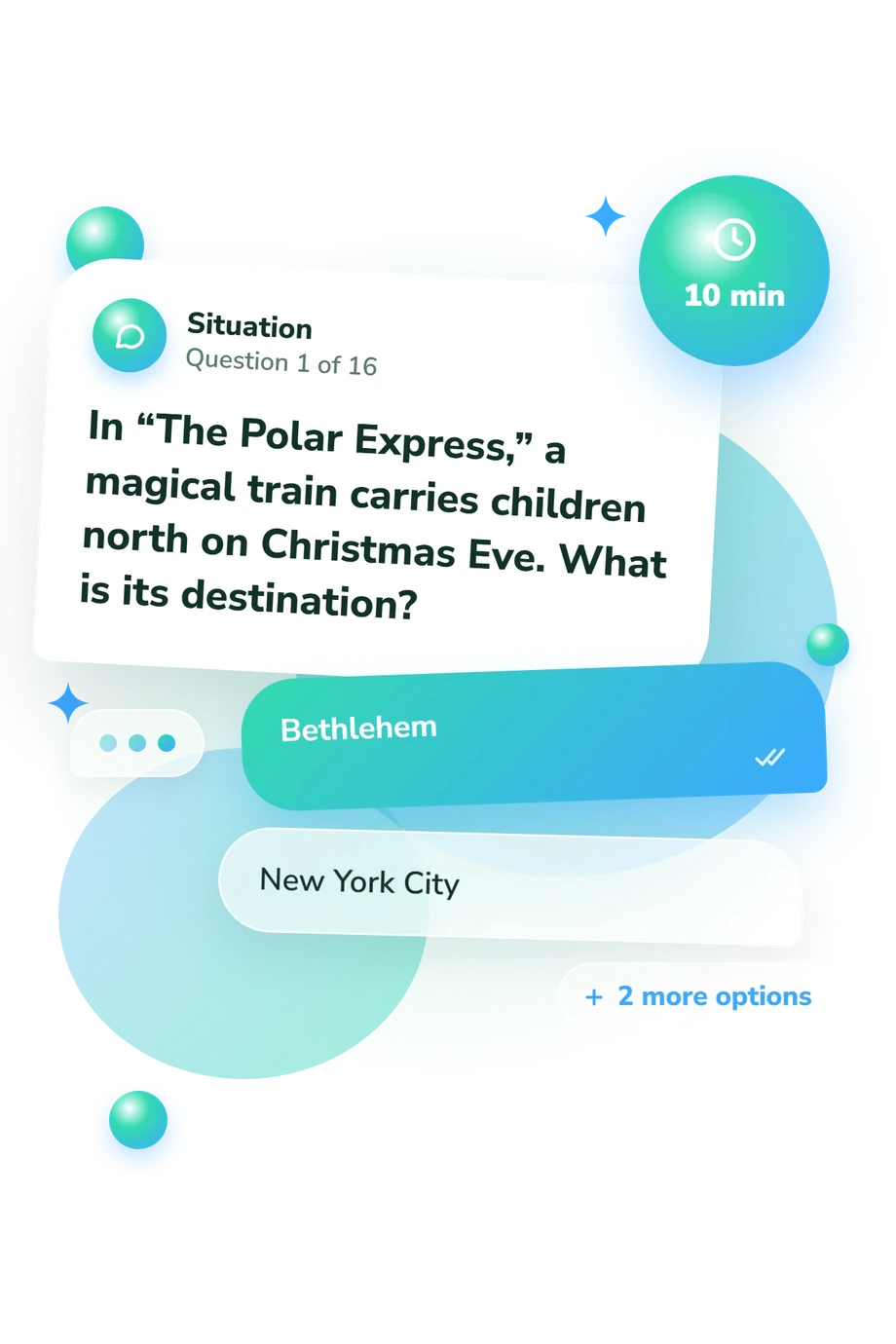
Example Questions From the Test
- Bethlehem
- New York City
- Lapland’s Korvatunturi mountain
- The North Pole
- Dasher
- Dancer
- Blitzen
- Rudolph
- Eight
- Seven
- Six
- Nine
Santa's Quiz - Description and methodology of the test
Designed for curious readers who enjoy seasonal stories and cultural traditions, Santa's Quiz offers a light knowledge check across literature, music, history, and international customs. It suits families, friends, students, and anyone wanting a seasonal knowledge test. The result places performance in a playful level and gives readers a simple way to explore seasonal knowledge. Its festive format can spark conversation in families, friend groups, or classroom activities.
What This Assessment Explores
Rather than measuring personality, the questionnaire checks recognition across Santa lore, Christmas media, history, and international customs. It suits anyone who wants to gauge the breadth of their festive knowledge through a Christmas knowledge quiz.
The main thematic groups are:
- Santa's origins and names link Saint Nicholas, Sinterklaas, Père Noël, and Kris Kringle with modern lore.
- Stories, films, and songs test recognition of familiar seasonal characters, scenes, lyrics, and works.
- Reindeer and North Pole imagery checks knowledge of sleigh stories and Santa's popular journey.
- International customs place gift-bringers, feast days, and winter visitors in their traditions.
The result is reported on the Santa & Christmas Knowledge scale (0-16) and reflects performance on the correct-answer items. The bands are Holiday Starter (0-6), Workshop Learner (7-12), and North Pole Expert (13-16), playful descriptions of seasonal familiarity.
Methodology and Evidence Base
Its format is closer to a Christmas trivia quiz than a self-report inventory. Each item offers a prompt with four answer choices, and the respondent selects the option matching the relevant fact, story, song, or tradition. The displayed result reflects the correct-answer outcome.
The questionnaire is conceptually consistent with Adam C. English's historical account of Santa traditions. Penne Lee Restad provides context for Christmas culture in the United States, while Maryanne Theobald, Gillian Busch, and Susan Danby situate Santa within social and popular-cultural learning. These sources support the subject matter and cultural framing; they do not make this questionnaire an adaptation of a published instrument.
It is an online knowledge assessment rather than a standardized psychological scale, so its labels are playful descriptions, not normative or clinical thresholds.
Interpret the outcome as a snapshot of seasonal knowledge shaped by memory, reading, viewing, language, family traditions, and cultural exposure. Self-selected answers may reflect familiarity with particular traditions; a lower result may suggest areas to explore when considered alongside the individual questions, while a higher result indicates strong performance on the material presented.
- English, Adam C. “St Nicholas to Santa Claus.” In The Oxford Handbook of Christmas, edited by Timothy Larsen, 252-264. Oxford University Press, 2020. 10.1093/oxfordhb/9780198831464.013.22
- Restad, Penne Lee. Christmas in America: A History. Oxford University Press, 1997. 10.1093/acprof:oso/9780195109801.001.0001
- Theobald, Maryanne, Gillian Busch, and Susan Danby. “Socializing children into pop culture: A visit to Santa.” Global Studies of Childhood 8, no. 3 (2018): 252-266. 10.1177/2043610618798930
Updated: