
Will I Die Alone Quiz
How the Scales are Structured
Who Usually Takes This Test?
See How You Compare
Below is a preview of how scores are typically distributed across each scale.
Example Questions From the Test
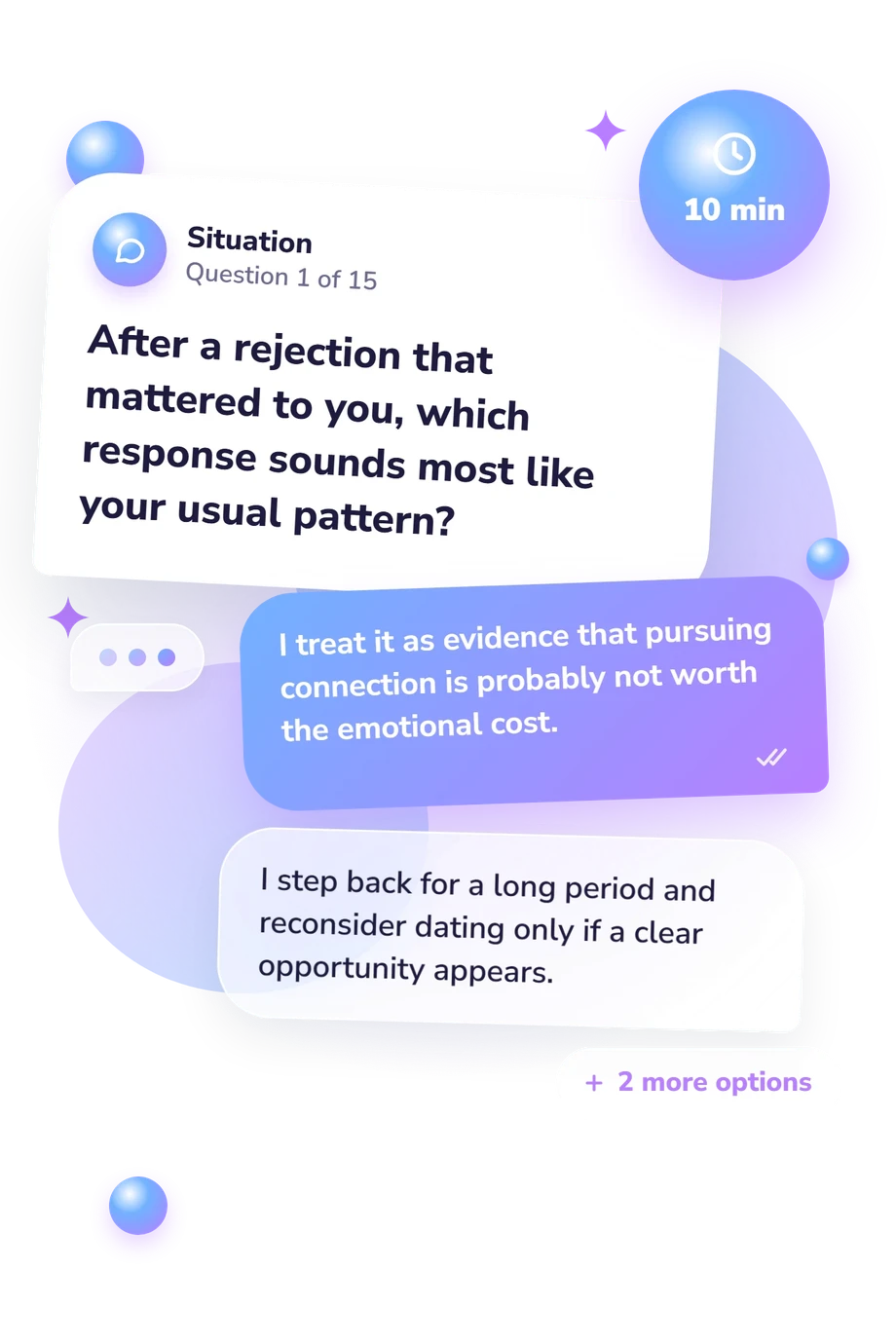
- I treat it as evidence that pursuing connection is probably not worth the emotional cost.
- I step back for a long period and reconsider dating only if a clear opportunity appears.
- I make space for disappointment, seek perspective, and return when I feel genuinely ready.
- I take a temporary break, then ease back into meeting people without forcing optimism.
- Redirect toward lighter conversation because depth this early feels too exposing.
- Listen closely and share a little, while keeping my most meaningful views for later.
- Engage openly while maintaining boundaries appropriate to how well we know each other.
- Discuss meaningful values honestly, but let the other person set the depth and pace.
- It includes occasional new people, but most of my time stays within a familiar circle.
- It gives me frequent, varied chances to meet people, and I usually engage with those chances.
- It is mostly private or highly familiar, with few realistic openings for meeting someone new.
- It includes at least one dependable setting where new connections can gradually form.
Will I Die Alone Quiz - Description and methodology of the test
For readers deciding whether a structured self-check fits their concerns, the Will I Die Alone Quiz offers a contained pause before taking action. Anyone seeking perspective on future loneliness can use it without treating the title as a prediction. Someone asking whether this is an Am I Going to Die Alone Quiz can decide whether its questions fit their current concerns.
What This Assessment Explores
The questions examine responses to vulnerable or uncertain moments in dating. They cover disclosure, receiving care, visible interest, mixed signals, compatibility, communicating preferences, recovering after rejection, and entering settings where new relationships may develop. Rather than treating this as a Will You Die Alone Quiz with a fixed outcome, the questionnaire translates that concern into present-focused patterns rather than a prediction.
The displayed dimensions are:
- Emotional Availability (0-15) shows comfort with being known, expressing interest, and receiving care; the bands are Guarded connection (0-5), Gradual connection (6-10), and Accessible connection (11-15).
- Relationship Agency and Resilience (0-15) shows intentional pursuit, need communication, and recovery after setbacks; bands are Waiting or withdrawing (0-5), Emerging agency (6-10), and Steady agency (11-15).
- Social Openness and Opportunity (0-15) shows how routines create realistic chances to connect; bands are Limited exposure (0-5), Selective openness (6-10), and Active openness (11-15).
Methodology and Scientific Basis
Each item is a situational self-report prompt with four answer options. Choices describe ways of handling closeness, uncertainty, disappointment, communication, or social initiative; the respondent selects the response closest to their usual pattern. Responses are grouped into the three dimensions; score ranges and bands are displayed, but the questionnaire does not explain how individual answer options are weighted.
Relevant conceptual parallels include Self-Efficacy in Romantic Relationships (Riggio et al., 2011) for relationship agency, Descutner and Thelen (1991) for intimacy, Smith and Betz (2000) for social self-efficacy, and Spielmann et al. (2013) for concerns about being single. The questionnaire is conceptually consistent with these lines of research, not an adaptation or validation of their instruments.
If you are asking yourself whether you are gonna die alone, use this Am I Gonna Die Alone Quiz to consider current openness, agency, and opportunity in the context of your circumstances rather than as a forecast.
These are unvalidated self-reflection scores. Mood, recent rejection, circumstances, and self-awareness can influence answers, so the result cannot establish attachment, guarantee a relationship, or measure personal worth.
- Riggio, H. R., Weiser, D. A., Valenzuela, A. M., Lui, P. P., Montes, R., & Heuer, J. (2011). Initial validation of a measure of self-efficacy in romantic relationships. Personality and Individual Differences, 51(5), 601-606. 10.1016/j.paid.2011.05.026
- Spielmann, S. S., MacDonald, G., Maxwell, J. A., Joel, S., Peragine, D., Muise, A., & Impett, E. A. (2013). Settling for Less Out of Fear of Being Single. Journal of Personality and Social Psychology, 105(6), 1049-1073. 10.1037/a0034628
- Descutner, C. J., & Thelen, M. H. (1991). Development and Validation of a Fear-of-Intimacy Scale. Psychological Assessment, 3(2), 218-225. 10.1037/1040-3590.3.2.218
- Smith, H. M., & Betz, N. E. (2000). Development and Validation of a Scale of Perceived Social Self-Efficacy. Journal of Career Assessment, 8(3), 283-301. 10.1177/106907270000800306
Updated: