
Detective Quiz
How the Scales are Structured
Who Usually Takes This Test?
See How You Compare
Below is a preview of how scores are typically distributed across each scale.
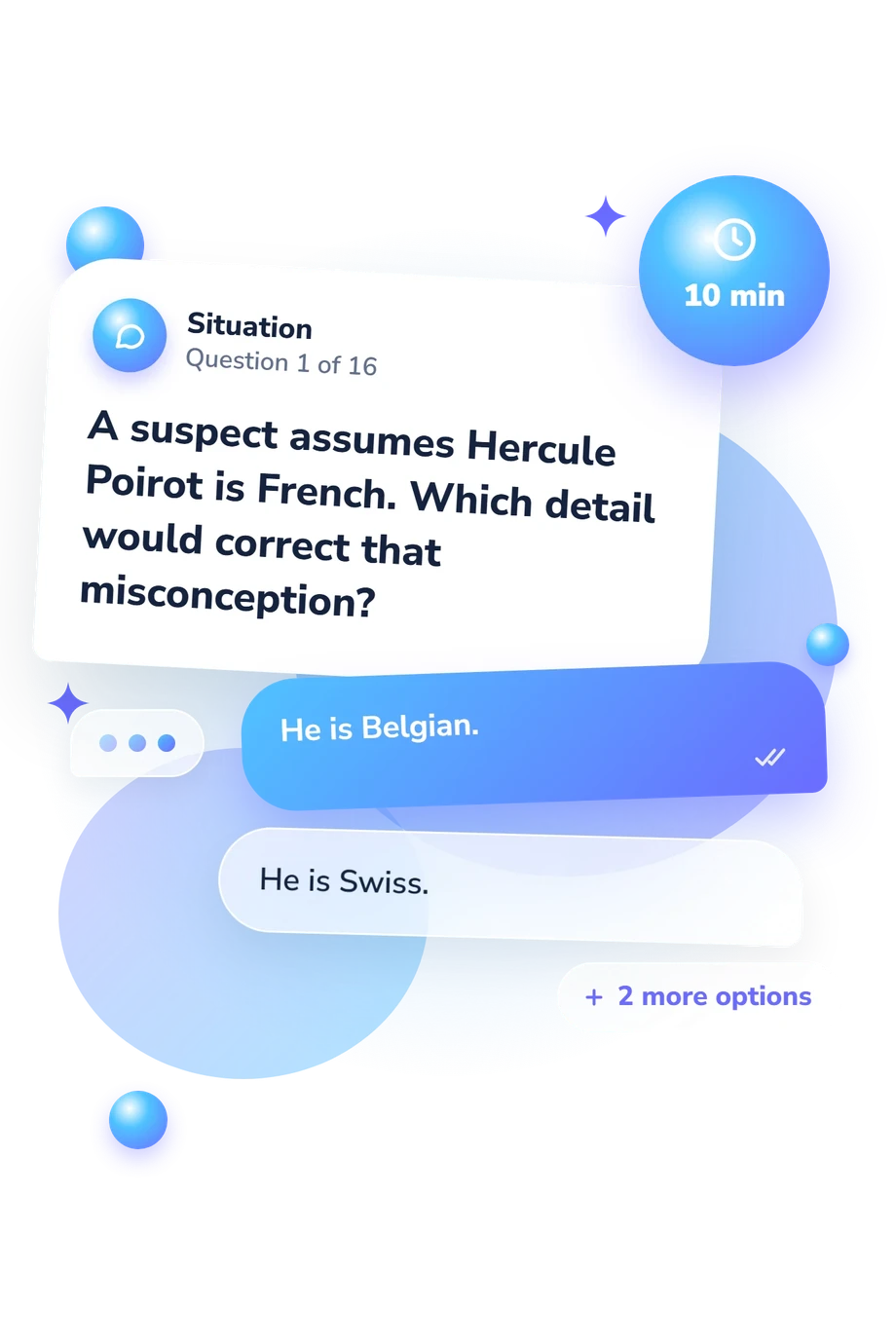
Example Questions From the Test
- He is Belgian.
- He is Swiss.
- He is Dutch.
- He is Canadian.
- Riverdale
- Rosewood
- Neptune
- Sunnydale
- Murder on the Orient Express
- Knives Out
- The Maltese Falcon
- Gone Girl
Detective Quiz - Description and methodology of the test
People who enjoy classic sleuths, screen mysteries, and fictional casework can use the detective quiz to check how securely they recognize the characters, settings, methods, and story conventions behind familiar investigations. It also suits anyone wondering whether they would perform well on a detective-fiction quiz, because the result maps entertainment knowledge rather than real-world investigative skill. The feedback can show which traditions are familiar and which deserve further exploration.
What This Assessment Explores
Questions sample detective knowledge across books, television, and film, asking you to recognize creators, sleuths, companions, settings, methods, and mystery structures. It suits anyone who enjoys fictional investigations and wants a focused profile of genre familiarity.
One scale, Detective Pop Culture Knowledge (0-16), reports familiarity with detective culture, not real investigative ability:
- Clue Collector (0-6) indicates recognition of some major references, with room to revisit their worlds and details.
- Mystery Reader (7-12) indicates developing-to-solid knowledge across several detective traditions.
- Case-Cracking Expert (13-16) indicates strong command of famous sleuths, settings, methods, and stories.
Here, a quiz asking whether you are good at detective fiction means being well-informed about fictional casework. Lower results may reflect unfamiliarity with particular traditions, not limited intelligence or reasoning.
Methodology and Evidence Base
Each item gives a clue with four answer choices. The groups cover authors, detectives, companions, settings, screen characters, and conventions such as the inverted mystery. The format tests recall and cultural association rather than open-ended deduction.
Keyed responses become a knowledge profile, while bands make performance easy to interpret. This entertainment quiz is not standardized and has no population norms or reliability estimates; exposure, memory, and represented traditions affect results.
Link (2023) helps frame detective fiction as narrative knowledge involving clues, lists, and recurring elements. Bartsch et al. (2024) is relevant to how audiences acquire and verify knowledge about fictional entertainment, and Rzepka and Horsley (2010) place detective traditions within crime fiction. These sources support the subject matter, not a claim that this questionnaire adapts or validates their instruments or frameworks.
A quiz about whether I could be a detective is answered in fictional terms. The result reflects recognition of fictional culture, not a prediction of professional performance. A quiz about whether you could be a detective can prompt self-reflection, but it cannot separate knowledge from prior exposure or recall.
- Link, Sarah J. A Narratological Approach to Lists in Detective Fiction. Crime Files. Cham: Palgrave Macmillan, 2023. 10.1007/978-3-031-33227-2.
- Bartsch, Anne, Marie-Louise Mares, Johanna Schindler, Jessica Kühn, and Ina Krack. Trust but verify? A social epistemology framework of knowledge acquisition and verification practices for fictional entertainment. Human Communication Research 50, no. 2 (2024): 194-207. 10.1093/hcr/hqad036.
- Rzepka, Charles J., and Lee Horsley, eds. A Companion to Crime Fiction. Blackwell Companions to Literature and Culture. Chichester: Wiley-Blackwell, 2010. 10.1002/9781444317916.
Updated: