
Southwest States and Capitals Quiz
How the Scales are Structured
Who Usually Takes This Test?
See How You Compare
Below is a preview of how scores are typically distributed across each scale.
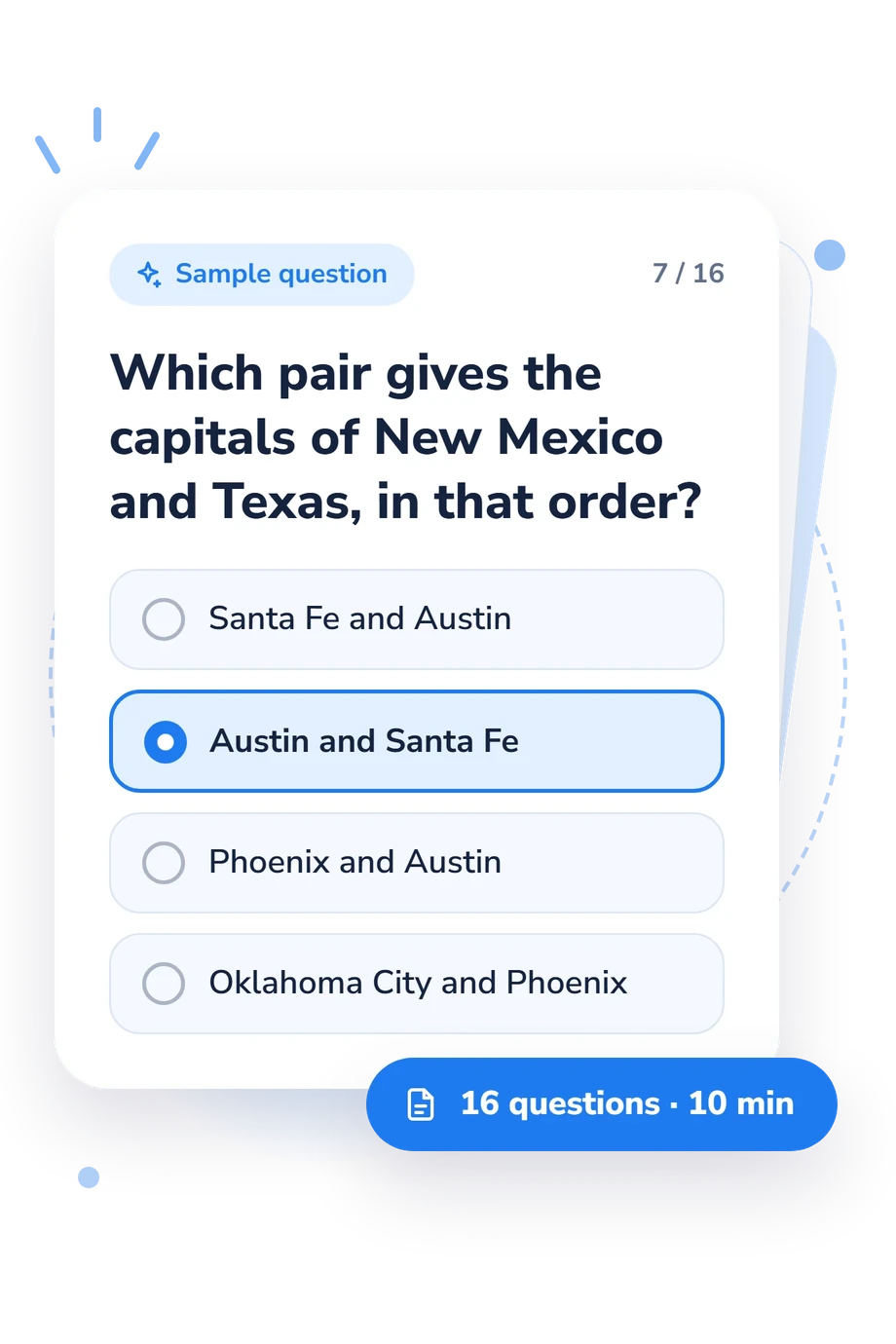
Example Questions From the Test
- Tulsa
- Santa Fe
- Austin
- Oklahoma City
- Texas—Santa Fe
- Arizona—Phoenix
- New Mexico—Santa Fe
- Oklahoma—Oklahoma City
- Texas
- Arizona
- New Mexico
- Oklahoma
Southwest States and Capitals Quiz - Description and methodology of the test
Students, teachers, and travelers who want to strengthen place-name knowledge can use this assessment to check how confidently they connect four Southwestern states with their capitals. The quiz about Southwest capitals uses varied situations-maps, abbreviations, alphabetical order, addresses, and neighboring states-making it a southwest capitals quiz rather than a single list of pairs. Anyone taking the Southwest States and Capitals Quiz can see how secure these links are.
What This Assessment Explores
The questionnaire focuses on one compact geography skill: linking Arizona, New Mexico, Oklahoma, and Texas with Phoenix, Santa Fe, Oklahoma City, and Austin. Its situations ask you to retrieve a capital from a state abbreviation, identify a state from a city, preserve the correct order, and recognize pairings in practical contexts such as addresses, study cards, and travel.
The result is reported on one scale:
- Southwest States and Capitals Knowledge: 0-16 shows how accurately you recall and apply the four state-capital connections. Foundation (0-6) indicates that review may help; Developing (7-12) reflects substantial knowledge with some gaps or mix-ups; Strong (13-16) indicates accurate performance across varied tasks.
This assessment offers southwest state capitals practice for learners checking readiness or teachers spotting topics for review. The profile describes demonstrated knowledge on these items, not general geographic ability.
Methodology and Evidence Base
Each prompt offers four answer choices, and the items cover retrieval, identification, ordering, and application: you may supply a capital from a state or abbreviation, identify a state from a capital, check alphabetical order, or apply a pairing to an address or travel situation. This tests recall and transfer rather than repeated wording.
The score summarizes knowledge of the four state-capital connections and is interpreted through the performance bands shown with the result. It describes performance on this questionnaire rather than making a broader ability estimate.
This questionnaire is a southwest state capitals test whose content is conceptually consistent with work on place-name instruction by Mason and Blankenship, geographic standards in the framework edited by Heffron and Downs, and mnemonic findings reported by Meshbane and Morris. Together, these perspectives fit the test’s emphasis on retrieving, checking, and retaining state-capital names in varied contexts.
Performance can vary with prior instruction, study strategies, guessing, attention, and familiarity with the contexts. Use the result to choose what to review when one capital is confused with another.
- Mason, Mary T., and Glen Blankenship. “Where in the World? The Status of Place-Name Geography Instruction.” The Journal of Social Studies Research, 12(1), 1988, 1-7. 10.1177/235227981988012001001
- Heffron, Susan Gallagher, and Roger M. Downs (eds.). Geography for Life: National Geography Standards, Second Edition. Washington, DC: National Council for Geographic Education, 2012.
- Meshbane, Alice, and John D. Morris. “Effectiveness of a Mnemonic Study Strategy for Retention of Geographic Names and Locations by College Students.” Perceptual and Motor Skills, 76(3), 1993, p. 830. 10.2466/pms.1993.76.3.830
Updated: