
I Can Make You Pee Quiz
How the Scales are Structured
Who Usually Takes This Test?
See How You Compare
Below is a preview of how scores are typically distributed across each scale.
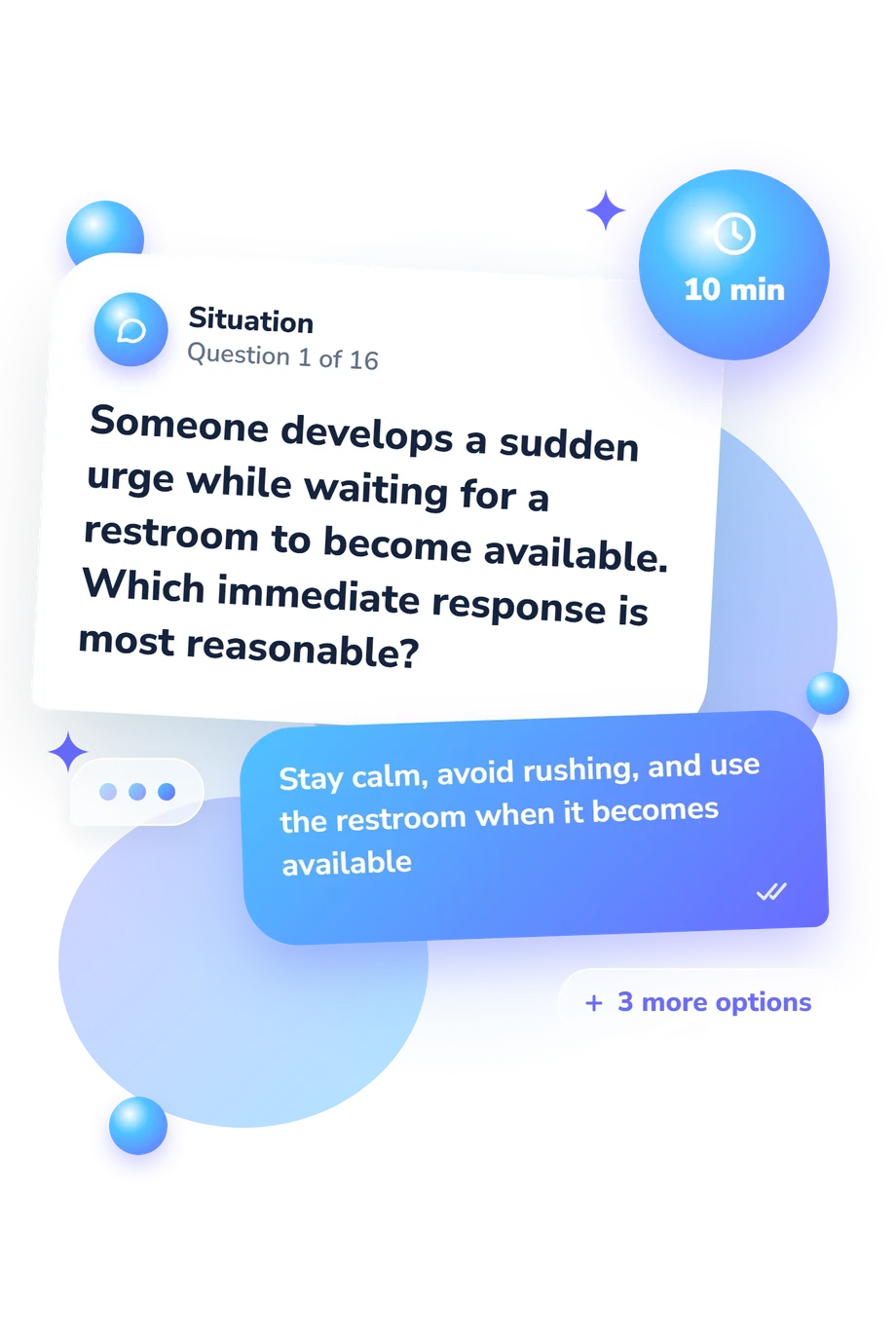
Example Questions From the Test
- Decline to force fluids and continue normal drinking habits
- Add salt so the body can absorb unlimited water
- Hold the urine afterward to make the result more accurate
- Drink them quickly because plain water cannot cause harm
- In the bladder
- In the kidneys
- In the urethra
- In the large intestine
- Ureters → kidneys → bladder → urethra
- Kidneys → urethra → bladder → ureters
- Bladder → kidneys → ureters → urethra
- Kidneys → ureters → bladder → urethra
I Can Make You Pee Quiz - Description and methodology of the test
People who want to understand everyday urinary function can use the I Can Make You Pee Quiz to check practical knowledge rather than predict a bodily reaction. As a urination knowledge quiz, it suits anyone curious about bladder signals, anatomy, or safer responses. The result highlights which concepts they understand and which areas may benefit from further learning.
What This Assessment Explores
Four themes feed the Urination Knowledge result: anatomy maps urinary flow, bladder cues address urgency, hydration covers fluid balance, and myth-checking tests safer judgment.
The question themes fall into four areas:
- Anatomy and flow explain where urine is produced, transported, stored, and released.
- Bladder cues show how attention, learned signals, cold, and pressure can affect urgency.
- Hydration links fluid intake, urine color, heat, and the kidneys’ conserving role.
- Myth-checking tests rejection of forced fluids, prolonged holding, and unsupported promises.
As a bladder health quiz, it yields the Urination Knowledge scale of 0-16. Starting Point (0-6) signals basic or myth-sensitive understanding; Developing Knowledge (7-12) shows a workable grasp; Strong Knowledge (13-16) reflects solid knowledge of anatomy, cues, hydration, and safer responses. This educational score is unvalidated; the catalogue’s safety guidance recommends normal drinking rather than forced fluids and avoiding deliberate delay.
Methodology and Scientific Basis
Short scenarios and factual prompts give this urinary knowledge test four answer choices. Respondents select the most reasonable interpretation rather than rate symptom severity. The score summarizes answer performance; its scoring has not been standardized, so the result is not a diagnosis.
The questionnaire is conceptually consistent with the published BH-KAB instrument, which addresses bladder-health knowledge, attitudes, and beliefs, but it is not an adaptation or validation of that work. Das and Grimmer-Somers examine links between fluid intake, voiding habits, and health knowledge, while Veilleux and colleagues examine hydration knowledge, attitudes, and behavior. Those studies provide context for the topics, not evidence that they shaped this questionnaire.
Interpretation should stay close to the items. A higher result suggests stronger recognition of urinary anatomy, bladder cues, hydration, and safer responses; a lower result identifies topics worth reviewing. It reflects knowledge, not individual urinary symptoms. Guessing, prior learning, and current attention can affect answer selection, so the result is a snapshot of knowledge rather than a complete picture of urinary experience.
- Daphne Yvette LaCoursiere, Lisa Kane Low, Sara Putnam, Jean F Wyman, Diane K Newman, Shayna Cunningham, Leslie Rickey, Amanda Berry, Sheila Gahagan, Camille P Vaughan, Oluwateniola Brown, Sonya S Brady, Prevention of Lower Urinary Tract Symptoms (PLUS) Research Consortium. Development of a tool to assess bladder health knowledge, attitudes, and beliefs (BH-KAB). Neurourology and Urodynamics. 2023;42(5):1055-1067. 10.1002/nau.25168
- Rebekah N Das, Karen A Grimmer-Somers. Fluid intake and voiding; habits and health knowledge in a young, healthy population. Research and Reports in Urology. 2012;4:9-15. 10.2147/RRU.S27801
- Jennifer C Veilleux, Aaron R Caldwell, Evan C Johnson, Stavros Kavouras, Brendon P McDermott, Matthew S Ganio. Examining the links between hydration knowledge, attitudes and behavior. European Journal of Nutrition. 2020;59(3):991-1000. 10.1007/s00394-019-01958-x
Updated: