
Spanish Body Parts Quiz
How the Scales are Structured
Who Usually Takes This Test?
See How You Compare
Below is a preview of how scores are typically distributed across each scale.
Example Questions From the Test
- riñones
- huesos
- músculos
- pulmones
- labio
- diente
- encía
- lengua
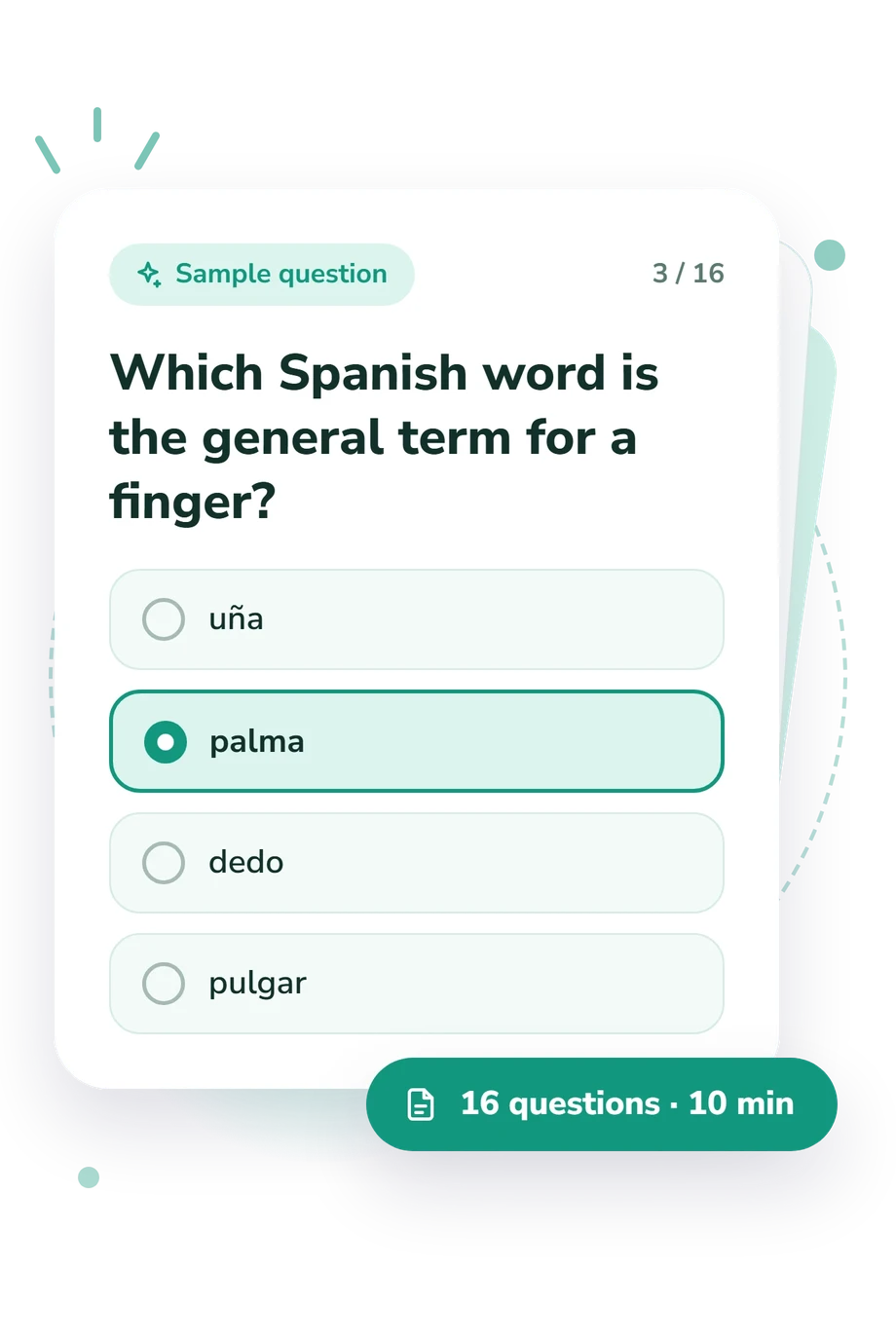
- uña
- palma
- dedo
- pulgar
Spanish Body Parts Quiz - Description and methodology of the test
Students building practical anatomy vocabulary, teachers planning a quick classroom activity, and independent learners organizing revision can use this assessment to target everyday Spanish study. The Spanish Body Parts Quiz suits independent practice, classroom revision, or planning the next stage of study. As a quiz on Spanish body parts, it helps learners choose an appropriate next step without measuring overall Spanish ability.
What This Assessment Explores
Questions use everyday situations-breathing, dental care, clothing, movement, pain, and translation-to place body-part vocabulary in practical settings. The audience is learners checking practical vocabulary; the result does not measure grammar, pronunciation, fluency, or medical knowledge. It reflects performance in understanding and applying selected Spanish body parts vocabulary, expressed through recognition in direct and contextual questions.
Three content groups are represented:
- Head and face terms show whether the learner can understand and apply vocabulary for the mouth, eye, ear, head, and related features.
- Limbs and joints show how accurately the learner handles terms for fingers, hands, arms, feet, knees, ankles, wrists, elbows, and shoulders.
- Torso and internal-body terms show understanding of the chest, back, neck, stomach, and lungs in practical contexts.
Spanish Body Parts Knowledge (0-16) reports Foundations to build (0-6), Developing knowledge (7-12), or Strong knowledge (13-16). The bands describe performance on this vocabulary set.
Methodology and Evidence Base
Each item presents a short real-life prompt, translation task, or direct vocabulary question with four answer choices. Selecting the best match makes the result a measure of performance in understanding and applying the targeted words through a fixed multiple-choice format. The score counts correct answers, while the bands provide descriptive feedback for this selected vocabulary set.
The content is conceptually consistent with Izura et al. (2005), which supports grouping Spanish words by semantic category, and with Wesche and Paribakht (1996), whose framework distinguishes vocabulary breadth from depth. These sources explain the relevance of semantic grouping and contextual recognition, but this questionnaire is not an adaptation of either instrument. It is a focused online check useful for Spanish vocabulary practice.
Gyllstad et al. (2015) note that guessing and item sampling can affect multiple-choice vocabulary estimates. Results may also vary with recent study, regional word choices, and whether a learner recognizes a term without assistance. The displayed band should be read as descriptive feedback about performance on this selected vocabulary set, not as a general estimate of Spanish proficiency.
- Izura, C., Hernández-Muñoz, N., & Ellis, A. W. (2005). Category norms for 500 Spanish words in five semantic categories. Behavior Research Methods, 37(3), 385-397. 10.3758/bf03192708
- Wesche, M., & Paribakht, T. S. (1996). Assessing Second Language Vocabulary Knowledge: Depth Versus Breadth. The Canadian Modern Language Review, 53(1), 13-40. 10.3138/cmlr.53.1.13
- Gyllstad, H., Vilkaitė-Lozdienė, L., & Schmitt, N. (2015). Assessing vocabulary size through multiple-choice formats: Issues with guessing and sampling rates. ITL - International Journal of Applied Linguistics, 166(2), 278-306. 10.1075/itl.166.2.04gyl
Updated: