
US Government Quiz
How the Scales are Structured
Who Usually Takes This Test?
See How You Compare
Below is a preview of how scores are typically distributed across each scale.
Example Questions From the Test
- The US Senate
- The Supreme Court
- The president's Cabinet
- The Electoral College
- The congressional conference committee
- The Electoral College
- The Cabinet
- The federal grand jury
- Approve it by a simple majority in the Senate alone
- Approve it by a two-thirds vote in both the House and Senate
- Ask the Supreme Court to sign it into law
- Send it to state legislatures for ratification
US Government Quiz - Description and methodology of the test
Readers who want a clear, structured check of how government works can use this civics knowledge assessment to connect familiar ideas with the institutions that apply them. The US Government Quiz focuses on practical recognition rather than personal opinion. Its result can show where your understanding is secure and where review may help. It suits independent learning, classroom preparation, and citizenship study.
What This Assessment Measures
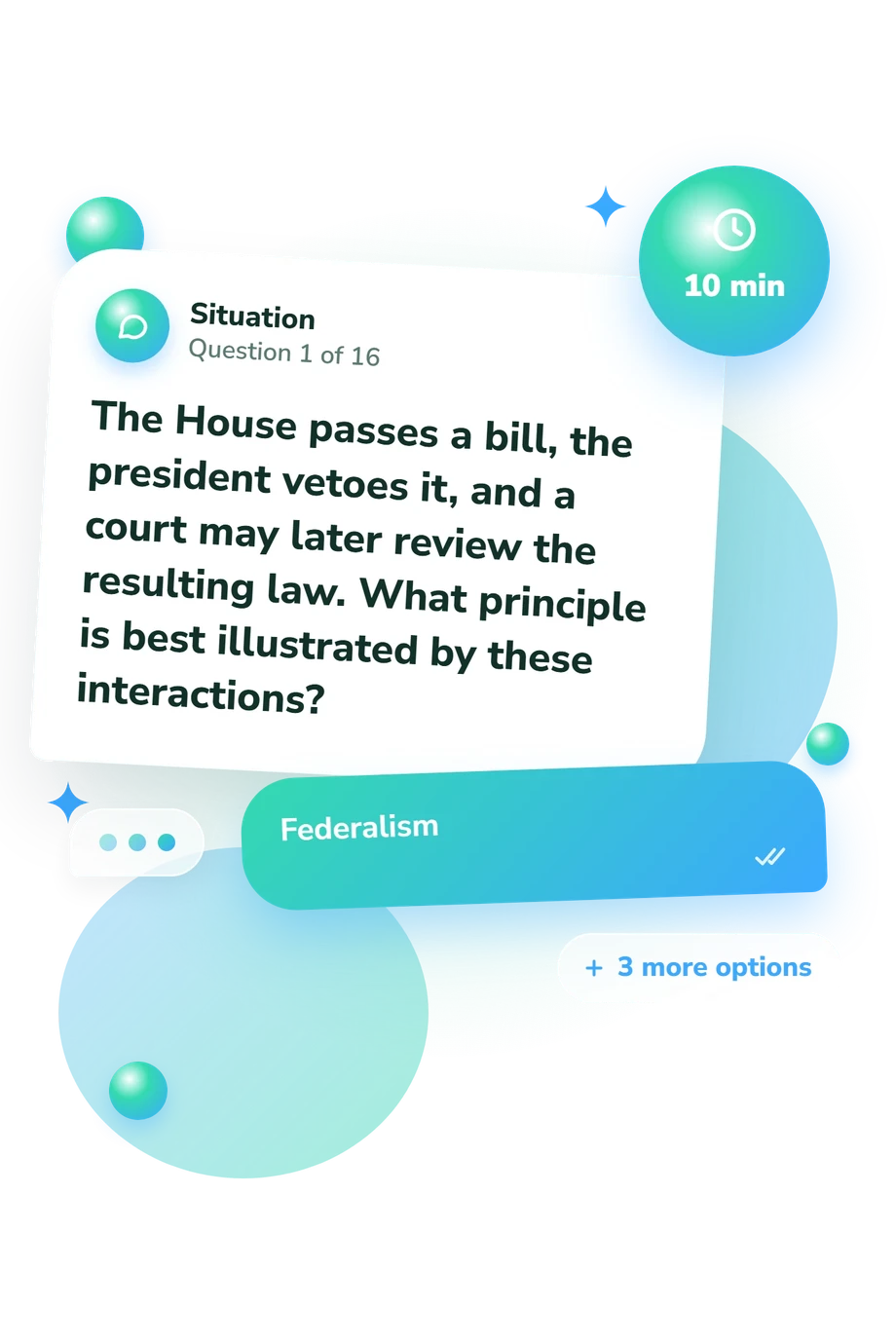
The assessment examines whether you can recognize foundational rules and relationships in the federal system. This American government quiz tests that knowledge by asking you to select the constitutional principle, institution, right, or procedure that best fits a short situation. The result describes civic knowledge across government structure and operation for everyday civic understanding; it does not measure ideology, party identity, or personal political preferences.
The questions fall into four practical content groups:
- Constitutional principles show how checks and balances, federalism, supremacy, reserved powers, and amendment rules organize authority.
- Federal institutions explain what Congress, the presidency, courts, the Cabinet, and the Electoral College do.
- Rights and legal protections indicate whether you recognize speech, due process, counsel, and related constitutional safeguards.
- Representation and civic procedures cover reapportionment, impeachment, House terms, and where revenue bills originate.
Methodology and Evidence Base
The format uses multiple-choice items, with each question presenting a brief civic scenario or factual prompt and four answer choices. Selecting the best answer tests recognition of government concepts rather than personal opinion or self-rating.
The score uses the US Government Knowledge scale from 0-16, with one point for each correct answer. Results for this United States government quiz are shown as Building Foundations (0-6), Developing Knowledge (7-12), or Strong Civics Knowledge (13-16). These bands provide a descriptive snapshot of performance on this questionnaire.
The content is conceptually consistent with Borelli and Gracia (2023) and overlaps with civic domains represented in the 2025 USCIS naturalization questions. Those sources support the quiz’s subject matter-constitutional principles, institutions, rights, and government processes-but the questionnaire is not presented as an adaptation of either source.
Several factors can affect a civics knowledge assessment like this, including prior exposure, reading interpretation, attention, and guessing. Its raw score and displayed bands indicate current performance on these questions, while broader review may be useful when unfamiliar procedures or principles account for missed answers.
- Borelli, Gabriel, and Shanay Gracia. "What Americans Know about Their Government." Pew Research Center, November 7, 2023.
- U.S. Citizenship and Immigration Services. Civic Questions and Answers for the Naturalization Test-2025 Version. U.S. Department of Homeland Security, 2025.
- Niemi, Richard G., and Jane Junn. Civic Education: What Makes Students Learn. New Haven, CT: Yale University Press, 2005.
- Galston, William A. "Political Knowledge, Political Engagement, and Civic Education." Annual Review of Political Science, vol. 4, 2001, pp. 217-234. 10.1146/annurev.polisci.4.1.217
Updated: