
Microbiology Quiz
How the Scales are Structured
Who Usually Takes This Test?
See How You Compare
Below is a preview of how scores are typically distributed across each scale.
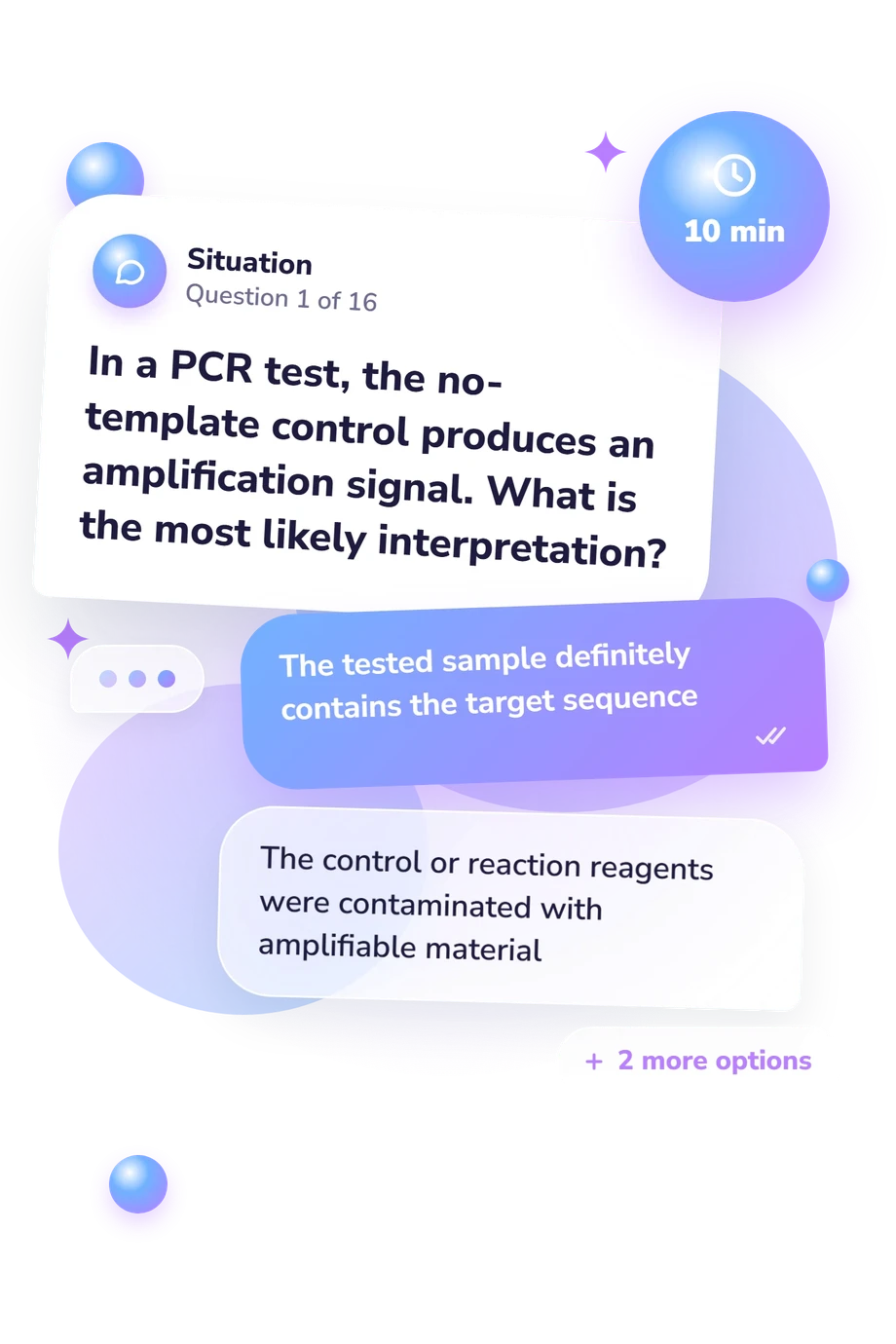
Example Questions From the Test
- Heating it under pressure in an autoclave
- Exposing the medium to ultraviolet light
- Wiping the outside of the container with disinfectant
- Refrigerating the medium overnight
- Transmission electron microscopy
- Bright-field microscopy after Gram staining
- Phase-contrast microscopy
- Scanning electron microscopy
- Viruses are always smaller than every bacterium
- Viruses contain proteins but no genetic material
- Viruses can reproduce independently on nutrient agar
- Viruses require host-cell machinery to reproduce
Microbiology Quiz - Description and methodology of the test
For students, trainees, and curious learners, this microbiology quiz checks how confidently core concepts can be connected with practical laboratory situations. It is useful for planning review, revisiting introductory biology, or testing whether textbook knowledge transfers to common laboratory scenarios. A practice quiz in microbiology also gives learners a quick way to identify which areas deserve closer attention before further study.
What This Assessment Measures
Together, these questions assess foundational microbiology through recognition and application. For learners wanting a basic quiz in microbiology, the content connects microbial structure, staining, viruses, cultivation, growth, and laboratory practice.
The result profiles current performance across several introductory domains. These areas explain what the score reflects:
- Cell structure and staining show how well you connect microbial features with laboratory observations.
- Microscopy and growth show how you interpret magnification, resolution, oxygen gradients, and growth phases.
- Laboratory methods and calculations measure contamination control, sterilization, plating, dilution, and PCR-control reasoning.
- Microbiology Knowledge (0-16) counts correct answers and places you in Foundations to build (0-6) for basic review, Developing knowledge (7-12) for core concepts with gaps, or Strong knowledge (13-16) for a well-developed grasp.
A higher band reflects broader success across the sampled concepts, while a lower band identifies topics for focused review.
Methodology and Evidence Base
Each item uses a selected-response format with one best answer among four choices. The questions ask for mechanism recognition, interpretation of observations, simple dilution or magnification calculations, and selection of suitable methods. Presented as a quiz with microbiology answers, the format supports checking both recall and application, although the combined score is more informative than any single response.
Scoring is direct: the total equals the number of correct responses, and the displayed band summarizes performance against the catalogue's three descriptive ranges. As a general quiz on microbiology, this is an online educational self-check without published norms, reliability estimates, or clinical cutoffs.
Its content is conceptually consistent with the introductory coverage in Tortora et al. (2019), including structure, staining, growth, cultivation, sterilization, and viruses. Gram-stain questions align with Jones and Dever (1984), while the PCR-control item reflects Bustin et al. (2009). The questionnaire is not presented as an adaptation or validated administration of those sources.
Performance can vary with recent study, attention, technical vocabulary, and testing context. The result can guide review, while practical laboratory competence also requires direct observation of technique.
- Tortora, Gerard J., Berdell R. Funke, and Christine L. Case. Microbiology: An Introduction. 13th ed. Pearson, 2019. ISBN 9780134605180.
- Jones, Gilda L., and Stanley M. Dever. The Gram Stain: A New Look at an Old Tool. CDC Lab Manual. U.S. Department of Health and Human Services, Public Health Service, Centers for Disease Control, 1984.
- Bustin, Stephen A., Vladimir Benes, Jeremy A. Garson, Jan Hellemans, Jim Huggett, Mikael Kubista, Reinhold Mueller, Tania Nolan, Michael W. Pfaffl, Gregory L. Shipley, Jo Vandesompele, and Carl T. Wittwer. The MIQE Guidelines: Minimum Information for Publication of Quantitative Real-Time PCR Experiments. Clinical Chemistry, 55(4), 611-622, 2009. 10.1373/clinchem.2008.112797
Updated: