
Environmental Science Quiz
How the Scales are Structured
Who Usually Takes This Test?
See How You Compare
Below is a preview of how scores are typically distributed across each scale.
Example Questions From the Test
- Use more dark roofing while making buildings more compact
- Expand tree cover and install lighter, more reflective roofs
- Replace parks with parking structures that provide indoor shade
- Increase air-conditioner use without changing outdoor surfaces
- Individual, population, and community diversity
- Genetic, species, and ecosystem diversity
- Habitat, climate, and nutrient diversity
- Producer, consumer, and decomposer diversity
- Ground-level ozone and chlorofluorocarbons
- Carbon dioxide and methane
- Sulfur dioxide and nitrogen oxides
- Nitrogen gas and oxygen gas
Environmental Science Quiz - Description and methodology of the test
Students, curious adults, and independent learners can use this environmental science quiz when they want a concise way to gauge their grasp of core environmental concepts. It suits classroom preparation, informal self-checking, and anyone building familiarity with ecology, climate, and sustainability. As an environmental quiz, it offers a structured starting point for engaging with the subject.
What This Assessment Explores
These questions examine environmental knowledge across ecology and change. They connect population limits, ecosystem services, biodiversity, pollution, climate, energy, and human choices, emphasizing applied understanding.
Readers preparing for a quiz bee in environmental science can use it to identify recognized principles and situations needing review. It links science with decisions about land, water, materials, and resources.
The result is Environmental Science Knowledge (0-16): Foundations to Build (0-6) signals core relationships needing review; Developing Knowledge (7-12) indicates understanding with gaps; Strong Command (13-16) indicates accurate application to environmental situations.
Thematic groups show performance in recognizing and applying relevant concepts:
- Ecosystems and biodiversity ask respondents to recognize relationships among habitats, species, and populations.
- Pollution, climate, and energy ask respondents to apply links among processes, causes, effects, and resource choices.
- Human impacts and sustainability ask respondents to evaluate management trade-offs and life-cycle consequences.
Methodology and Evidence Base
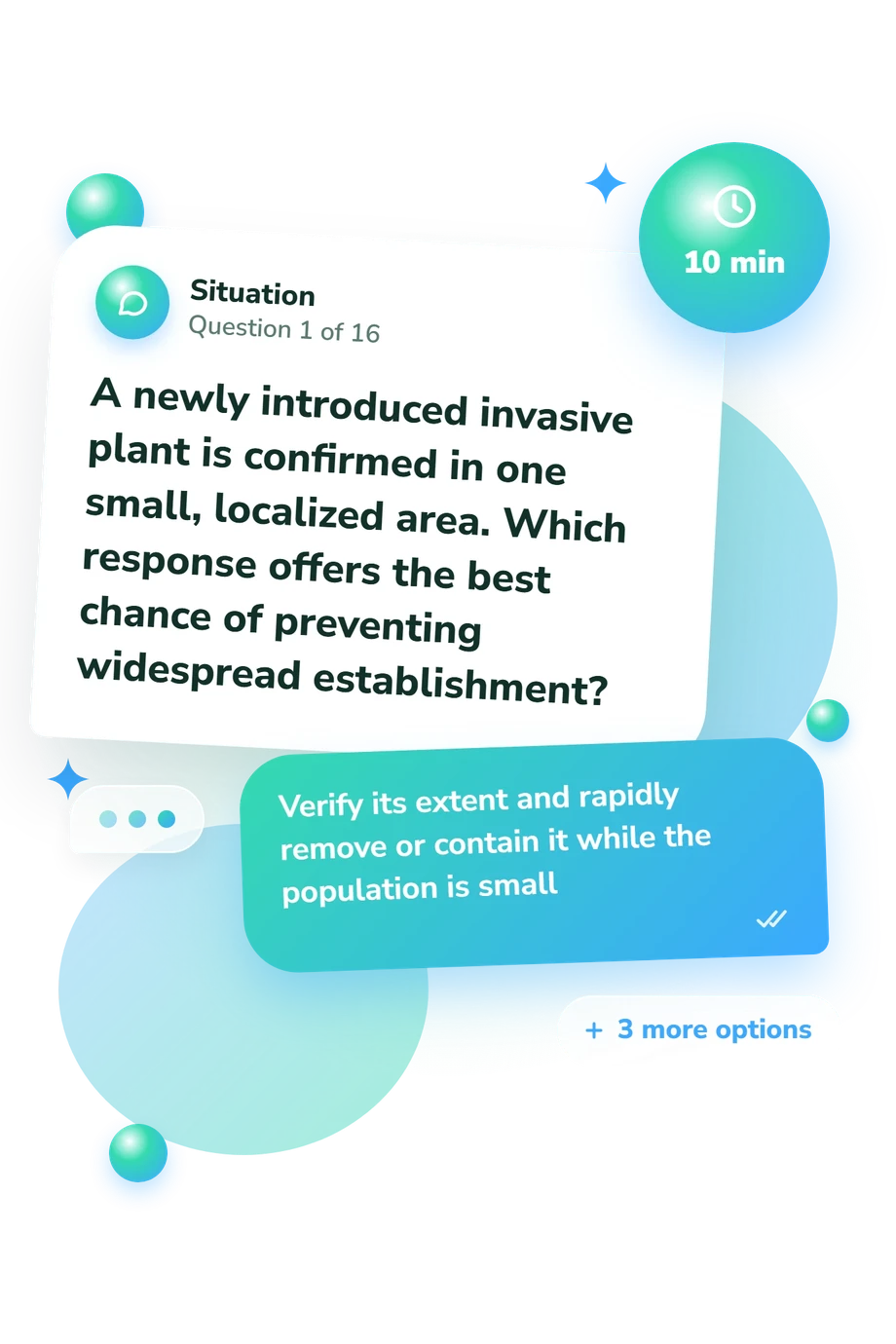
Each item presents a scenario or definition with four answer choices. The respondent selects the option that best explains a process, predicts an outcome, or supports a management choice. Topics include invasive species, water quality, population ecology, and sustainability.
The displayed result reports overall performance through the single knowledge scale and its bands above, without separate topic scores. Question themes may suggest areas for general review, but the aggregate result is best read as overall environmental-science knowledge.
Conceptually, the questionnaire is closest to EKT-19, a published environmental-knowledge measure, although it is not presented as a formal adaptation. A published study by Geiger and colleagues distinguishes environment-specific from general knowledge; that distinction explains the quiz's subject focus without validating its questionnaire or displayed score.
A quiz on science and the environment offers a compact learning check while building understanding of our environment in a practical way: knowing a principle does not guarantee a particular behavior.
Responses can vary with prior education, language, guessing, attention, and current context, so the score describes this questionnaire rather than professional certification or diagnosis.
- Player, Lois, Paul H. P. Hanel, Lorraine Whitmarsh, and Punit Shah. The 19-Item Environmental Knowledge Test (EKT-19): A short, psychometrically robust measure of environmental knowledge. Heliyon 9, no. 8 (2023): e17862. 10.1016/j.heliyon.2023.e17862
- Geiger, Sonja Maria, Mattis Geiger, and Oliver Wilhelm. Environment-Specific vs. General Knowledge and Their Role in Pro-environmental Behavior. Frontiers in Psychology 10 (2019): 718. 10.3389/fpsyg.2019.00718
Updated: