
Atomic Structure Quiz
How the Scales are Structured
Who Usually Takes This Test?
See How You Compare
Below is a preview of how scores are typically distributed across each scale.
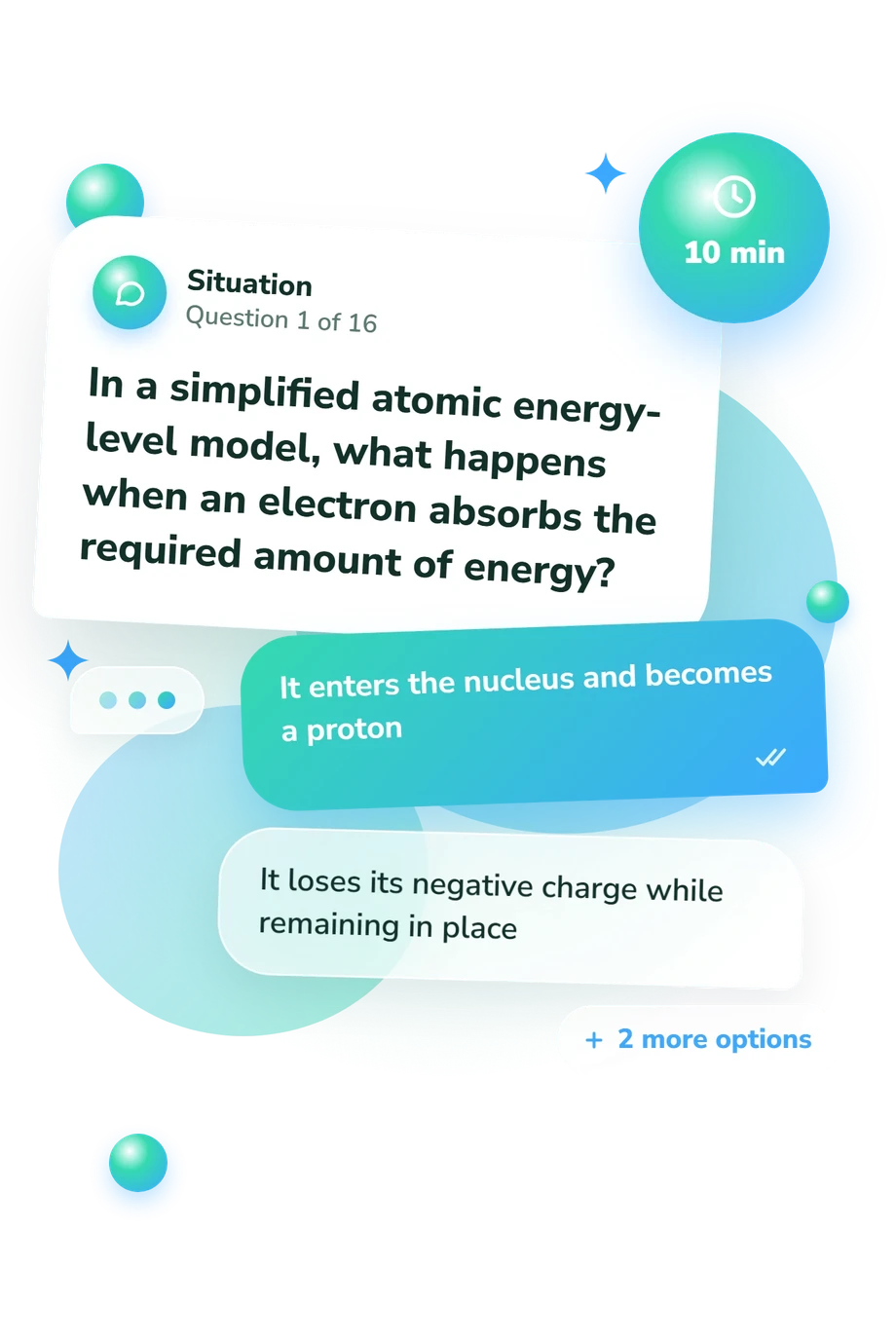
Example Questions From the Test
- It enters the nucleus and becomes a proton
- It loses its negative charge while remaining in place
- It moves to a higher available energy level
- It causes the atom's atomic number to increase
- 2, 9
- 2, 8, 1
- 2, 7, 2
- 8, 2, 1
- 7 valence electrons
- 8 valence electrons
- 17 valence electrons
- 2 valence electrons
Atomic Structure Quiz - Description and methodology of the test
Students reviewing foundational chemistry can use this assessment to connect familiar terms with the particle-level behavior they describe. The Atomic Structure Quiz is intended for learners who want a focused check before classwork, homework, or an exam. Learners can use their atomic-structure quiz answers to guide broad review of foundational atomic-structure concepts.
What This Assessment Explores
Questions connect subatomic particles with relationships defining atoms, ions, and isotopes. Learners use proton, neutron, and electron counts to identify charge, element identity, mass number, isotope status, valence electrons, and simplified energy-level changes.
The result profiles conceptual recall and application rather than broad chemistry ability or laboratory skill. In this chemistry quiz on atomic structure, the main areas are:
- Particle identity and charge show whether you distinguish the three particles and recognize atoms and ions from their counts.
- Atomic number, mass number, and isotopes show whether you identify elements and calculate missing nuclear particles.
- Energy levels and shell distributions show whether you apply a simplified model to valence electrons and energy changes.
Atomic Structure Knowledge (0-16) summarizes performance. Foundations to review (0-6) marks core ideas for revision; Developing knowledge (7-12) reflects partial command; Strong knowledge (13-16) reflects accurate recall and application.
Methodology and Evidence Base
Each item presents a question with four answer choices. The prompts cover particle counts and charges, nuclear composition, isotope relationships, electron shells, valence electrons, energy-level changes, and evidence for the nuclear model. Selecting one option requires applying a definition or relationship to a concrete example.
For this assessment, the atomic structure test presents one overall result through the displayed scale and bands. It offers a broad summary of quiz performance for general review, not item-level diagnosis or norm-referenced conversion.
The content is conceptually consistent with OpenStax Chemistry 2e, which explains subatomic particles, atomic numbers, isotopes, ions, and electron arrangements. It is not presented as an adaptation of that textbook. Rutherford’s gold-foil research supports the nuclear interpretation, Bohr’s atomic model supports the simplified energy-level context, and IUPAC terminology supplies language for atomic number, isotope, and ion.
The score is a snapshot of performance on foundational concepts. Because the online format has no stated population norms, reliability estimates, or external validation, guessing, recent study, and test-taking context can affect results; use them to target review rather than make a high-stakes judgment about ability.
- Flowers, Paul, Klaus Theopold, Richard Langley, and William R. Robinson. Chemistry 2e. Houston, TX: OpenStax, 2019.
- Rutherford, Ernest. “The Scattering of Alpha and Beta Particles by Matter and the Structure of the Atom.” Philosophical Magazine, Series 6, 21(125), 669-688, 1911. 10.1080/14786440508637080
- Bohr, Niels. “On the Constitution of Atoms and Molecules.” The London, Edinburgh, and Dublin Philosophical Magazine and Journal of Science, Series 6, 26(151), 1-25, 1913. 10.1080/14786441308634955
- International Union of Pure and Applied Chemistry. Compendium of Chemical Terminology, 5th ed. 2025. 10.1351/goldbook
Updated: