
Chlamydia or Yeast Infection Quiz
How the Scales are Structured
Who Usually Takes This Test?
See How You Compare
Below is a preview of how scores are typically distributed across each scale.
Example Questions From the Test
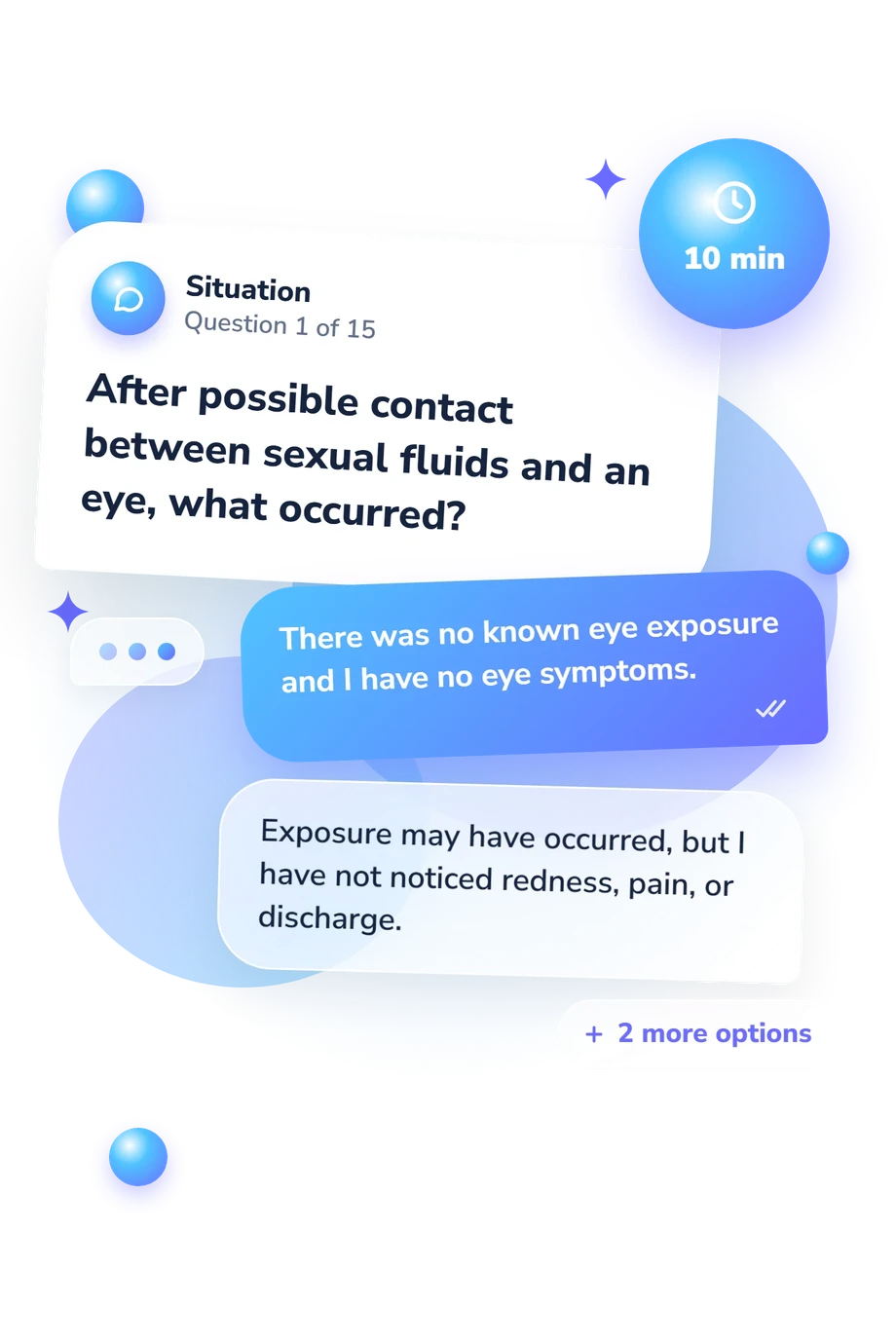
- There was no known eye exposure and I have no eye symptoms.
- Exposure may have occurred, but I have not noticed redness, pain, or discharge.
- The eye has developed persistent redness, discharge, swelling, or light sensitivity.
- I have severe eye pain, reduced or changed vision, marked swelling, or rapidly worsening symptoms.
- I have not had a possible exposure that would call for chlamydia testing.
- I tested negative at the time recommended by a clinician and have had no later exposure.
- I was tested, but it may have been too early or I had another exposure afterward.
- I have had a possible or known exposure and have not received an appropriately timed test.
- I was not diagnosed with chlamydia during the past year.
- I completed treatment and followed the clinician's advice about partners and repeat testing.
- I completed treatment, but recommended partner steps or repeat testing were not completed.
- Treatment was not completed, or sexual contact resumed before the advised conditions were met.
Chlamydia or Yeast Infection Quiz - Description and methodology of the test
For readers deciding whether a chlamydia or yeast infection quiz fits their situation, this questionnaire offers a structured way to sort exposure history, genital symptoms, and signs that may need quicker medical attention. The questions can help someone notice which details to discuss when causes overlap. This sexual health questionnaire is intended for people seeking a clearer starting point before speaking with a clinician about sexual-health concerns.
What This Assessment Explores
Instead of naming an infection, it organizes clues that may support testing, symptom review, or prompt care. When exposure timing, partner status, barrier use, prior treatment, or shared toys complicate interpretation, this questionnaire organizes details relevant to chlamydia testing. The items cover itching, soreness, discharge, urinary burning, pelvic or testicular pain, skin changes, pregnancy, and acute illness.
The result dimensions and bands are:
- Chlamydia Exposure and Testing Cues (0-15) reflects exposure or testing circumstances: No cue reported (0); Review testing context (1-2); Clear testing priority (3-15).
- Prompt Medical Evaluation Cues (0-15) reflects symptoms that may call for clinician contact or urgent care: No listed urgent cue (0); Contact advised (1-2); Prompt action cues (3-15).
- Yeast-Pattern Symptoms (0-15) reflects yeast-associated features while acknowledging similar symptoms can have other causes: No listed pattern (0); Limited pattern (1-2); Stronger evaluation cue (3-15).
Methodology and Evidence Base
Items offer four ordered choices, from no relevant experience through milder or uncertain cues to more concerning symptoms or exposure circumstances. Anatomy-sensitive options and distinctions such as persistent, severe, rapidly worsening, or pregnancy-related symptoms help separate context that changes the urgency of follow-up.
The yeast-associated questions can describe a recognizable pattern, but yeast infection symptoms can also result from other conditions. The scores summarize endorsed cues within each dimension; they are not probabilities, diagnoses, clinical cutoffs, or severity ratings. The displayed bands are unvalidated reflective summaries, and a single red-flag answer matters independently of the total.
The content is conceptually consistent with Eckert and colleagues' 1998 candidiasis work, the 2021 STI guidance from Workowski and colleagues, candidiasis context discussed by Pappas and colleagues in 2016, and chlamydia screening guidance from the US Preventive Services Task Force. Those sources support the subject matter, but this online questionnaire is neither an adaptation nor a standardized administration of them. Self-report is affected by recall, embarrassment, incomplete exposure details, and current context; persistent, severe, or rapidly changing concerns warrant clinical assessment.
- Eckert LO, Hawes SE, Stevens CE, Koutsky LA, Eschenbach DA, Holmes KK. Vulvovaginal candidiasis: clinical manifestations, risk factors, management algorithm. Obstetrics & Gynecology. 1998;92(5):757-765. 10.1016/S0029-7844(98)00264-6
- Workowski KA, Bachmann LH, Chan PA, Johnston CM, Muzny CA, Park I, Reno H, Zenilman JM, Bolan GA. Sexually Transmitted Infections Treatment Guidelines, 2021. MMWR Recommendations and Reports. 2021;70(4):1-187. 10.15585/mmwr.rr7004a1
- Pappas PG, Kauffman CA, Andes DR, Clancy CJ, Marr KA, Ostrosky-Zeichner L, Reboli AC, Schuster MG, Vazquez JA, Walsh TJ, Zaoutis TE, Sobel JD. Clinical Practice Guideline for the Management of Candidiasis: 2016 Update by the Infectious Diseases Society of America. Clinical Infectious Diseases. 2016;62(4):e1-e50. 10.1093/cid/civ933
- US Preventive Services Task Force. Screening for Chlamydia and Gonorrhea: US Preventive Services Task Force Recommendation Statement. JAMA. 2021;326(10):949-956. 10.1001/jama.2021.14081
Updated: