
The Crucible Act 3 Quiz
How the Scales are Structured
Who Usually Takes This Test?
See How You Compare
Below is a preview of how scores are typically distributed across each scale.
Example Questions From the Test
- His public reputation and claim to moral respectability
- His ownership of the farm inherited from his family
- His legal right to testify before Deputy Governor Danforth
- His membership in Reverend Hale’s congregation
- He asks to lead the next examination of Elizabeth
- He denounces the proceedings and quits the court
- He joins Parris in demanding Proctor’s immediate execution
- He withdraws his earlier criticism and supports Abigail
- Jacobs had accused Putnam’s wife of reading forbidden books
- Jacobs had refused to testify in defense of Rebecca Nurse
- Putnam hoped to gain access to Jacobs’s land
- Putnam wanted Jacobs to replace Parris as minister
The Crucible Act 3 Quiz - Description and methodology of the test
Readers studying Arthur Miller or preparing to discuss Act 3 can use The Crucible Act 3 Quiz to check whether their understanding rests on the scene’s evidence and turning points rather than on general memory of the play. It suits classroom revision, independent reading, and essay preparation. Its focus on Act III of The Crucible can also clarify which events, motives, or consequences deserve another look.
What This Assessment Explores
The assessment follows Act 3’s Salem courtroom crisis, linking setting, evidence, character choices, and the court’s language of loyalty to its conflict between conscience and institutional power. The result indicates how securely a reader understands the act’s events, motives, reversals, and dramatic meaning; it measures literary knowledge, not personal qualities.
These areas shape the result:
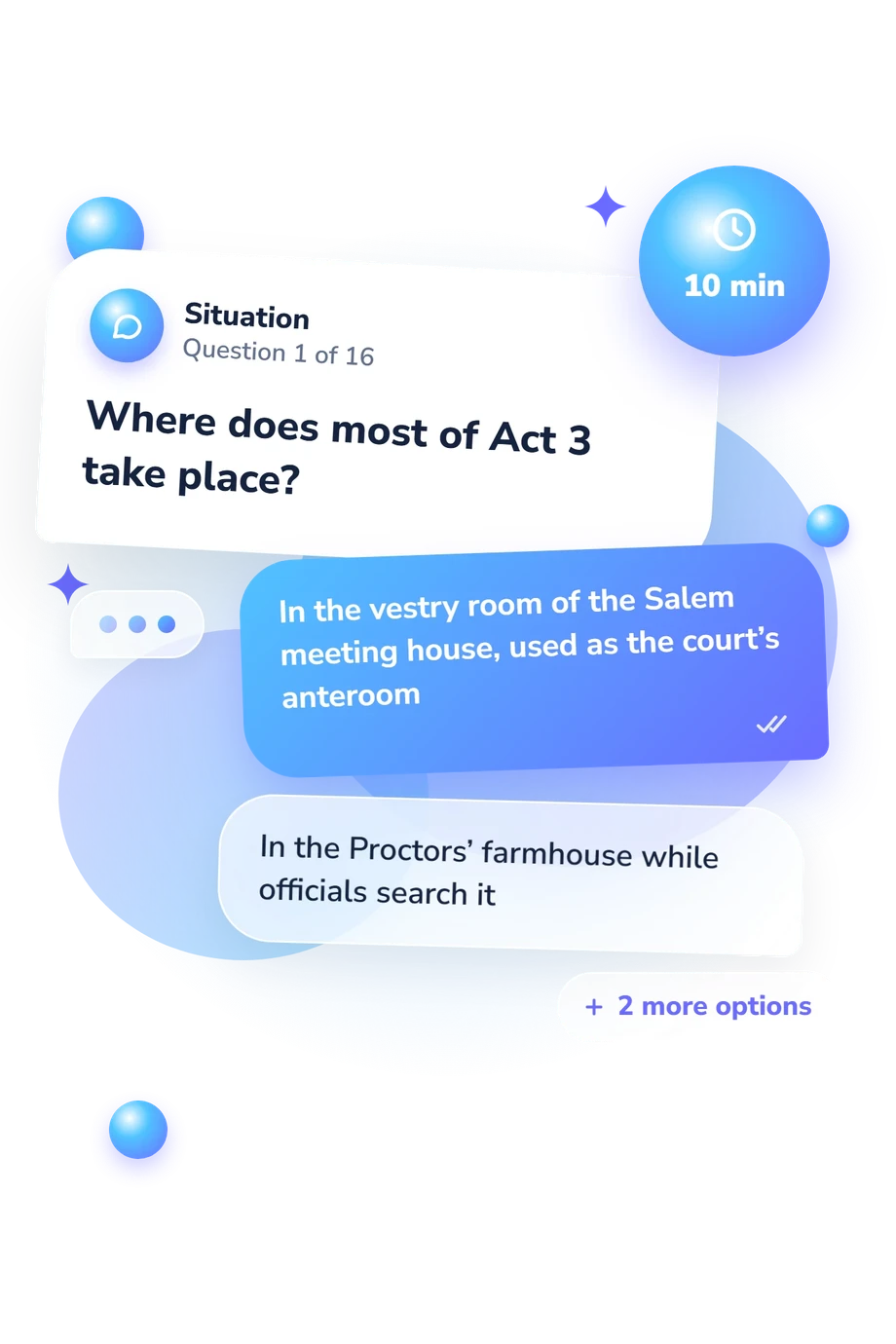
- The courtroom sequence shows whether you can place confrontations within the vestry-room proceedings.
- Evidence and testimony show how well you follow petitions, depositions, accusations, and reversals.
- Character decisions show what Proctor, Elizabeth, Mary Warren, Hale, and Danforth risk or protect.
- Authority and dramatic irony show how pressure, reputation, and rigid judgment drive the tragedy.
Afterward, comparing your answers about Act 3 with the relevant scene can distinguish a missed detail from a wider interpretive gap.
Methodology and Evidence Base
Each item presents four multiple-choice options and asks the reader to identify the best-supported detail or interpretation from Act 3. The set covers location, motives, testimony, reversals, and consequences of authority, combining factual recall with close reading.
The displayed result uses The Crucible Act 3 Knowledge scale, with scores from 0 to 16. The bands are Foundations to revisit (0-6), Developing understanding (7-12), and Strong understanding (13-16). These ranges describe the reported result; they do not establish an unstated point-by-point scoring rule.
As an Act 3 knowledge quiz, this questionnaire is conceptually consistent with the play, not an adaptation of a standardized psychological instrument. Miller’s play supplies the events and conflicts under review. Adler’s treatment of conscience and community, and Jeihouni and Hooti’s analysis of Proctor’s moral speech, support the focus on pressure, reputation, resistance, and authority.
The result is a descriptive performance band for these items, affected by reading recency, edition, classroom discussion, and memories of a stage production. Use it to target courtroom review rather than judge overall literary ability.
- Miller, Arthur. The Crucible. Introduction by Christopher Bigsby. Penguin Classics, 2003. ISBN 9780142437339.
- Adler, Thomas P. "Conscience and Community in An Enemy of the People and The Crucible." In The Cambridge Companion to Arthur Miller, edited by Christopher Bigsby, 89-103. Cambridge University Press, 2010. 10.1017/CCOL9780521768740.006.
- Jeihouni, Mojtaba, and Noorbakhsh Hooti. "Because It Is My Name!": Miller, Proctor, and Parrhesia in The Crucible. Orbis Litterarum 73, no. 2 (2018): 103-126. 10.1111/oli.12158.
Updated: