
Skull Sutures Quiz
How the Scales are Structured
Who Usually Takes This Test?
See How You Compare
Below is a preview of how scores are typically distributed across each scale.
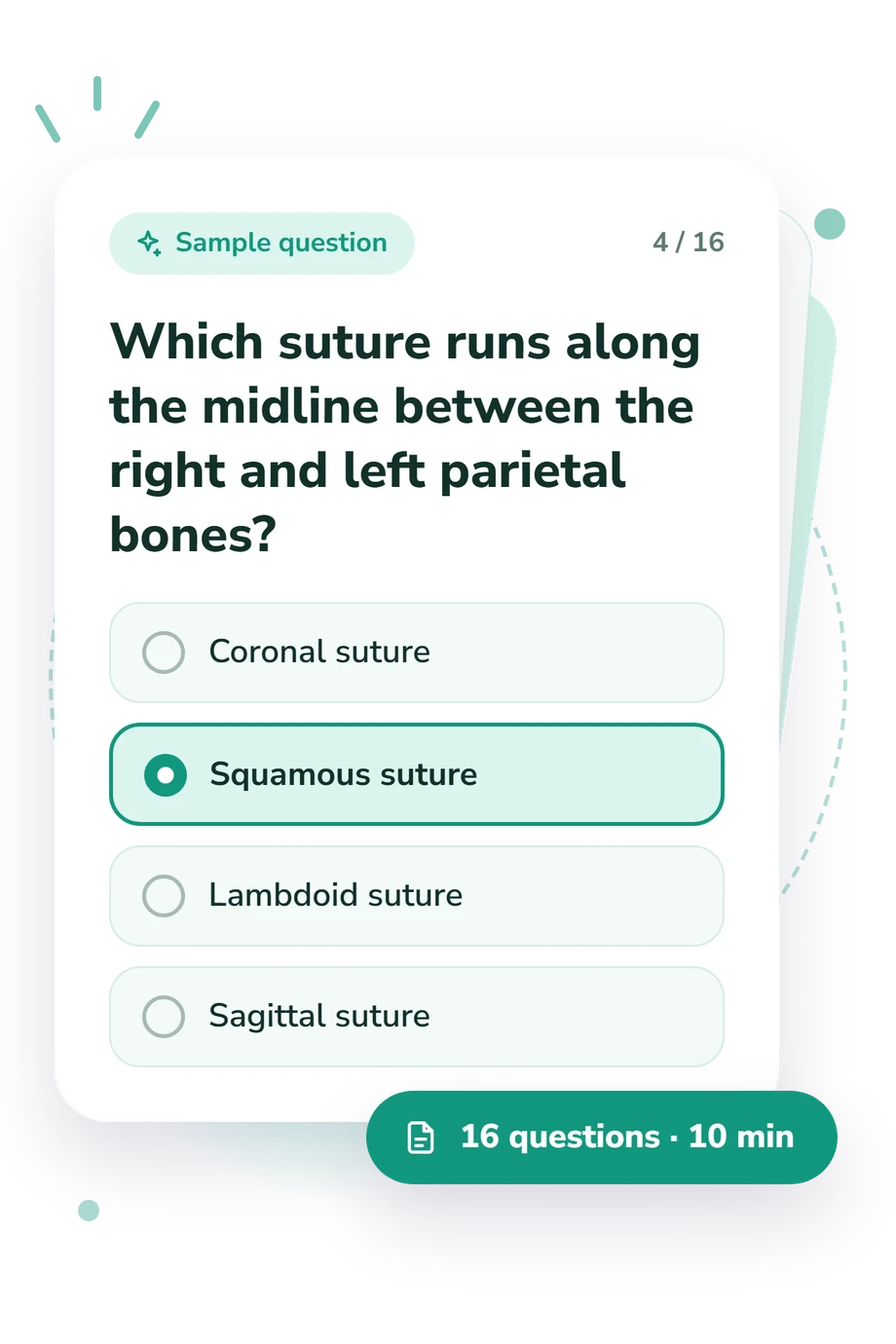
Example Questions From the Test
- Parietomastoid suture
- Sphenosquamous suture
- Occipitomastoid suture
- Lambdoid suture
- The frontal and parietal bones
- The parietal bones and occipital bone
- The temporal and sphenoid bones
- The two parietal bones
- Coronal suture
- Squamous suture
- Lambdoid suture
- Sagittal suture
Skull Sutures Quiz - Description and methodology of the test
For learners deciding whether the skull sutures quiz fits their study needs, this assessment offers a focused check of cranial anatomy rather than a broad examination of the head and neck. It suits students and anatomy learners who want a skull bones and sutures quiz to test recognition of sutural landmarks, connect bone names with spatial relationships, and identify which foundations merit further review.
What This Assessment Explores
Questions cover the major cranial sutures, the bones they separate, and landmarks formed where junctions meet. They also test fontanelles, premature fusion, altered skull growth, joint classification, and the pterion’s clinical relevance. This makes the result useful for learners reviewing osteology, neuroanatomy, or head-and-neck anatomy.
The result uses one overall scale, Skull Sutures Knowledge (0-16), with these bands:
- Foundations to Review (0-6) indicates that basic locations and bone relationships need further consolidation.
- Developing Knowledge (7-12) shows that many core structures are understood, while less familiar junctions or clinical links remain to strengthen.
- Strong Knowledge (13-16) reflects accurate coverage of landmarks, development, and common anatomical applications.
When a learner uses this quiz on the sutures of the skull, the band is most useful when paired with a review of the concepts behind missed answers.
Methodology and Evidence Base
Each item uses a fixed-choice format: an anatomy prompt is followed by four answer options, and the respondent selects the best match. Prompts test locations, bone relationships, landmarks, development, joint type, and clinical structures in this quiz about the sutures of the skull. The output is one aggregate knowledge result rather than separate subscores.
The cranial-sutures content in this quiz is conceptually consistent with the anatomical descriptions in Moore, Dalley, and Agur (2023). The pterion and middle meningeal artery questions are consistent with Ma, Baillie, and Stringer (2012), while the craniosynostosis questions align with distinctions discussed by Ghizoni et al. (2016). These sources support the subject matter; the questionnaire is not presented as a direct adaptation of any of them.
Interpretation should remain educational: a stronger result means better performance on these anatomy items, while errors may point to unfamiliar terminology, landmark confusion, or limited clinical context. Because this online version has no stated standardization or clinical norms, the result is not a medical qualification, and it can be influenced by prior study, memory, and the care taken with each response.
- Dalley AF II, Agur AMR. Moore's Clinically Oriented Anatomy. 9th ed. Philadelphia: Wolters Kluwer; 2023.
- Ma S, Baillie LJM, Stringer MD. Reappraising the surface anatomy of the pterion and its relationship to the middle meningeal artery. Clinical Anatomy. 2012;25(3):330-339. 10.1002/ca.21232.
- Ghizoni E, Denadai R, Raposo-Amaral CA, Joaquim AF, Tedeschi H, Raposo-Amaral CE. Diagnosis of infant synostotic and nonsynostotic cranial deformities: a review for pediatricians. Revista Paulista de Pediatria. 2016;34(4):495-502. 10.1016/j.rpped.2016.01.004.
Updated: